Congratulatory letter from Lord Kinnoull to the Duke of Atholl following the successful conclusion of the negotiations for the sale of sovereignty over the Isle of Man to the British Parliament. Kinnoull affirms that the compensation agreement was prudent and reflects positively on Atholl's conduct and firmness in the transaction. The letter also commends the oratorical performance of Mr Cooper at the House of Commons Bar.
Lord Chief Justice, the most senior judicial figure in England below the Lord Chancellor. Legal adviser to the Duke of Atholl during the Revestment negotiations. Told the Duke plainly: 'They don't mean to treat, much less to contract or agree.' His assessment of the Treasury's letter: 'Their letter is a strange one, it is insidious & looks like laying a trap.' The Duke wrote to Mansfield after his three-hour meeting with Grenville: 'you only saw the law on my side but there was as much or more against me... mighty good bargain I promise you as matters stood.'
Letter from Lord Mansfield advising the Duke of Atholl on strategy regarding the prospective purchase of the Isle of Man by Parliament. Mansfield cautions against premature response and emphasizes the importance of legal counsel before Parliament convenes. He critiques the approach of other parties (identified cryptically as Sr R W Mr P & D of N) who seek to extract information and demands without committing to formal negotiation or purchase of the whole sovereignty.
Letter from Lord Mansfield (Lord Chief Justice) to the Duke of Atholl advising on strategy for responding to a Treasury proposal regarding Isle of Man. Mansfield counsels caution, recommends a private approach to Grenville, and suggests textual revisions to the Duke's draft response. The letter reveals concerns about the Treasury's intentions and draws parallels to earlier negotiations under Newcastle.
Legal advice from Lord Mansfield (Chief Justice) to the Duke of Atholl regarding the pending parliamentary purchase of Isle of Man sovereignty. Mansfield cautions against responding to Parliament's inquiries until the Duke has retained proper counsel, warns that Parliament intends no formal treaty but rather demands the Duke reveal his circumstances and price expectations, and advises waiting until after Christmas when Parliament reconvenes.
Private letter from Lord Chief Justice Mansfield to the Duke of Atholl offering legal and tactical advice on how to respond to a letter from the Lords of the Treasury regarding Isle of Man affairs. Mansfield cautions against the Treasury's 'insidious' approach and recommends diplomatic communication with Grenville, comparing the situation to previous dealings with Walpole, Pelham, and Newcastle. Includes editorial suggestions for revising Atholl's draft response.
George Stanley, Thomas Stanley's son and heir. Taken hostage by Richard III at Bosworth to compel his father's loyalty. The gamble failed — Stanley chose Henry Tudor despite the threat to his son's life.
Official letter from the Treasury to the Duke of Atholl dated 25 July 1764, offering to negotiate the purchase of his rights in the Isle of Man. The letter cites the powers granted under 12 Geo. I, references House of Commons concern about smuggling, and requests Atholl's proposal regarding the sale of his property and rights in the island. Signed by George Grenville, John Turner, and James Harris.
Official letter from the Lords of the Treasury (Grenville, Turner, Hunter, North) to the Duke of Atholl requesting detailed financial information about Isle of Man revenues and property rights as a precondition for negotiating its purchase. The letter addresses the Duke's claim inability to price the island and insists on a full accounting of customs duties, rental income, and trading conditions before Parliament can authorize terms of purchase.
Official letter from the British Treasury to the Duke of Atholl proposing negotiations for the Crown's purchase of Isle of Man or its sovereign rights. The letter cites Parliamentary concern over smuggling and illicit trade, references the authority granted under the 12th of George I, and requests Atholl's proposal for sale terms. This is a pivotal foundational document in the Revestment negotiations.
Official letter from the British Lords of the Treasury (Grenville, Turner, Hunter, North) to the Duke of Atholl requesting detailed financial and revenue information about the Isle of Man as a prerequisite to negotiating its purchase. The letter references Parliamentary powers and anticipates parliamentary consideration of the island's constitution, trade, and smuggling activities.
Official letter from the Lords Commissioners of the Treasury to the Duke of Atholl, requesting his proposals for the sale of the Isle of Man to the Crown. The letter cites widespread smuggling and revenue fraud as the justification, and notes that both the Irish Revenue Board and English Customs Board believe the island cannot be effectively controlled while in private hands.
Official letter from Treasury officials J West and Samuel Martin to the Duke of Atholl, requesting negotiations for the Crown purchase of the Isle of Man. The letter cites widespread revenue fraud caused by illicit trade to/from the Island and states that the Boards of Revenue (Ireland) and Customs (England) believe effective remedy requires Crown ownership. This is a key early document in the chain leading to the 1765 Revestment.
The feudal sovereignty of the Isle of Man, held under Letters Patent from the English Crown. The grant to Sir John Stanley in 1405 was made 'to Sir John Stanley and his heirs for ever' — a custodianship of an operating nation, not ownership of a territory. The Lords appointed Governors, received customs revenues, and held criminal jurisdiction, but the Island governed itself through its own institutions. The Stanleys held the lordship from 1405 to 1736, the Atholls from 1736 to 1765. The title changed from King to Lord under the 2nd Earl of Derby. Parliament purchased the sovereign rights in 1765 for £70,000 under the Isle of Man Purchase Act. The Duke retained land, manorial rights, and ecclesiastical patronage until the final settlement of 1829. The Crown has held the title Lord of Mann since 1765. No monarch since the Revestment has stayed on the Island the way the Stanleys stayed.
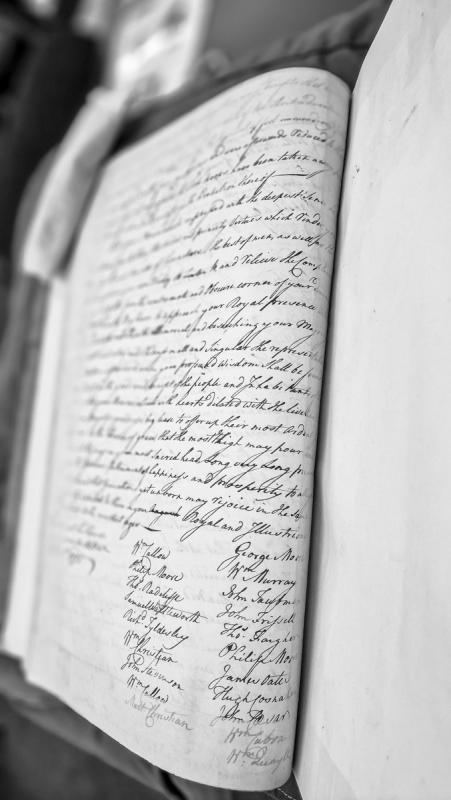
A fragmentary loyal address, likely from the House of Keys to the reigning monarch, expressing devotion and seeking royal guidance. The document conveys the representatives' deep concern for the welfare of the Isle of Man and its people, with prayers for the monarch's long life and prosperity. Significant portions are obscured due to photography angle and document damage.
A lengthy letter from Lieutenant Governor Alex Shaw to the Duke of Atholl discussing parliamentary addresses, the threat of French invasion, proposals to garrison prisoners of war on Langness, legislative measures against smuggling (wine and salt trade), and broader concerns about effective governance and administrative harmony on the Isle of Man. Reflects contemporary tensions over smuggling enforcement, political dysfunction, and the relationship between the Island's government and Westminster.
Letter from Lieutenant Governor Alexander Shaw to the Duke of Atholl discussing Island governance, potential prisoner-of-war depot at Langness, legislative remedies for smuggling (wine, salt), creditor laws, and the need for effective government presence. Shaw advocates for the Duke as Governor-in-Chief and discusses tensions between administrative efficiency and party politics on the Island during the Napoleonic Wars.
Letter from Lieutenant Governor Alex Shaw to the Duke of Atholl reporting on anti-smuggling operations, suspected arms caches at Port Erin intended for Ireland, seizure of contraband wine and tobacco, and measures to control the smuggling trade. Reflects post-Revestment governance challenges and the effectiveness of revenue enforcement under the new Crown jurisdiction.
Letter from Lieutenant Governor Alexander Shaw to the Duke of Atholl reporting on smuggling activity, suspected arms shipments to Ireland, seizures of contraband at Port Erin, and challenges in enforcing revenue laws on the Isle of Man. Shaw requests greater military resources and advocates for duty allowances on gin and brandy to undercut smugglers. Provides insight into post-Revestment governance challenges and the persistence of the running trade.
Letter from Lieutenant Governor Alexander Shaw to Home Secretary Lord Pelham reporting on Irish arrivals to the Isle of Man following the Dublin disturbances of July 1803. Shaw details security measures implemented to register and examine strangers, including three or more Roman Catholic priests, and expresses concerns about potential political refugees or fugitives. The letter contextualizes post-rebellion security protocols and military preparedness on the island.
Letter from Lieutenant Governor Alexander Shaw to Home Secretary Lord Pelham reporting on the arrival of Irish strangers on the Isle of Man following the 1803 Dublin disturbance (Robert Emmet's rebellion). Shaw describes measures taken to register and examine suspicious arrivals, including several Catholic priests, and requests military reinforcement for Castle Rushen. While post-dating the Revestment by 38 years, this document illustrates the Island's strategic importance in security matters and cross-Irish Sea movements.
Letter from newly arrived Lieutenant Governor Charles Smelt to Home Office official John King reporting on repairs to Castle Rushen Government House and requesting permission for a month's leave to England to obtain furniture and prepare his family. Includes contemporary newspaper notice of the auction sale of his predecessor's household effects, providing context on conditions for incoming governors.
Letter from Lieutenant Governor Charles Smelt to John King at the Home Office, dated 25 July 1805, reporting on repairs to Government House in Castle Rushen and requesting permission to travel to England for one month to prepare his family for relocation to the Isle of Man. Accompanied by editorial notes on the auction of his predecessor Alexander Shaw's household goods (1804) and commentary on post-Revestment property arrangements.
Letter from Lieutenant Governor John Dawson to Governor Smith expressing concern about the Duke of Atholl's planned visit to the Isle of Man. Dawson fears public disorder and lack of proper royal dignity, and seeks advance knowledge of his instructions from the Secretary of State. The letter reflects tensions between the Duke's residual authority and the Crown's governorship on the island.