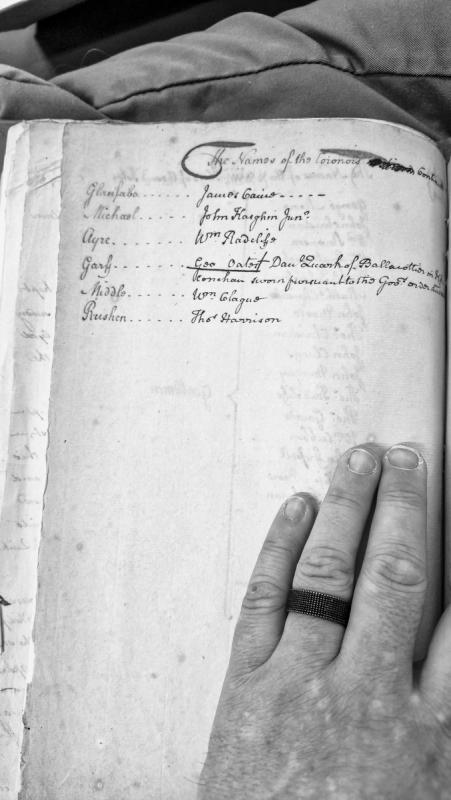
A partial administrative record listing coroners appointed for various parishes (Glenfaba, Michael, Ayre, Garff, Middle, Rushen) in the Isle of Man. The document appears to be a continuation of a larger list, with some names struck through and annotations regarding oaths taken under gubernatorial direction.
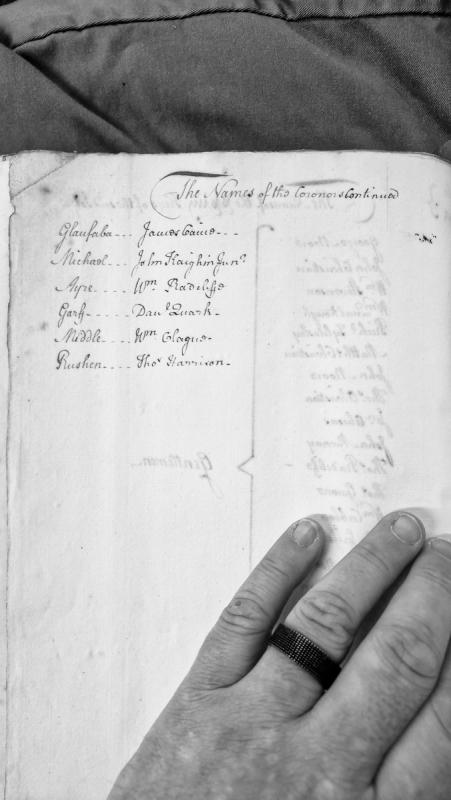
A continuation of a list of coroners appointed to the six parishes (sheadings) of the Isle of Man. Each parish is paired with the name of its coroner, including James Cains (Glaufaba), John Kaughin Jun. (Michael), William Radcliffe (Ayre), Daniel Quark (Garff), William Clague (Middle), and Thomas Harrison (Rushen).
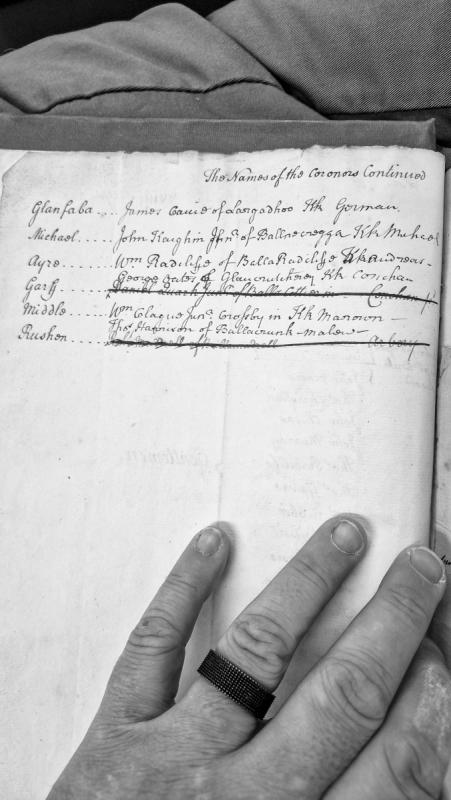
A continuation of a list naming coronors (coroners) for various Manx parishes including Glanfaba, Michael, Ayre, Garff, Middle, and Rushen, with their residences and associated districts. Some entries are crossed out or illegible, suggesting this is a draft or working document.
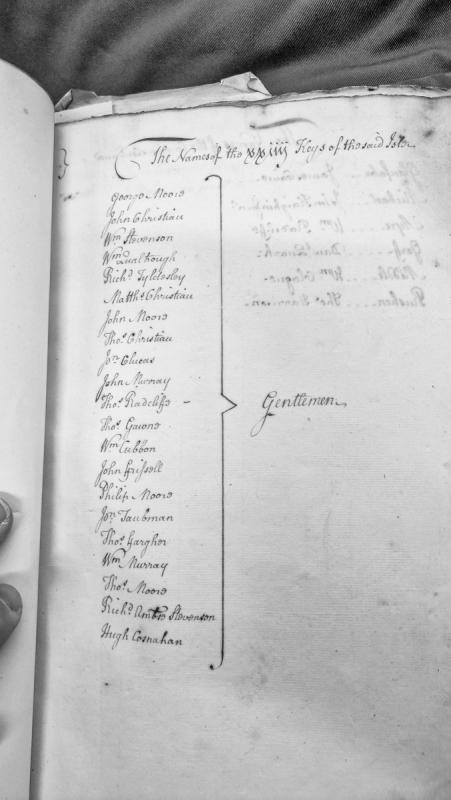
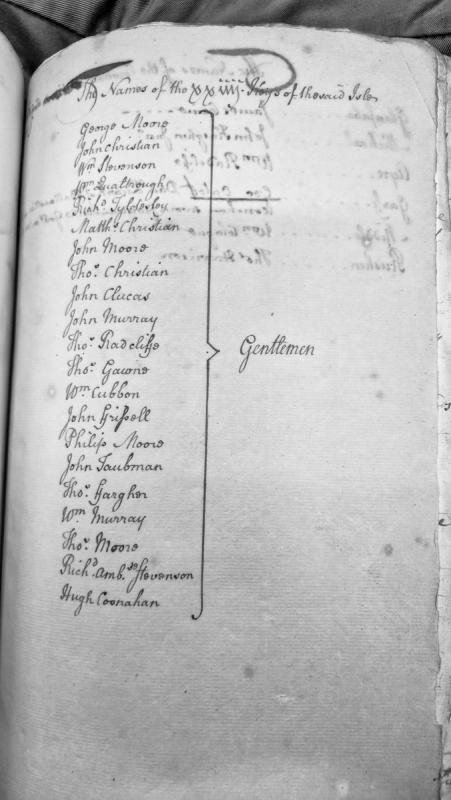
A register of the twenty-four members (Keys) of the House of Keys legislative body of the Isle of Man. The document lists the names of gentlemen serving in this capacity, though the exact date of composition is not specified in the transcription.
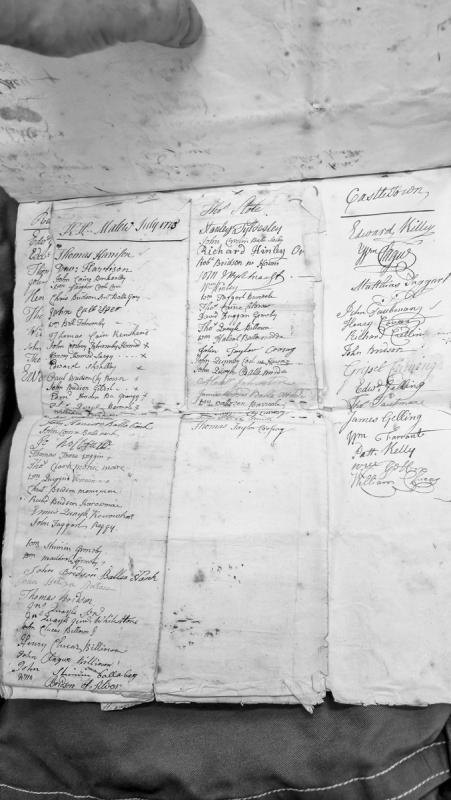
A handwritten document from July 1773 listing numerous names of individuals associated with various parishes and locations across the Isle of Man. The document appears to be an administrative or census-related record, with names organized by geographical location. Many entries contain place names and personal identifiers, though legibility is significantly compromised throughout.
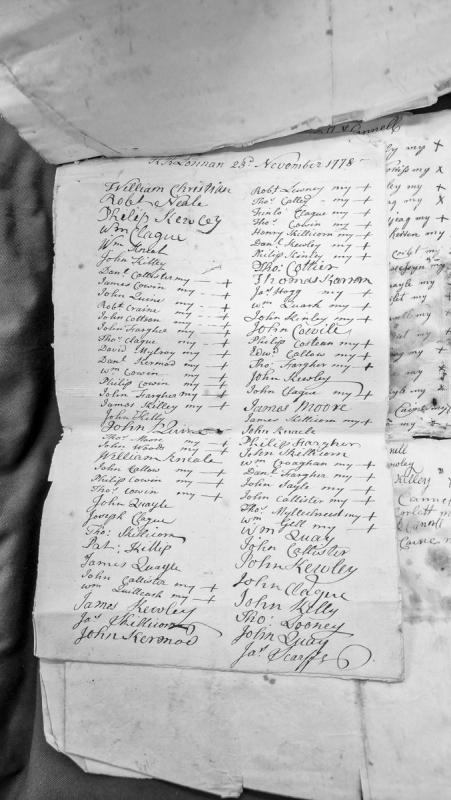
A document listing approximately 80 names from K.K. Lonnan (Kirkby, Kirk Lonan parish) dated 23 November 1778. Many names are marked with 'my' and '+' symbols, possibly indicating some form of parochial or manorial listing, tax assessment, or household enumeration. The purpose and significance of the marks remains unclear without additional context.
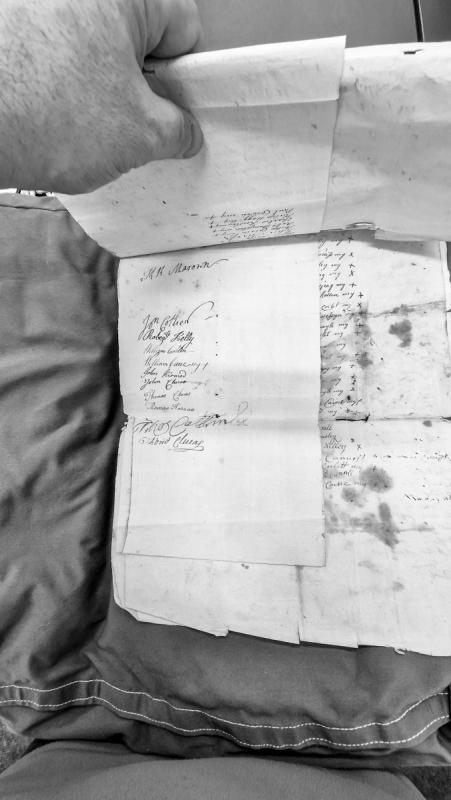
A manuscript list of names from the Marown parish, organized in two columns with various marks ('+', 'x', 'my') beside entries. The right column is substantially obscured by staining and damage. The document appears to be a record or register of local residents.
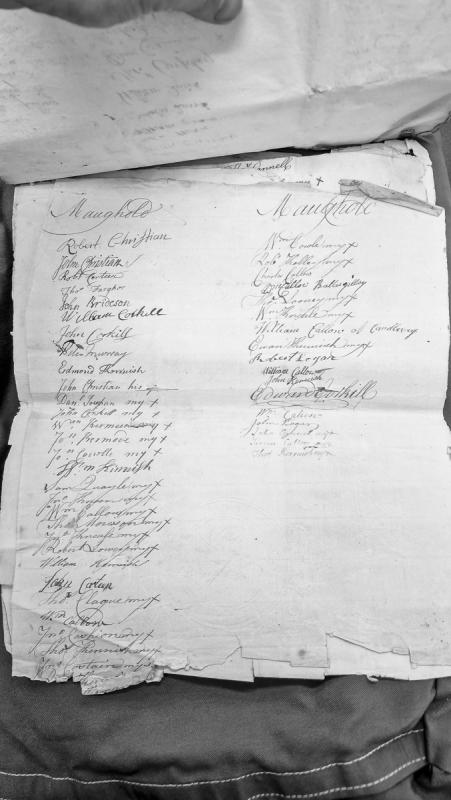
A two-column list of names from the Maughold parish, with many entries marked with '+' (possibly indicating votes, presence, or status). The document appears to be an administrative or court record, though its specific purpose is unclear. Many names are abbreviated and some readings are uncertain.
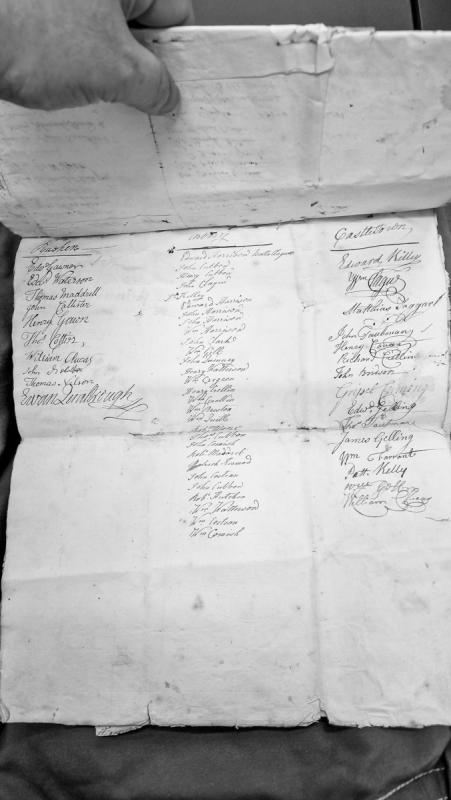
A three-column list of names organized by parish location (Rushen and Castletown). The document appears to be a roster or register of individuals, possibly for administrative, legal, or parochial purposes. Many names have uncertain readings indicated by question marks.
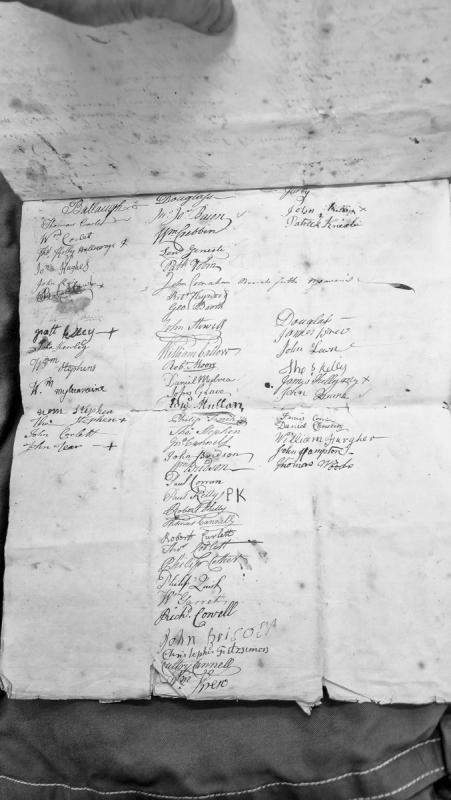
A three-column list of names organized by Manx parishes, likely representing residents, property holders, or participants in an administrative process. The document contains numerous uncertain readings and partial names, suggesting it may be a roster, tax list, or administrative register.
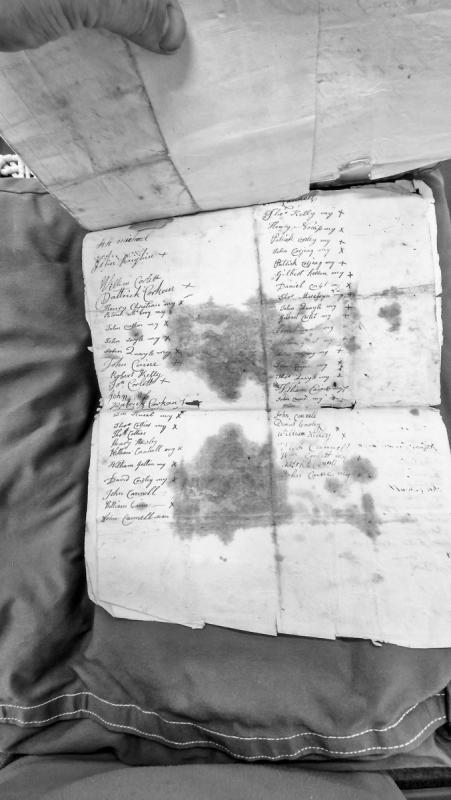
A two-column list of names, predominantly Manx surnames, with various marks ('+', 'my', 'x', '-') indicating signatures, marks, or witness attestations. The document appears to be a record of signatories or participants in a legal or administrative proceeding, though the specific context and date are not provided.
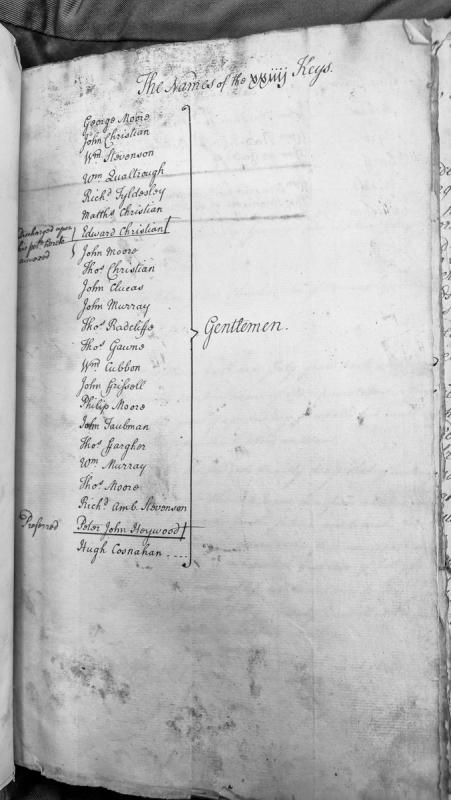
A roster listing the names of 24 members of the House of Keys, the legislative body of the Isle of Man. Marginal annotations indicate that Edward Christian was discharged upon his own request and Peter John Heywood was proposed as a member.
A roster of 21 named members of the House of Keys, the legislative body of the Isle of Man. The document appears to be an administrative list identifying the gentlemen who comprised the Keys during an unspecified period.
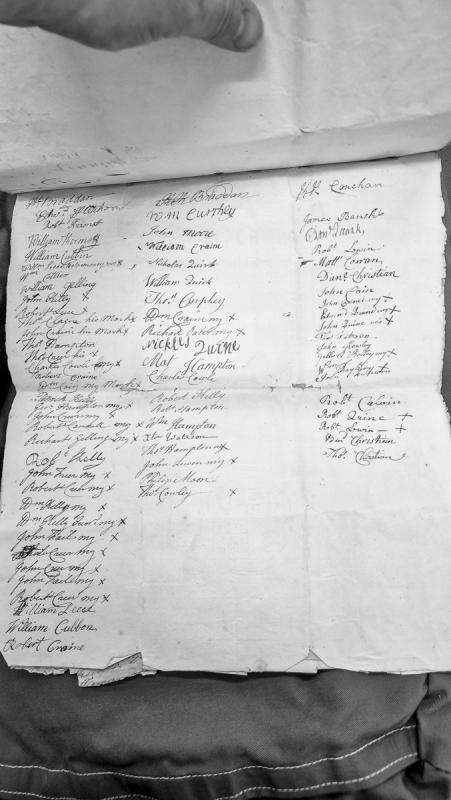
A document containing three columns of names, primarily from the parishes of Kirkby Braddan and Kirkby Conchan on the Isle of Man. Many entries include personal marks (denoted by 'x') or signatures, suggesting this may be a petition, poll list, or administrative register. The presence of marks alongside names indicates inclusion of those unable to write.
Lord Cadogan's official report to the Treasury Lords on the problems of Manx copper coinage, referencing a 1766 memorial by Charles Lutwidge. Discusses the overvaluation of Manx pennies (14 pieces = 1 British shilling despite intrinsic worth of only 3 pence), counterfeiting risks, and the potential adoption of English copper coin. Relevant to post-Revestment fiscal and monetary policy.
Lord Cadogan's report to the Treasury Lords addressing the overvaluation of Manx copper currency (14 Manx pennies equalling one British shilling despite intrinsic worth of only 3 pence). References an earlier 1766 memorial by Mr Lutwidge and discusses the problems of counterfeiting and the need for currency reform, including introduction of English copper coin.
Offered the verdict on Wilson's achievement that placed the Island's ecclesiastical life in a larger context: 'If the ancient discipline of the church was lost elsewhere, it might be found in all its pomp in the Isle of Man.'
First Lord of the Board of Trade. When George Moore described the sufferings of Manx people to him in London — the towns emptied, the young people leaving, the warehouses deserted — Clare responded with contempt: 'The inhabitants of all the former trading towns, he said, were a Nest of Vermin collected from the Dregs of the neighbouring Countries.' Moore's quiet response: 'since the Trade was gone all or most of these Gentry were gone and had dissolved like snow.' Clare's contempt was pure. Moore accommodated it, conceding the secondary point in the hope of winning the primary one.
Lord Chief Justice of England who, in the House of Lords debate of 8 July 1805, called the Revestment 'one of the most corrupt jobs ever witnessed in Parliament.' He was challenged. He did not withdraw. He expanded: 'a proceeding which could only be sanctioned by Parliament in the worst and most corrupt times.' The Lord Chief Justice of England characterising an Act of Parliament as corrupt, in the House of Lords, unchallenged on the substance.
Appointed Lord of Mann by Oliver Cromwell during the Parliamentary interregnum. The constitutional form was maintained — Tynwald still met, the Deemsters still judged. But the extraction pattern continued. Fairfax reproduced the identical relationship the Stanleys had maintained. When he dismissed William Christian and appointed James Chaloner, the new man charged Christian with misappropriating bishopric funds — the funds Christian had spent on schoolteachers to educate Manx children.
The Duke of Atholl's cousin. The 42nd Black Watch (Freiceadan Dubh) was 'his' regiment — raised in 1739 to police the Scottish Highlands, then sent to garrison the Isle of Man after Revestment. The family connection was not coincidental.
His assessment of Grey Cooper's speech survives in the Atholl Papers: 'No performance at the Bar of the House of Commons has been mentioned with so universal and high applause as Mr Cooper's since Ld Mansfield left that Bar.'