An archive of correspondence between Governor Edward Smith, Lt. Governor Richard Dawson, and George Aust (Westminster agent for Manx affairs) covering administrative, financial, and constitutional matters on the Isle of Man in the post-Revestment period. Topics include copper coinage, revenue accounts, water bailiff appointments, harbour management, customs duties, and interactions with the Duke of Atholl. Includes supporting documents on revenue surplus, harbour infrastructure, and Atholl's reserved rents.
Parish in the north of the Isle of Man. Home parish of the Christian family, whose seat at Milntown dominated the northern landscape. The Christians of Lezayre produced Illiam Dhone, the Deemsters Christian, and — through the Virginia branch — Patrick Henry.
Transcription of ecclesiastical census records from the Liber censuum Romanae ecclesiae (1192), composed by Cencius Camerarius, listing bishoprics under Norwegian metropolitan authority. Includes references to the Bishopric of Sodor (Sudreys/Isle of Man) and comparative 14th-century ecclesiastical provincial records. Relevant to understanding Man's ecclesiastical status and Norwegian jurisdiction before 1266.
Extract from the Vatican Archives manuscript (Vat. lat 8486) containing the Liber censuum Romanae ecclesiae compiled by Cencius Camerarius in 1192, listing ecclesiastical jurisdictions and bishoprics under various Norwegian archbishoprics, with specific mention of the Sudereiensi (Manx) bishopric. Includes comparative 14th-century ecclesiastical provincial list showing Man's ecclesiastical status under Norwegian rather than English or Scottish metropolitan authority.
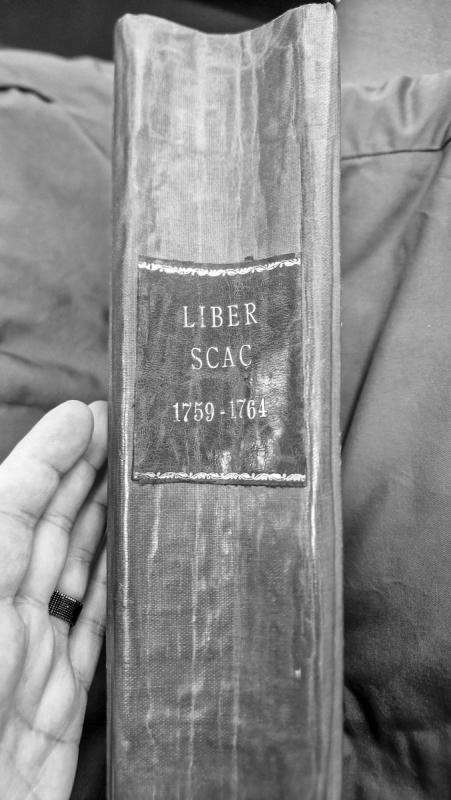
Title page or cover of a bound volume designated 'Liber Scac' (Manx legal/administrative register) covering the period 1759-1764. This appears to be a registry or account book of official records from the Isle of Man.
A transcribed guide to the Libri Irrotulamentorum (records of commissions of Manx officials from 1594 onwards), with comprehensive abbreviations for positions, places, and administrative signatures. Covers the period 1688–1765, including the critical Revestment period. Essential reference for interpreting official documents and understanding the administrative structure of the Isle of Man.
A reference guide to the Libri Irrotulamentorum (records of official commissions on the Isle of Man), presenting an index of signatures, job functions, place names, and abbreviations used in the historical record. Covers officials and administrative positions from 1594 onwards, with detailed focus on the period 1688–1765, which encompasses the Revestment era. Compiled by Ros Stott with presentation by the editor.
A royal licence granted by King Henry IV permitting William Hobbesson, servant of the Earl of Northumberland, to purchase and transport 12 crannocks of barley to Mann castle for victualling purposes. This document demonstrates early medieval governance of the Isle of Man under English crown authority and the logistical supply chains required for maintaining the castle.
A royal licence granted by Henry IV permitting three merchants (John Hale, John Maystry, and Alexander Mercer of Cockermouth) to purchase 500 quarters of corn in Ireland and transport it to the Isle of Man and western Scotland for relief of the King's subjects. This document demonstrates medieval trade patterns, royal commercial regulation, and the Isle of Man's position within English maritime jurisdiction.
A royal licence issued by Henry IV permitting merchants John Hale, John Maystry, and Alexander Mercer of Cockermouth to purchase and transport 500 quarters of corn from Ireland to the Isle of Man and the West Marches of Scotland. The document demonstrates medieval trade regulation, customs procedures, and the strategic importance of provisioning the Isle of Man.
A royal licence issued by King Henry IV granting permission to two servants of the Earl of Northumberland to purchase four ships' loads of corn in Ireland and transport them to the Isle of Man and Carlisle. This document illustrates early medieval trade regulation and the Crown's control over Isle of Man commerce and supply.
A royal licence granted by King Henry IV permitting John Mathoren and William Hobson, servants of the Earl of Northumberland, to purchase four weyes of corn in Ireland and transport them to the Isle of Man and Carlisle. The document is transcribed from the Rotuli Patentium et Clausarum Cancellariae Hiberniae and represents early medieval trade regulation between Ireland, Man, and England.
A royal licence granted by Henry IV of England authorising Robert Yvenhowe of Mann to transport two ways (units) of corn to the island. This is a transcription from the Rotuli Patentium et Clausarum of the Irish Chancery, providing early evidence of trade regulation and royal authority over Manx commerce in the medieval period.
A royal licence issued by King Henry IV permitting Robert Yvenhowe of Mann to transport two weys of corn to the island. This document illustrates early medieval trade regulation and royal control over Isle of Man commerce, providing context for the later 18th-century customs and smuggling issues central to the Revestment study.
Letter from Lieutenant Governor R. Dawson to an unnamed superior (likely the Secretary of State or Lord Lieutenant) reporting an attempt by the Duke of Atholl's Seneschal to claim possession of the Court Room in Peel (Douglas). The letter details the legal basis for Crown possession following the 1765 Revestment Act, explains how the Douglas Court Room came to be held by Atholl's agent, and defends Dawson's refusal to surrender Crown property without proof of legal right.
A letter from newly appointed Lieutenant Governor Alexander Shaw to Evan Nepean (Under Secretary of State) dated 26 February 1791, requesting copies of gubernatorial instructions and records that were not provided by his predecessor, Lieutenant Governor Dawson. Shaw references instructions from 1765 relating to the Crown's vesting of the Isle of Man and seeks guidance on his administrative duties.
Of HMS Maria. Arrived at Douglas in early August 1811. Norris Moore, the High-Bailiff, asked his intentions. Hawkes assured him he did not intend to impress fishermen or interfere with the fishery. On the night of 17 August, he broke his word. His men moved through the harbour, impressing fishermen and working men after a hard fight in which several were dangerously wounded. The Admiralty's reply when petitioned: 'their Lordships have determined not to discharge these men on account of the very improper conduct of the people of Douglas.' The Admiralty punished the Island for the fishermen's refusal to be taken quietly.
Lieutenant-Governor Alexander Shaw's formal letter to the Commissioners of Inquiry (1792), submitted 19 October 1791, detailing the constitutional structure of the Isle of Man, the composition and powers of the three Estates (Sovereign, Governor and Council, House of Keys), and critical observations on governance including the exclusion of clerical members from Council and abuses of appeals to the King in Council. Directly relevant to post-Revestment constitutional arrangements and administrative practice.
Letter from Lieutenant-Governor Alexander Shaw to the Secretary of the Commissioners of Inquiry (1792), submitted 19 October 1791, detailing the constitutional structure, legislature, laws, and governance of the Isle of Man. Covers the three estates (Sovereign, Governor and Council, House of Keys), the composition and election of the Keys, the controversy over clerical members of the Council, and extensive discussion of the problem of appeals to the King in Council. A key post-Revestment administrative document.
An extensive biographical and historical introduction to the life of Robert Clive, focusing on the political and military state of India at the outset of his career (1746). The text covers the decline of the Mughal Empire, the rise of European trading companies (especially the East India Company), the Carnatic Wars, and key figures like Dupleix, La Bourdonnais, and various Indian rulers. While primarily biographical, it provides crucial context for understanding the geopolitical environment that shaped the events leading to the 1765 Isle of Man Revestment by illustrating how overseas colonial ventures and commercial rivalries drove imperial expansion.
A comprehensive biography of John Wilkes (1725–1797) by Horace Bleackley, published in 1917 by John Lane. While primarily a biography of the radical politician Wilkes, the work contains extensive contextual material on 18th-century British politics, Parliamentary procedure, radical journalism, and constitutional conflicts that provide important background for understanding the political climate leading to the 1765 Revestment debate.
Comprehensive biography of John Wilkes (1725–1797), the radical politician and libertarian activist whose career paralleled the 1765 Revestment period. Covers Wilkes's political agitation, Parliamentary activities, publishing ventures (The North Briton), and constitutional conflicts with George III. Relevant to the Revestment project for context on 1760s–1770s political radicalism, Parliamentary procedure, and the ideological climate affecting colonial and constitutional questions.