Letter from Dan Mylrea and John Quayle (revenue officials) to the Duke of Atholl enclosing a demand for customs duties from merchant John Taubman, with Taubman's detailed response. Taubman contests the duty charges, claiming he was misled about the Revestment and argues he is owed £300 plus interest lent on harbour security now transferred to the Crown. The letter documents post-Revestment revenue collection conflicts and merchant grievances.
Administrative letter from acting officials (Mylrea and Taubman) to the Duke of Atholl during the Governor's absence, reporting on the completed audit, accounts settlement, and a drowning incident involving a ship from Whitehaven. The letter documents financial remittances, tithe accounts, and the handling of a criminal matter under Manx jurisdiction.
Administrative letter from acting officials (Mylrea and Taubman) to the Duke of Atholl regarding the autumn audit of 1749, financial remittances, and the criminal case of David Prichard (drowned James McGee in Bordeaux). Provides insight into governance procedures, revenue accounting, and Manx judicial authority over crimes committed by crew members of trading vessels.
A letter from Peter John Heywood to the Duke of Atholl dated 22 September 1786, discussing post-Revestment governance issues including the appointment of a Receiver-General (Mr Watts), revenue inspection procedures, Tynwald Council composition, and the ongoing dispute over treasure trove rights. Heywood reports on the qualifications of new officials and expresses concerns about administrative competence and constitutional implications.
Letter from Peter John Heywood (Manx administrator) to the Duke of Atholl regarding governance issues on the Isle of Man, including disputes over treasure trove rights, currency, and the controversial appointment of William Watts as Receiver-General. Discusses the relationship between the Crown and the Duke's interests, local opposition, and the implications of holding offices by deputy rather than in person.
Letter from Peter John Heywood (Manx official) to the Duke of Atholl regarding the appointment of Mr. Watts as Receiver General, following Charles Lutwidge's tenure. Discusses the warrant from Treasury, salary arrangements, herring fishery regulation, and administrative concerns about the succession to the office.
Letter discussing the newly appointed Receiver General (Watts), his appointment conditions, salary arrangements, and related administrative matters. Also covers herring fishery issues, water bailiff absence, and account audit procedures. Written by Peter John Heywood, a key figure in post-Revestment Isle of Man governance.
A letter from Peter John Heywood (likely an agent or administrator in the Isle of Man) to the Duke of Atholl reporting on rumours and activities of a man named Frazer, who claims to be Inspector General of the Revenues appointed by Pitt. The letter discusses concerns about Frazer's authority, his lack of proper credentials, and his alleged attempts to audit the late Charles Lutwidge's accounts. It also reports on political appointments including a Water Bailiff position and a Commissioner of the Port of Douglas.
Peter John Heywood writes to the Duke of Atholl from Isle of Man reporting on rumours regarding a Mr. Frazer's appointment as 'Inspector General of the Revenues' by Mr. Pitt. Heywood details Frazer's questionable authority, vague credentials from the Treasury, and activities on the island, expressing concerns about the implications for Atholl's rights and the Keys' conduct. The letter touches on revenue administration, Treasury oversight, and local governance tensions post-Revestment.
A detailed letter from R Frazer to Prime Minister William Pitt proposing solutions to the constitutional and administrative problems arising from the divided sovereignty created by the 1765 Revestment. Written 22 years after the purchase, Frazer outlines the impediments caused by the Duke of Atholl's reserved rights, proposes either enhanced Duke governance or full purchase of his remaining claims, and discusses revenue improvements, smuggling suppression, and fishery bounties.
A lengthy administrative letter from R Frazer to Prime Minister William Pitt proposing solutions to tensions arising from the 1765 Revestment settlement, specifically the reserved rights retained by the Duke of Atholl. Frazer analyzes 21 years of experience with divided sovereignty, proposes either a reformed governance structure maintaining Atholl's interests or full purchase of his reserved rights, and provides detailed revenue projections and recommendations for suppressing smuggling.
A bilingual (English and Latin) letter dated 1290 from the people of the Isle of Man to King Edward I, formally submitting themselves to royal protection and pledging obedience. The document establishes the basis of English sovereignty over Man, with inhabitants forfeiting two thousand pounds in silver as penalty for rebellion. This is a foundational constitutional document predating the 1765 Revestment by nearly 500 years.
William Sacheverell, Governor of the Isle of Man under the Earl of Derby, appeals to the Archbishop of Canterbury for ecclesiastical support in 1693. He details the desperate condition of the Manx church: vacant bishopric, ruined churches, unpaid royal benefaction of £100 annually, impoverished clergy, and the need to complete Dr. Barrow's library and academic facilities. This reveals pre-Revestment governance structures, the Earl of Derby's authority, and the island's ecclesiastical and economic vulnerabilities.
A 1693 letter from William Sacheverell, Lieutenant Governor of the Isle of Man under the Earl of Derby, to the Archbishop of Canterbury detailing the poor condition of the Manx church, including a vacant bishopric, ruined churches, unpaid royal stipends, and impoverished clergy. The letter appeals for ecclesiastical and financial support to repair churches, fund clerical livings, and establish academic lodgings and a library.
A detailed summary of the 1792 Commissioners' Report examining the Duke of Atholl's complaints regarding losses from the 1765 Revestment Act, including allegations about uncollected revenues, rights unnecessarily vested in the crown, customs establishments, duties, smuggling, and proposals for trade relief. This is a published letter transcription discussing the official investigation into compensation claims.
This letter provides an abridged statement of the 1792 Commissioners' report examining the Duke of Atholl's claims for additional compensation following the 1765 Revestment Act. The report addresses allegations of unfair revenue collection, loss of rights, and constitutional issues, with detailed analysis of customs establishments, duty systems, illicit practices, and proposals for trade relief.
A detailed letter examining the constitutional structure of the Isle of Man as documented in the Commissioners' Report, covering the legislative (Governor, Council, Deemsters, and Keys), executive, and judicial branches. Discusses the historical development from 1406 onwards, the composition and powers of various courts, and the minimal constitutional changes occasioned by the 1765 Revestment transfer of sovereignty from the Duke of Atholl to the Crown.
A detailed analysis of the Isle of Man's constitutional structure at the time of the 1765 Revestment, covering the legislative, executive, and judicial branches. The letter examines the Tynwald court, the House of Keys, the Council, the Deemsters, and various courts of law, drawing on the Commissioners' Report and correspondence from key officials including Deemster Moore, Sir Wadesworth Busk, and Lieutenant-Governor Alexander Shaw. It traces the island's governance from Henry IV's 1406 grant to the Stanley family through to the transfer of sovereignty to the Crown.
A letter from Bishop Levinze (likely Bishop of Sodor and Man) to Thomas Choldmondsley dated 28 June 1688, requesting funds for schoolmasters and preachers in Ramsey and Douglas, and expressing concern about Catholic missionary activity on the Isle of Man. Written during the period of the trial of the seven bishops, reflecting Protestant anxieties and ecclesiastical governance of the island.
A letter from Bishop John Meryck of the Isle of Man (dated 4 April 1590) to the Lord Treasurer of England, appealing for relief from financial distress and alleged wrongful seizure of goods by authorities in Anglesey. The letter provides context on episcopal finances, the burden of travel between Wales and Man, personal debts incurred through loans to friends, and charges of fraud. Relevant as a pre-Revestment primary source documenting administrative relationships between the Isle of Man and Westminster.
A letter from Bishop John Meryck of the Isle of Man to the Lord Treasurer of England dated 4 April 1590, detailing his financial hardships and debts incurred while serving between Wales and Man, and seeking protection from legal process. The letter provides insight into ecclesiastical administration, personal finances of the Manx bishopric, and the bishop's precarious position in the late 16th century.
A petition from the Bishop of Sodor and Man (Phillips) to the Earl of Salisbury, Lord High Treasurer of England, dated June 1610, complaining of his dispossession by the Lieutenant (Mr Ireland) of traditional turfery rights belonging to the Bishopric. The Bishop describes his efforts to repair the ruinous Bishopric and his financial losses, and requests leave to travel to England for redress and to attend to his personal affairs.
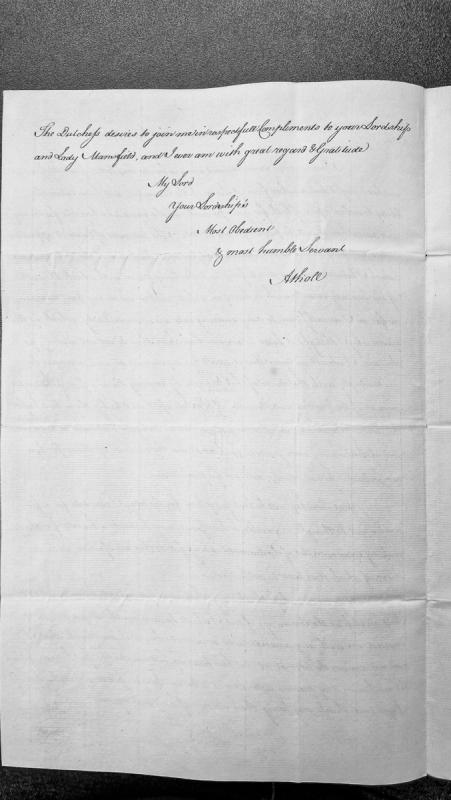
A brief closing portion of a letter expressing respectful compliments from the writer (Atholl) and the Dutchess to Lord Mansfield and Lady Mansfield. The fragment demonstrates formal 18th-century correspondence conventions with expressions of regard and gratitude.
A letter from Gerard (likely governor or revenue official for the Isle of Man) to Robert Cecil, Earl of Salisbury and Lord High Treasurer of England, concerning accounts and revenue from the island. The writer disputes charges against him and discusses arrangements for transporting revenue to England via Liverpool. Demonstrates early 17th-century administrative oversight of the island and revenue management.
A letter from Gerard (at Bromley) to Robert Cecil, Earl of Salisbury (Lord High Treasurer of England), discussing administrative and financial matters related to the revenue of the Isle of Man. The letter addresses discrepancies in a commission for the Island's revenue, references the Countess of Derby's receipts, and confirms arrangements for transporting revenue by bark from Liverpool. Provides early 17th-century context for feudal lordship and revenue collection under the Stanley/Derby family.