Arthur Onslow, Collector of Customs at Liverpool, reports to the Honourable Board on his enforcement efforts against illegal East India goods (particularly tea) being smuggled through the Isle of Man. He details witness operations, vessel seizures, evidentiary challenges, and his proposal for renewed surveillance. The letter illustrates the practical difficulties in prosecuting smugglers and the constitutional limitations of revenue enforcement in the years before the 1765 Revestment.
Letter from William Christian, Attorney General of Isle of Man, to the Duke of Atholl reporting the discovery of a grave containing weapons (sword and battleaxe) and silver coins found during building works in the parish of Kirk Christ Lezayre in summer 1750. Christian asserts the Duke's legal right to the treasure trove and explains the delay in reporting due to difficulty in securing all items and examining witnesses.
Letter from William Christian, Attorney General of the Isle of Man, to the Duke of Atholl reporting the discovery of a grave containing medieval weapons (sword and battleaxe) and 39 silver coins during building works in the parish of Kirk Christ Lezayre. Christian confirms the items as treasure trove, the Duke's legal property, and explains the delay in reporting due to initial secrecy and difficulty in recovering all items.
Informal letter from Baron Maule to the Duke of Atholl discussing the drafting of an important letter to 'the chief man himself' (possibly a senior government figure), the proposed use of Mr Forrester for negotiations, and the candidacy of Captain John Wood to succeed Governor Cochrane on the Isle of Man. The letter provides insight into the Duke's political networks and the process of appointment to the Manx governorship in the pre-Revestment period.
A letter from Baron Maule to the Duke of Atholl discussing proposed correspondence on Isle of Man matters, the suitability of Mr Forrester for negotiations, and the qualifications of potential candidates (particularly Captain John Wood) to succeed Governor Cochrane. The letter reveals informal networks of influence involving 'two friends' (possibly Lord Mansfield and the Duke of Argyll) advising on Isle of Man affairs before the 1765 Revestment.
Administrative letter from Charles Lutwidge (Collector of Customs at Whitehaven) to Grey Cooper at the Treasury, reporting the destruction of Douglas Pier by storms and noting its strategic importance to naval operations. Directly relevant to post-Revestment Crown management of Isle of Man ports and infrastructure.
A summons letter from the Commissioners for the Advance of Money to Lieut.-Col. Worsley and others, dated 16 July 1652, requesting testimony regarding alleged acts of delinquency by John Sharpeles and William Christian during the Parliamentary reduction of the Isle of Man. This document provides evidence of Commonwealth administrative and legal procedures applied to the island during the English Civil War period.
A summons from the Commissioners for the Advance of Money to Lieut.-Col. Worsley and others, requesting their testimony regarding alleged acts of delinquency by John Sharpeles and William Christian during the Parliamentary reduction of the Isle of Man. The document dates to the Commonwealth period and provides evidence of Parliamentary control mechanisms and judicial proceedings on the island.
Administrative correspondence from Manx customs collectors Mylrea and Quayle to the Duke of Atholl concerning merchant John Taubman's refusal to pay customs duties following the 1765 Revestment. Taubman claims the duties are unjust because he had advanced £300 on credit of harbour revenues now transferred to the Crown, and alleges he was misled by Quayle about the Duke's intention to sell the island. The letter includes Taubman's detailed goods account (rum, tea, brandies, silks, gin) and his conditional offer to pay if his loan is credited against the duties.
Administrative letter from Castletown officials Mylrea and Quayle to the Duke of Atholl concerning cash remittances, duty disputes with Cosnahan and Taubman, Lutwidge's legal case on boon services, and applications for land enclosure and mill licences. Reveals internal management of Atholl's Manx sovereignty and emerging opposition to ducal rights.
Correspondence from Daniel Mylrea (likely a revenue official or factor) to the Duke of Atholl regarding tithe money remitted to the Duke during 1763–1764, with detailed accounting of three payments. The letter also expresses concern about a recent proclamation affecting the Isle of Man and its merchant community, and notes difficulties with the herring fishery. Directly relevant to understanding revenue administration and economic conditions preceding the 1765 Revestment.
Letter from Daniel Mylrea (likely a revenue official or factor in Man) to the Duke of Atholl, reporting on tithe money remittances and expressing concern about a recent proclamation affecting the Isle of Man. Mylrea notes alarm among merchants and difficulties with the herring fishery, suggesting this was written during the period leading up to the 1765 Revestment negotiations.
A letter from Daniel Mylrea, likely a senior administrator on the Isle of Man, to the Duke of Atholl dated 1 August 1764. Mylrea reports having communicated the Duke's reassuring intentions to merchants in Douglas, Peel, and Ramsey, indicating that commercial anxiety about political change has been alleviated. He notes plans for a collection at Douglas with the Comptroller and promises remittance of revenues to the Duke. The letter provides insight into merchant concerns during the period leading up to the 1765 Revestment and the Duke's efforts to maintain commercial confidence.
A letter from Daniel Mylrea (likely a revenue official or administrator in the Isle of Man) to the Duke of Atholl dated 1 August 1764, discussing the positive reception of the Duke's recent communication among Manx merchants. Mylrea reports that merchants are relieved of fears about a 'revolution' (likely political change) and indicates plans for a revenue collection at Douglas. This document is directly relevant to the period immediately preceding the 1765 Revestment negotiations.
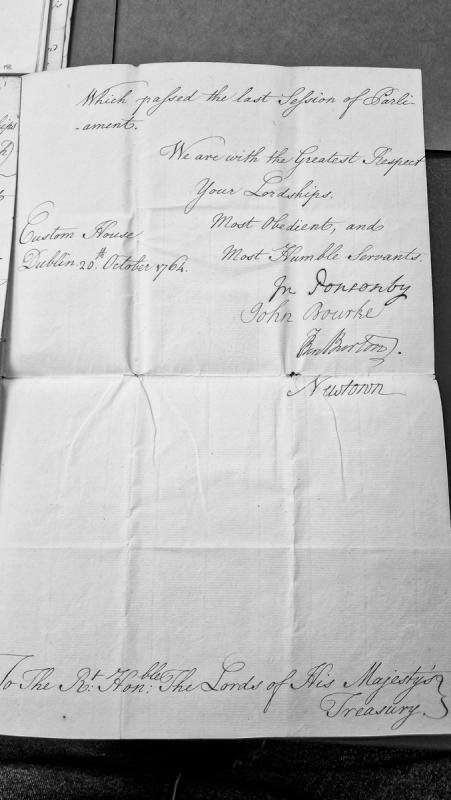
A formal letter from officers at the Dublin Custom House (J. Ponsonby, John Bourke, and Ben Burton) addressed to the Lords of His Majesty's Treasury. The letter references passage through Parliament in the previous session and is written in respectful, formal language typical of 18th-century official correspondence.
A letter from the Duke and Duchess of Atholl to Dan Mylrea, denying rumours that they intend to sell the Isle of Man to the British government. The Duke states no application has been made by government for such a sale. This document is significant as it predates the actual Revestment by less than a year and shows the Duke's public denial of sale intentions just before negotiations began.
A letter dated 18 July 1764 from the Duke and Duchess of Atholl to Dan Mylrea, denying rumours that they intend to sell the Isle of Man to the Crown. The document explicitly states no government application has been received. This is a crucial pre-Revestment source showing the Duke's position before the 1765 parliamentary purchase.
The Duke of Atholl writes to Lord Mansfield (Lord Chief Justice) seeking legal advice on how to respond to pressure from the Treasury and Mr Grenville regarding the sale of Isle of Man sovereignty. Atholl expresses concern about recent orders stationing cutters in Manx harbours, the Treasury's demand for detailed customs accounts, and threats of Parliamentary action. He seeks Mansfield's counsel on whether to delay negotiations, withhold confidential documents from Parliament, or travel to London immediately.
The Duke of Atholl writes to Lord Mansfield (Lord Chief Justice) seeking legal and political advice on how to respond to Treasury demands for detailed accounts of Manx customs and revenues ahead of a potential parliamentary sale of the island. Atholl expresses concern about the precipitous pace of negotiations, the unprecedented stationing of revenue cutters in Manx harbours, and the implied threat of unfavourable legislation if he delays. He claims previous revenue papers were given in confidence and should not be made public.
A 16th-century diplomatic letter from G. Nicolson to Mr. Bowes (likely concerning Scottish/English border security) reporting on attempted Manx landings in Scotland and defensive preparations. The letter mentions instructions from the Earl of Argyle and references failed Manx attempts to land due to Scottish readiness. This provides historical context for early modern Isle of Man activity and Anglo-Scottish relations.
Letter from George Moore, a Manx merchant and tenant, to the Duke of Atholl concerning a disputed intack (enclosed land) near Fort Douglas and Moore's proposal to improve Peel Harbour with merchant funding. Moore defends himself against encroachment charges, criticizes the conduct of officials (particularly Deputy Searcher Lidderdale), and proposes a £1,500 harbour improvement scheme to attract shipping from Liverpool, Lancaster, Whitehaven, and Glasgow. Relevant to trade, governance, revenue, port infrastructure, and merchant-authority relations in pre-Revestment Isle of Man.
Letter from George Moore, a merchant and leaseholder in Douglas, to the Duke of Atholl detailing disputes over his intack (leased land) near Fort Douglas and outlining a proposal to improve Peel Harbour with merchant investment. The letter references administrative tensions with Governor Cochrane and other officials, complaints about searcher Captain Lidderdale's conduct, and Moore's vision for expanding trade through Liverpool, Lancaster, and Clyde merchants. Documents Moore's role in Isle of Man commerce and the Duke's proprietary interests pre-Revestment.
Letter from John Wood, Governor of the Isle of Man, to the Board of Customs acknowledging receipt of correspondence via Mr Lutwidge dated 23 May 1765. Wood expresses his readiness to execute orders but notes his constraint due to lack of formal directions from either the Crown or the Duke of Atholl regarding necessary post-Revestment measures. This is a critical document showing the transition period immediately after the Revestment Act (passed May 1765) when governance structures were being established.
Extract of a letter dated 29 July 1763 from Dutch merchant Herman van Yzendoorn to Mr Taubman (presumed intermediary to the Duke of Atholl) reporting the seizure of three vessels carrying East India goods at Liverpool and the imposition of £2600 bail. The letter discusses an English act (over 40 years old) rendering confiscable any vessel that brought East India goods to the Isle of Man, and argues that such enforcement violates the Duke's sovereignty. It references comparative treatment of Guernsey and Jersey and appeals for the Duke to intervene to protect his privileges and the island's trade.
A letter from Hugh Cosnahan in Douglas, Isle of Man, to George Farquher, discussing the appointment of Captain Small as Collector, the Duke of Atholl's presence in London to claim rights and compensation, and the visit of House of Keys deputies to solicit the King's confirmation of laws. Cosnahan requests Farquher's assistance in obtaining a position on the island. This document sheds light on post-Revestment (1765) governance, the Duke's continued interests in the island, and the House of Keys' relationship with Westminster.