Parish adjoining Douglas. Christopher Hampton's parish, referenced in the context of Bishop Wilson's ecclesiastical discipline. One of the ancient parishes of the Isle of Man with important Norse cross-slabs.
Parish on the west coast near Peel. Bishop Wilson imprisoned the Clerk of the Rolls in its dungeon. Later the site of a vicar appointment dispute involving Mr Gell.
Parish church in the south of the Isle of Man near Castletown. William Christian (Illiam Dhone) was buried here; the parish register records his death. One of the ancient parishes of the Island.
Parish church on the northeast coast, named for the saint said to have arrived from Ireland in a coracle. The churchyard holds one of the most remarkable collections of carved crosses anywhere in the British Isles — over a hundred fragments and complete stones spanning the full breadth of the Island's cultural life. Some purely Celtic, others unmistakably Norse, and some carrying both traditions on the same piece of rock.
Parish on the west coast of the Isle of Man. Bishop Thomas Wilson's parish — where he lived, where he was buried, where his parochial library survived longest. Important Norse cross-slab collection in the churchyard.
Site near Peel of the largest internment camp in the British Isles during World War I. At its peak, Knockaloe held over 23,000 men. The Isle of Man's role as an internment site — in both world wars — is one of the Island's most significant twentieth-century stories.
During the First World War, the British government established one of the largest internment camps in the world at Knockaloe, near Peel. At its peak, Knockaloe held over twenty-three thousand civilian internees — men of German, Austrian, and other enemy-nation origin, held behind barbed wire on the western slopes of the island. The camp was larger than any town on Mann. The island that had governed itself for a thousand years, whose parliament had been silenced and whose economy had been destroyed, was now being used as a convenient place to put people Britain did not want on the mainland. Knockaloe was one of the external definitions that accumulated over the centuries — each one seeing the island as something to be used rather than something to be known.
Stanley family seat. The Earl wrote to his Manx officers from Knowsley with exact instructions about everything from Deemster appointments to pasturage for the Water Bailiff's horses. Across the water, not absent — that distinction matters.
The Dadaist artist, interned at Hutchinson Square in Douglas during the Second World War. Hutchinson Square is still there. People walk through it every day.
May Day in the Manx calendar. Mountain ash branches placed on doorways and gateposts to protect the household from evil. Rowan crosses tied with red thread above the door. Cattle driven between fires for purification. The combat between winter and summer enacted on every farm. One of the quarter days marking the turning of the Manx year, connecting the agricultural calendar to the older world of protective custom. The mountain ash went on the door because that was what you did on May Day. The practice required no explanation to the people who carried it out, and no permission from anyone else.
Lammas, 1 August. The people climbed to the highest hills and visited the sacred wells. Probably originally associated with the Celtic god Lug, who in Manx tradition had been brought up at the court of Manannan. Another point in the ritual year where the Christian calendar and something older converged without contradiction.
St Bridget's Day, 1 February, the first of the Manx quarter days. Rushes gathered and laid at the threshold with a spoken invitation: Brede, Brede, tar gys my thie, Bridget, Bridget, come to my house. Was this a Christian saint's day or something connected to the Celtic goddess Brigid? Both. Neither. It was what the Manx people did on the first of February, and they had always done it. The crossing point between the Celtic goddess and the Christian saint was so seamless that nobody needed to choose. The accommodation at work in a doorway.
St Patrick's Day, 17 March. The saint's staff was carried in procession. Staffland was held on that tenure since at least 1231, confirmed by Papal Bull. Another intersection of the Christian calendar with older practice, woven into the land tenure system itself.
A financial and property abstract listing various parcels of land on the Isle of Man with their valuations, dates of transaction, and associated owners or lessees. The document spans from 1793 to 1822 and includes monetary figures, likely representing rents, fees, or property values. The final totals suggest a comprehensive accounting or rental roll.
A financial schedule listing salaries and positions of military and administrative officers stationed across the Isle of Man's five principal fortifications (Rushen, Peel, Douglas, Ramsey, Derby) immediately prior to the 1765 Revestment. Provides evidence of the manpower and cost structure of governance under the Duke of Atholl's rule.
A financial schedule listing military and administrative salaries and posts across Isle of Man's fortified garrisons (Rushen, Peele, Douglas, Ramsey, Derby) immediately prior to the 1765 Revestment. Shows the structure and cost of the Atholl administration's military establishment, totalling £305 5s. Relevant to understanding the institutional framework inherited by Parliament.
Stanley family seat in Lancashire. When the third Earl needed a new Deemster in the 1530s, he appointed one from his manor at Lathom. The Stanleys governed the Isle of Man from their English estates — absentee lords whose instructions crossed the Irish Sea.
A compiled historical account of Lathom House and Knowsley, the principal estates of the Stanley family. Covers the architectural history of Lathom House (destroyed in the Civil War and rebuilt 1724), the genealogy of the Stanley family from the 12th century, the legendary Eagle and Child crest, and biographical sketches of notable Earls of Derby including the 14th Earl (Edward Geoffrey Smith Stanley), a prominent Victorian statesman. Includes detailed accounts of the 1644 siege of Lathom House by Parliamentary forces under Sir Thomas Fairfax and the heroic defence by Charlotte de la Tremouille, Countess of Derby.
Sir William le Scrope was inaugurated as Lord of Mann at Tynwald — the first recorded formal installation of a lord at the ancient assembly site. He was executed six years later in 1399, his lordship forfeit.
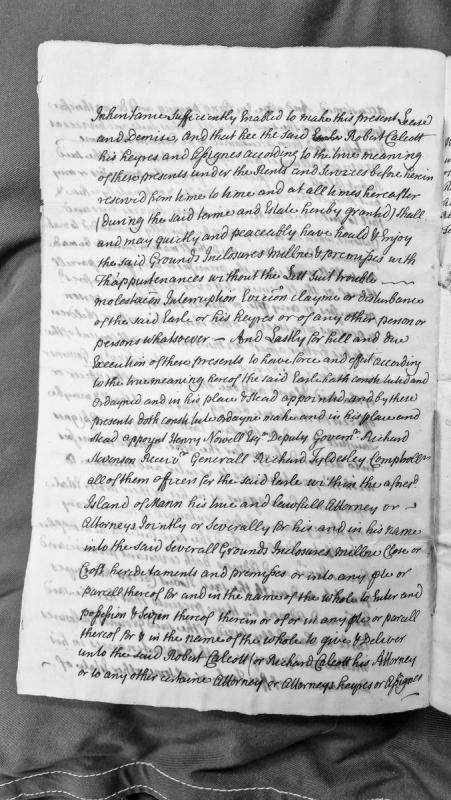
A legal lease document transferring grounds, enclosures, a mill and premises to Robert Calcott, with warranty against disturbance and appointment of attorneys for possession and seizin. The document appears to be part of a larger conveyance, with the Earl as grantor appointing officers as his legal representatives.
Two related administrative documents from the Atholl Papers concerning the lease of the Governor's house on the Isle of Man. The first (November 1769) is a rent assessment by appointed valuers Thomas Moore and Samuel Wattleworth, setting the annual rent at 24 pounds Manx currency. The second (June 1770) is a letter from the Duke of Atholl granting approval for repairs (£81 4s 6d) and offering a lease during the Governor's tenure. Relevant to governance structures, post-Revestment administrative relations, and the Duke's retained interests in Manx properties.
Two documents relating to the lease and maintenance of Governor John Wood's residence on the Isle of Man. The first (23 Nov 1769) is an arbitrated valuation by Thomas Moore and Samuel Wattleworth of a reasonable yearly rent (£24 manx) for the Governor's lands and recommendation for house repairs. The second (9 June 1770) is a letter from the Duke of Atholl granting consent to repairs (£81 4s 6d) and offering a lease during Wood's governorship with compensation provisions. Provides insight into post-Revestment governance arrangements and the Duke's property interests.
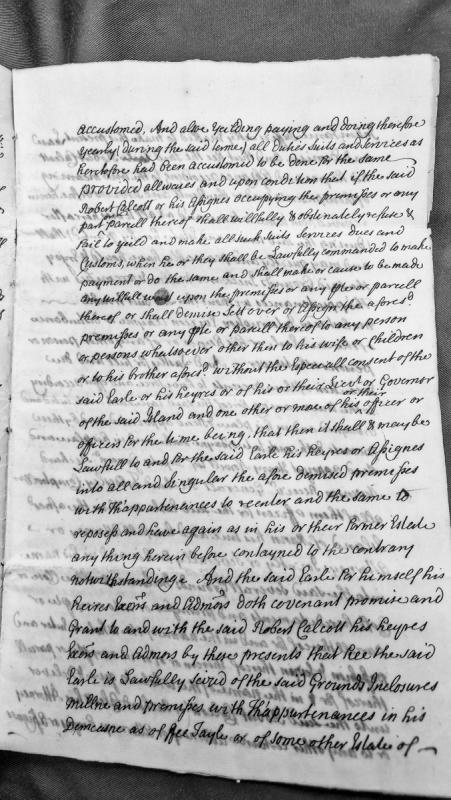
This is an excerpt from a lease or property grant document establishing the terms under which Robert Calcott may occupy and use certain premises including grounds, enclosures, and a mill. The document outlines required duties, suits, services, and customs to be performed, conditions for forfeiture including wilful waste or unauthorized assignment, and the Earl's covenant regarding lawful seizin of the property.
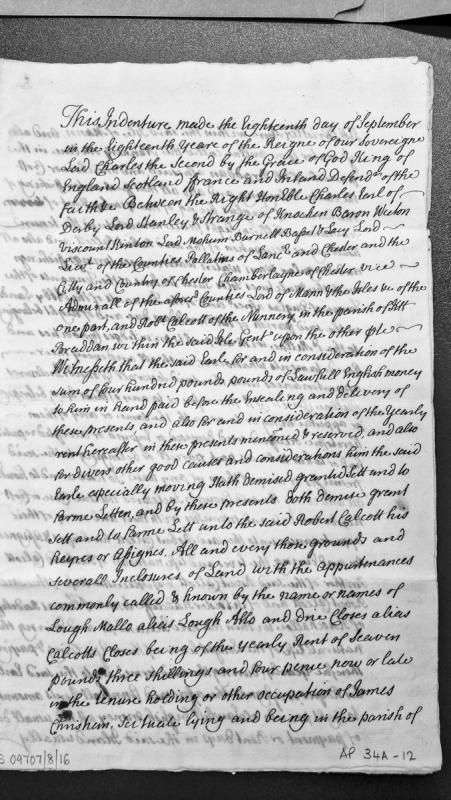
An indenture dated 18 September 1666 between Charles, Earl of Derby (Lord of Mann and the Isles) and Robert Calcott of the Nunnery parish, Kitt Braddan. The Earl leases to Calcott lands known as Lough Mallo and Drie Closes (Calcotts Closes) in exchange for £400 and an annual rent of £7 3s 4d. The document specifies terms of the lease and identifies the previous tenant as James Chrishem.