Letter from John Wood (likely Governor of Isle of Man) to the Treasury dated 27 June 1770, protesting that Revenue Officers issued orders to Civil and Military officers without gubernatorial authority or knowledge. Wood notes receipt of duplicate letters regarding potential plague vessels and raises constitutional concerns about the Treasury's direct exercise of power over island officials.
Letter from John Wood, Governor of the Isle of Man, to the Board of Customs acknowledging receipt of their letter of 23 May 1765 and confirming his readiness to execute orders. Wood notes he awaits formal directions from the Crown and the Duke of Atholl regarding necessary measures. This correspondence dates to the critical transition period immediately after the Revestment Act (1765) and reveals the administrative uncertainty during implementation.
Interned at Knockaloe camp near Peel from September 1915 for three and a half years. He developed what he called 'Contrology' during his internment, using springs from camp hospital beds to build his early equipment. Millions practise Pilates worldwide. How many know it was developed on the Isle of Man?
A historical essay on the Dublin banker Richard McGwire and Liverpool merchant Josiah Poole, who farmed the Isle of Man customs from 1720 and became major operators in the contraband trade. Covers their customs lease, smuggling operations in tobacco, spirits, wine, and East India goods, disputes with Crown officers, and McGwire's death in 1727. Directly relevant to understanding the commercial interests and illicit trade networks that preceded the 1765 Revestment.
A detailed historical narrative of the customs farming activities of Richard McGwire (Dublin banker) and Josiah Poole (Liverpool merchant) on the Isle of Man from 1720 onwards. The article documents their smuggling operations in tobacco, spirits, wine, and East India goods, their recruitment of customs collectors and officers, the exposure of their activities by Joshua Robinson, McGwire's death in 1727, and the broader context of the running trade that eventually prompted the 1765 Revestment. Directly relevant to understanding the economic and operational foundations of Manx smuggling before Parliamentary intervention.
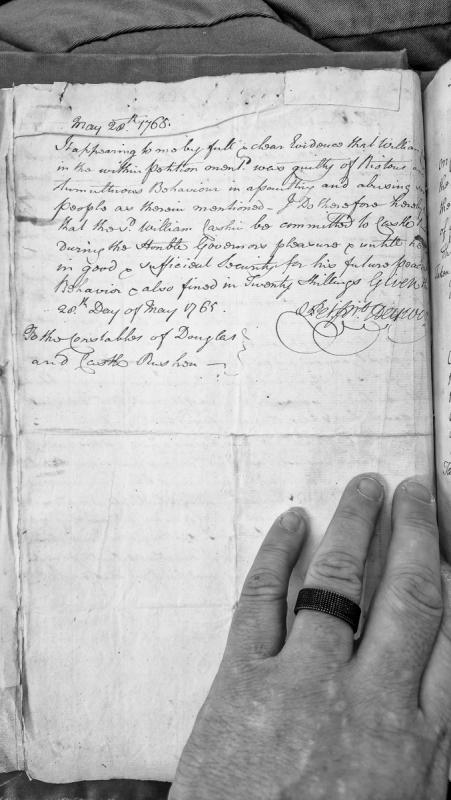
A judicial order dated May 28, 1765, committing William Cashin to Castle Rushen for riotous and tumultuous behaviour involving assault and abuse. The order imposes imprisonment at the Governor's pleasure, requires security for future good behaviour, and levies a fine of twenty shillings.
Charles Lutwidge reports to the Treasury Lords that the Keys of the Isle of Man have enacted statutes at Castletown, including one on licensing spirituous liquors, which may affect royal revenue. Written in September 1774, this is the first legislative exercise by the Keys since the 1765 Revestment. Lutwidge notes the absence of an Attorney General and urges that authentic copies be obtained before royal assent is granted.
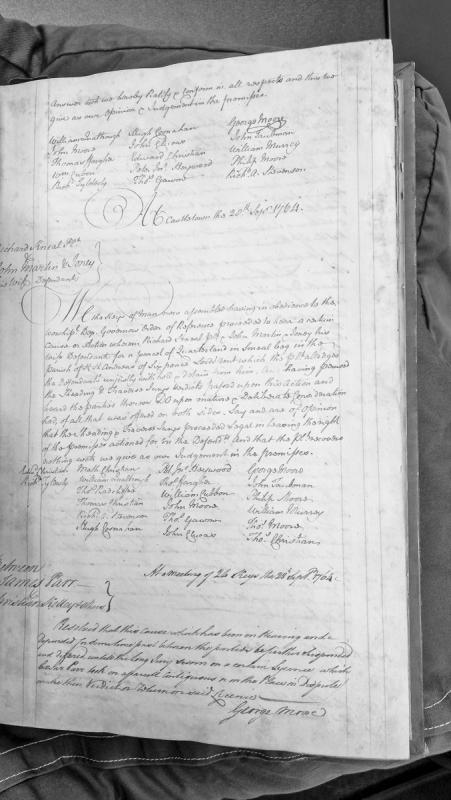
A House of Keys judgment dated 20 September 1764 concerning a dispute over a parcel of quarterland in Kneal beg, Kirk Andreas parish, with six pence lord rent. The Keys upheld the verdict of the Sheading and Traverse Juries in favour of the defendants, denying the plaintiff's claim. The document also includes a subsequent resolution from 28 September 1764 to suspend another case between James Parr and Christian Kelley pending a jury verdict on a disputed licence.
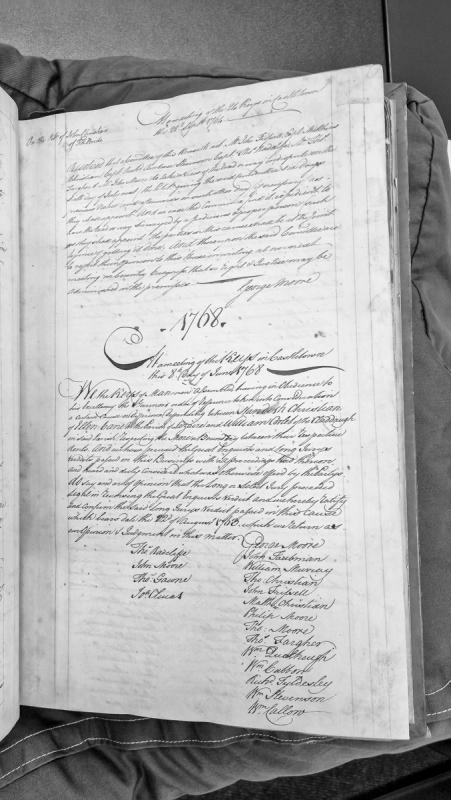
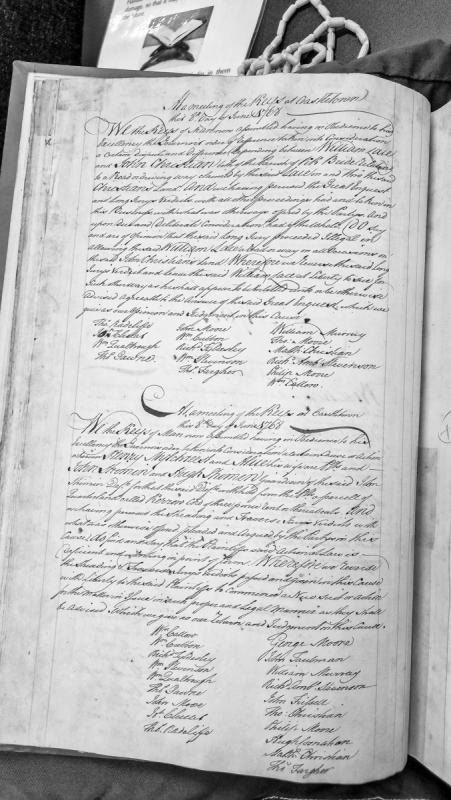
A judgment delivered by the Keys of Man at Castletown ratifying a Long Jury verdict from August 1765 concerning a boundary dispute between Mondus Christian of Ellen Vane and William Corlet of the Claddagh, both in the Parish of Bride. The Keys confirmed the Long Jury's reversal of the Great Inquest's original verdict.
A House of Keys judgment from Castletown reversing lower jury verdicts in a land dispute between Henry Mitchell and his wife (plaintiffs) against John Shimmin and Hugh Shimmin (defendants) concerning a parcel of land called Kerrow. The Keys found the plaintiffs' action deficient in form and granted them liberty to commence a new suit in proper legal manner.
The House of Keys passed a formal resolution opposing the sale of the Island. The signatories — the elected representatives of the Manx people — recorded their opposition 'as much as in them lies.' They sent Hugh Cosnahan to London to deliver the petition. Parliament received it and ignored it.
The House of Keys passed a formal resolution opposing the sale of the Island. The signatories recorded their opposition 'as much as in them lies.' Hugh Cosnahan carried the deputation to London. George Quayle would later write that they had 'silenced the neighbours but could not silence me.' Parliament received the petition and ignored it.
King of England and Scotland (James VI of Scotland). His reign saw the consolidation of Crown interest in the Isle of Man and the formal assertion of overlordship.
A charter issued by King John of England placing Reginald, King of Mann, under royal protection. The document guarantees Reginald's safety and that of his lands and people, forbidding any harm to them. Relevant to understanding early medieval Manx sovereignty and the island's relationship with the English Crown, providing constitutional and political context predating the 1765 Revestment.
A royal charter in which King John of England takes Reginald, King of Mann, under his protection, defence, and custody, extending protection to all his lands and people. This is a foundational document for understanding the feudal relationship between the English Crown and the Kings of Mann in the medieval period, establishing the protectorate model that would evolve through subsequent centuries leading to the 1765 Revestment.
A royal letter patent from King John of England protecting the King of Mann and his possessions from incursion by Irish mariners. This early 13th-century document demonstrates English Crown assertion of authority over Mann and establishes a precedent for protective sovereignty. It is relevant to understanding the constitutional relationship between England and Mann in the pre-Revestment period.
A royal writ from King John of England protecting the territory and possessions of the King of Mann from unauthorized entry by English mariners and Irish ships. The document establishes early English royal recognition and protective authority over Mann, predating the Revestment by over 550 years. It is transcribed from Rotuli Litterarum Patentium and appears in the Manx Society's Monumenta de Insula Manniae collection.
Norse King of Mann who invited Savignac monks to cross from Furness Abbey and found Rushen Abbey in 1134. His patronage of the monastery established the most powerful religious institution on the Island.
Godred Crovan sailed to the Isle of Man in 1079. He was Norse-Gaelic, a survivor of Stamford Bridge, and he came by sea.
The Manx people named the Milky Way after him — Raad Mooar Ree Gorree, the Great Road of King Orry, the path his ships followed across the night sky.
On a clear night, go outside and find the Milky Way. You’re looking at the same sky Godred’s sailors navigated by nearly a thousand years ago.
Bring a blanket. Bring a flask of something warm. Bring the story of how a man who lost at Stamford Bridge won a kingdom in the Irish Sea.
Parish church on the northern plain. Home of Thorwald's Cross, which carries Odin being devoured by the wolf Fenrir on one face and Christ triumphant on the other — two religions on the same slab, the accommodation made literal in stone. The church also contains the only zodiac rose window in a British church outside Balsham, Cambridgeshire — a pre-Christian arrangement permitted by the diocese. Built on a keeill site dedicated to Columba.