Water-Bailiff at Peel. Held court in his own house every Saturday. His deputies were paid from his own pocket. The total court fees amounted to less than four pounds a year. This was the Island's maritime jurisdiction — wrecks, fishing disputes, harbour matters — administered from a man's front room, at his own expense. When the Commissioners examined him in 1792, they were documenting a judicial system that worked not because it was funded but because the people who ran it considered it their duty.
Presided at Tynwald in 1945 — the first Lord of Mann to stand on Tynwald Hill since the Duke of Atholl's last appearance in 1736. Two hundred and nine years without a Lord of Mann presiding over the parliament they held authority over. Two centuries. George VI broke the silence.
English visitor who arrived on the Island around 1720. His Description of the Isle of Man became one of the most detailed accounts of Manx life in the early eighteenth century. A careful observer who documented the completeness with which Manx people inhabited the commercial world and the spirit world simultaneously. He recorded the moddey dhoo at Peel Castle — the garrison soldiers adjusting their language for a ghost — and noted that Manx people 'would be even refractory' to their clergy if they tried to preach against fairies.
Personal letter from George Washington to Burwell Bassett discussing agricultural conditions in Virginia during the drought of 1765, recent burgess elections in which Washington was elected for Fairfax County, and Governor Fauquier's prorogation of the Virginia Assembly. Provides contemporary perspective on colonial electoral politics and the political climate following the Stamp Act crisis.
Man of Ballasalla accused of counterfeiting Manx copper pence in 1723. Thomas Tubman the Coroner discovered the counterfeits. Wilks admitted making a penny 'to try the mettal.' The Grand Jury acquitted to avoid sending a neighbour to his death. The Keys found the proceedings illegal. Governor Lloyd reduced the fines. The case demonstrated every layer of the Manx constitution functioning: Coroner, petty jury, Grand Jury, Keys exercising judicial review, and Governor tempering justice with mercy.
German archaeologist interned on the Isle of Man as an enemy alien during the Second World War. After his release, he excavated Viking graves on the Island — contributing to Manx history while having been held prisoner on Manx soil. The man who was imprisoned on the Island ended up illuminating its past.
21 November 1918. HMS King Orry, a Manx Steam Packet vessel serving as an Armed Boarding Vessel, was given the place of honour as sole representative at the surrender of the German fleet at Scapa Flow. Admiral Beatty awarded the Manx vessel this distinction.
Royal letters of presentation from Edward I gifting ecclesiastical benefices in the Isle of Man to Alan of Wygeton (church of St. Carber) and Odo the clerk (church of St. Santan) in 1291, asserting the King's authority over vacant churches by reason of the land being in royal hands. Demonstrates early English Crown sovereignty claims over Manx ecclesiastical appointments.
Two letters patent issued by Edward I granting presentations to vacant churches in the Isle of Man (St. Carber and St. Santan), exercised on the basis of royal custody of the island. These documents establish the Crown's medieval ecclesiastical patronage rights over Manx benefices and are part of the Monumenta de Insula Manniae collection, a key primary source series for Manx history.
A royal writ from King John directing payment of thirty marks from the English treasury to the King of Mann as a gift. This early 13th-century document demonstrates the feudal relationship between the English Crown and Mann, and provides context for understanding the island's constitutional status prior to the later Atholl period and 1765 Revestment.
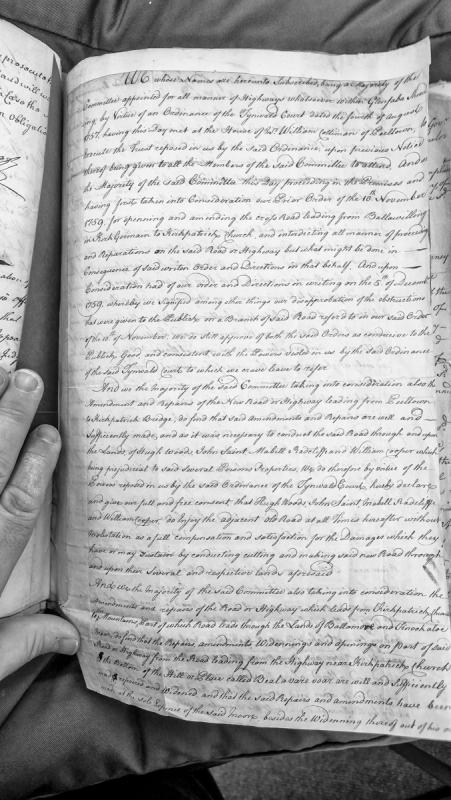
A formal order from the majority of the Highway Committee for Glenfaba Sheading, appointed under a 1757 Tynwald Court ordinance, approving previous orders regarding road maintenance and new road construction from Peeltown to Kirkpatrick Bridge. The committee grants consent for adjacent landowners (Hugh Woods, John Saint, Mabell Radcliffe, and William Cooper) to use the old road as compensation for damage caused by the new road's construction through their lands.
A scholarly glossary defining ecclesiastical and temporal terms found in medieval and early modern Manx documents, charters, and historical records. Provides Latin and Anglo-Norman terminology for feast days, liturgical seasons, and calendar conventions used in administrative and legal documents relevant to Manx history. Essential reference for interpreting dated clauses and temporal references in period documents related to the Revestment era.
Norse king who conquered Mann in 1079 after two failed attempts, establishing the dynasty that would rule the sea kingdom of Mann and the Isles. His settlement divided the island between the existing Manx population and his Norse followers, creating the accommodation between cultures that defined Mann for two centuries.
Administrative letter from Governor Basil Cochrane to the Duke of Atholl reporting on Isle of Man governance matters including clergy appointments, brass coinage, naturalization papers, harbour plans, and financial arrangements. Reflects the Duke's direct administrative authority over the island prior to the 1765 Revestment.
Report from Governor Basil Cochrane to the Duke of Atholl concerning ecclesiastical revenue recovery (£2658:93.75 for the clergy), audit transmission, and a legal dispute over the herring fishing trade to the West Indies. Cochrane seeks confirmation that the Isle of Man may export herrings to His Majesty's Plantations despite an obscure Restoration-era Parliamentary act.
An order from the Governor and Council of the Isle of Man declining to interfere with the House of Keys' proceedings without the explicit approval of the Lord of the Isle (the Duke of Atholl). Dated 28 January 1765, this document reflects the constitutional tensions and procedural protocols during the period preceding the 1765 Revestment, showing deference to the Duke's authority and the limitations placed on the Governor's independent action.
An official order from the Governor and Council of the Isle of Man (28 January 1765) responding to Speaker George Moore's request to convene the House of Keys during a period of constitutional uncertainty. The order defers to the Lord of the Isle (Duke of Atholl) before permitting Keys proceedings, reflecting the pre-Revestment constitutional hierarchy and the Governor's subordination to the Duke's authority.
Report from Governor Basil Cochrane to the Duke of Atholl regarding Island trade, merchant sentiment, remittance procedures, administrative appointments, and proposed reforms to customs and revenue collection. Discusses the merchants' relief that the Island was not sold, trade recovery, coin design (ducal bust vs. crest), and staffing of revenue offices to prevent confusion in water bailiff and customs duties.
Report from Governor Basil Cochrane to the Duke of Atholl detailing financial remittances to Liverpool, arrival of merchant ships carrying rum, a legal dispute between native Manx and foreign merchants regarding debt priority, and recommendations for naturalizing foreign merchants to encourage trade. The letter illustrates the commercial importance of foreign traders and tensions between native and settler merchant communities in mid-18th century Isle of Man.
Letter from Governor Basil Cochrane to the Duke of Atholl reporting on negotiations for the sale of tithes, the management of parish lands, and administrative disputes. Discusses resistance from Lord Derby to reasonable annuity terms, Cochrane's strategy for gradual parish sales, and a court incident with an attorney Stevenson. Reflects pre-Revestment governance challenges and revenue management under ducal sovereignty.
Letter from Governor Basil Cochrane to the Duke of Atholl reporting on money collection for the Duke, clergy accounts, revenue abstracts, and addressing concerns about Roman Catholic naturalization on the Isle of Man. Cochrane defends the naturalization policy as being in the Duke's interest and discusses friction with the Moore family trading interests.
Three letters from Governor Cochrane (and Major Cochrane) to the Duke of Atholl, dated September–November 1758, addressing administrative matters on the Isle of Man, delegation of duties to Deemster Taubman and the Receiver General, correspondence with Mr Hamersley concerning law-related matters, and personal health updates. Demonstrates governance structure and correspondence between the Atholl-appointed governor and his patron.