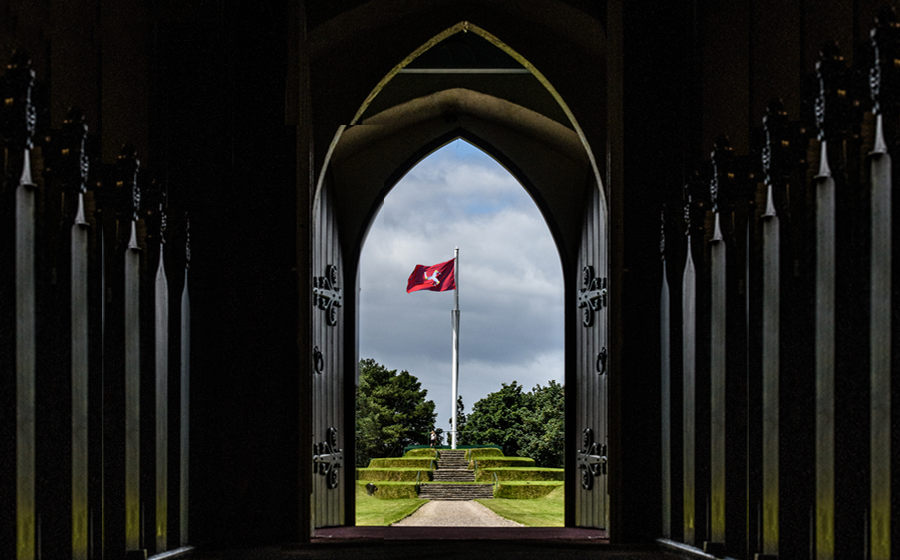
Savignac (later Cistercian) monastery in Lancashire from which monks crossed to found Rushen Abbey on the Isle of Man in 1134, at the invitation of King Olaf. The mother house of Manx monasticism.
A certificate issued by royal commissioners (Robert Suthwell, James Layborne, Thomas Holcrofte, and John Ashton) surveying the lands and revenues of Furness Abbey following the Dissolution of the Monasteries. The document specifically lists ecclesiastical and temporal holdings in the Isle of Man, including Rouat wathe (valued at 12d. annually) and the parsonages of St Mahold and St Michael (let at farm for £6 13s. 4d. yearly). Relevant to understanding pre-Revestment Manx governance, church property, and historical land tenure.
Letter from G. Nicolson to Mr. Bowes reporting on attempts by Islanders (Manx) to land in Scotland, with intelligence that they were deterred by defensive preparations. Dated 1 August 1595 (37 Eliz). Originally from State Paper Office, Scotland. Provides evidence of 16th-century Isle of Man activity and cross-border tensions.
A 16th-century historical narrative tracing the legendary and actual rulers of the Isle of Man, from the mythical Mananan mac Leirе through the Stanley dynasty. The text combines folklore (Mananan's necromancy, St Patrick's conversion) with dynastic history, documenting succession through Scandinavian, Scottish, English, and Stanley periods. Provides genealogical context essential for understanding pre-Revestment sovereignty claims.
A 1595 state paper from the Scottish State Paper Office reporting on military intelligence regarding a threat of invasion from Islesmen (likely MacDonald forces from the Hebrides) against Scottish territory and the Isle of Man. The letter discusses the positioning of a 4,000-strong army near Mull of Buntyre and warns of planned attacks on the Isle of Man before potential raids on Ireland. It reflects 16th-century geopolitical tensions in the Irish Sea and northern Atlantic regions.
A letter from George Ackroyd Erskine to George Nicolson dated 25 July 1595 reporting intelligence of a military force of 4,000+ men threatening invasion of the Isle of Man and Scotland from the sea. The writer warns that the force may first attack Man before proceeding to Ireland to seek aid from the Earl of O'Neill. The letter requests urgent notification to the Lord Warden and border officials to dispatch ships for the defence of the island, emphasizing the strategic importance of Man and the threat posed by hostile forces allied with enemies of the English Crown.
George Borrow, travelling in 1855, met a woman whose son lived in an Ohio village where the Manx language was spoken. The encounter, recorded decades after the first emigration ships sailed, confirmed that the language the emigrants carried across the Atlantic was still alive in the American settlements — at a time when institutional support for Manx on the island itself was continuing to erode.
Son of Illiam Dhone. After his father's execution, George appealed to the Privy Council and sent coded letters to a contact at the Three Anchors tavern in Milk Street, London. Derby sent a man named Roper to the same tavern, pretending to carry messages from George, to find out who was helping the Christian family's appeal. George produced accounts showing the substantial accuracy of his father's stewardship of the sequestrated bishopric funds. The Privy Council eventually intervened — ordering restitution of the Christian estates, committing the Deemsters to King's Bench prison, and restoring Edward Christian to his judicial office.
First Lord of the Treasury from April 1763. Inherited a post-war fiscal crisis — the Seven Years' War had nearly doubled the national debt. Methodical where predecessors had been indifferent, systematic where they had been opportunistic. He found revenue in two places: the American colonies and the Isle of Man. The Stamp Act and the Revestment Act were conceived as parts of a single fiscal strategy. The Duke of York listed 'the proposing the American Tax, and the purchase of the Isle of Man' as twin achievements. Grenville's diary entry: 'Mr. Grenville was able to go to the House of Commons upon the business concerning the purchase of the Isle of Man, in which he met with universal approbation.' One line. Universal approbation for the purchase of a kingdom.
Letter from George Grenville (First Lord of the Treasury) to the Duke of Atholl acknowledging receipt of correspondence regarding the Isle of Man settlement and promising to present the Duke's letter to the Treasury Board at their next meeting. Grenville expresses willingness to help settle 'this important business' in accordance with Parliamentary intention and in a manner agreeable to both the Duke and the public interest.
A letter from George Grenville (First Lord of the Treasury) to the Duke of Atholl dated 2 September 1764, acknowledging receipt of the Duke's letter of 20 August and promising to transmit the Duke's letter to the Treasury Commissioners at their next meeting. Grenville expresses willingness to help settle 'this important business' in accordance with Parliament's intention and to the Duke's satisfaction. This is a crucial document in the pre-Revestment negotiations.
King of Great Britain and Lord of Mann from 1765 to 1820. Fifty-five years as Lord of Mann. He never visited the Island. The Revestment was done in his name, with his Royal Assent, and he never saw the place whose sovereignty he had purchased for seventy thousand pounds. His response to Grenville's papers: 'The proposal of the Duke and Duchess of Athol seems modest; I return the papers signed.' Seven words on the price. Nothing on the principle. Nothing on the people. The fate of the Island was settled in a sick-note. George came from a dynasty selected by Parliament — the Hanoverians, whose experience of sovereignty was Imperial and German, not English. They had no framework for understanding what the lordship of Mann was.
King of the United Kingdom and Lord of Mann. He never visited the Isle of Man. His reign continued the pattern of Crown indifference that followed Revestment — the lord ruled but did not come.
Merchant, landowner, and the most documented private individual in eighteenth-century Mann. His Letter Books, preserved at Bridge House and now in the Manx Museum, provide the richest surviving account of Manx commercial and social life before the Revestment. Moore traded across the Irish Sea, built roads at his own expense, and recorded everything.
A biographical and historical study of George Moore (1709–1787), a prominent Peel merchant and Speaker of the Keys, examining his commercial ventures in the contraband trade, his family life, and his political role during and after the 1765 Revestment. Based on Moore's personal letter books held in the Manx Museum, this retiring presidential address illuminates merchant life, smuggling economics, and the political tensions surrounding Manx independence.
A scholarly article by David Craine examining the life and business activities of George Moore (1709–1787), a prominent Peel merchant and Speaker of the Keys during and after the 1765 Revestment. Based on Moore's letter books held in the Manx Museum, the paper explores his involvement in the smuggling trade, his transatlantic commercial ventures, his role in Manx political affairs, and his complex relationship with Bishop Wilson's anti-contraband stance.
Official correspondence warning of a potential Highland incursion against the Isle of Man, addressed to a Scottish official. The document comes from the State Paper Office, Scotland, and reflects 16th-century security concerns regarding the island. While predating the 1765 Revestment by 170 years, it provides historical context on external threats to Manx governance and authority.
A brief administrative letter from George Nicolson to Mr. Bowes dated 8 May 1595, reporting intelligence that Highland forces intend a surprise attack or incursion against the Isle of Man. The letter urges vigilance and defensive preparations. This document provides early modern context for external threats to the island's security and governance prior to the Revestment period.
Son of John Quayle (Clerk of the Rolls) and Margaret 'Peggy' Moore (George Moore's daughter). Banker, politician, innovator, and officer in the local militia. He sat in the Keys, became Speaker. Ran Quayle's Bank from Bridge House in Castletown. In 1789, twenty-four years after the Revestment, he built himself an armed yacht — the Peggy — with six small cannon and two stern chasers. He housed her in a purpose-built dock beneath Bridge House with sea gates opening onto the harbour, concealed cupboards, secret doorways, and mechanical alarm bells. After his death in 1835 the sea gates were walled up. The Peggy was found in 1935 — the oldest surviving yacht in the world, entombed, still armed, still rigged, still ready.
Letter from George Quirk, Water Bailiff of the Isle of Man, to James Clarke discussing contemporary political tensions on the island, including disputes between the House of Keys and the Governor over parliamentary procedure, the Gaol Delivery question, and a proposed High Road Bill. References memorials to the Privy Council and House of Commons, and mentions resignation of General Cuming from the Keys.
Letter from George Quirk, Water Bailiff of Isle of Man, to James Clarke (likely a government official) detailing internal political tensions on the island in 1824. Discusses memorials from the House of Keys challenging the Lieutenant Governor's authority, disputes over Gaol Delivery court membership, disagreements on highway legislation, and factional divisions. Written in the post-Revestment era, it illuminates continued constitutional friction between the Manx legislature and British-appointed executive.
A confidential letter from George Quirk (Castletown) to James Clarke reporting on Isle of Man political affairs in 1824, including the House of Keys' petition against the Duke of Atholl, the Petition presentation, governance disputes, proposed legislation (Registry, Highroad, Coroners' Bills), and tensions between the Keys and the Duke's administration. Provides contemporary insight into post-Revestment constitutional friction.
A detailed letter from George Quirk (Castletown) to James Clarke (presumed Home Office official) dated 22 April 1824, discussing tensions between the House of Keys and the Duke of Atholl, the Keys' petition against the Duke, disputes over legislative bills (Registry, Highroad, Jail Delivery), and broader constitutional conflicts. The letter provides insights into post-Revestment governance, local political factionalism, press suppression, and the Keys' growing institutional power.