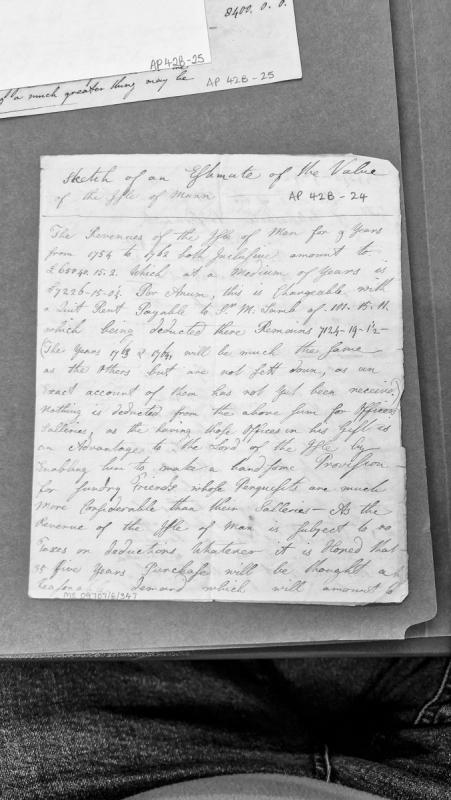
A financial estimate calculating the annual average revenue of the Isle of Man from 1754 to 1762, deducting quit rent payable to Sir M. Lamb, and proposing a valuation based on five years' purchase. The document notes that no deductions are made for officers' salaries as these positions are perquisites of the Lord of the Isle.
Assistant revenue officer at Douglas, paid three pounds Manx per year — the same as his superior Paul Bridson. These were the men responsible for collecting six or seven thousand pounds annually.
Negotiated the Act of Settlement of 1704 — the Manx Magna Carta. One of three members of the Keys sent with Bishop Wilson to Lathom to negotiate with the Lord. The Act confirmed customary estates of inheritance, fixed the fines, and gave Manx people back the right to hold, sell, and pass on land. It had taken a century. It had cost Edward Christian his freedom and Illiam Dhone his life. Sixty years after Edward was imprisoned, forty years after Illiam Dhone was shot, a Christian was still at the table, negotiating for the same thing both of them had fought for.
Testimony by John Quayle, Clerk of the Rolls for the Isle of Man, given before commissioners of inquiry in September 1791. Quayle describes the pre-1765 customs administration, the role of Paul Bridson as Deputy Searcher, the Duke of Atholl's denial in 1764 that he would sell the island, and the procedures for collecting duties on tea, tobacco, brandy, and other commodities. His account provides detailed insight into revenue collection, smuggling activity, and the administrative transition at the 1765 Revestment.
Sworn examination of John Quayle, Clerk of the Rolls in the Isle of Man, taken before a Commissioners of Inquiry in September 1791. Quayle provides detailed testimony on pre-1765 customs administration, the role of Paul Bridson as Deputy Searcher, revenue collection procedures, duties on tea and tobacco, smuggling seizures, and the transition of authority following the 1765 Revestment Act. This document is part of a post-Revestment inquiry into the island's governance and revenue management.
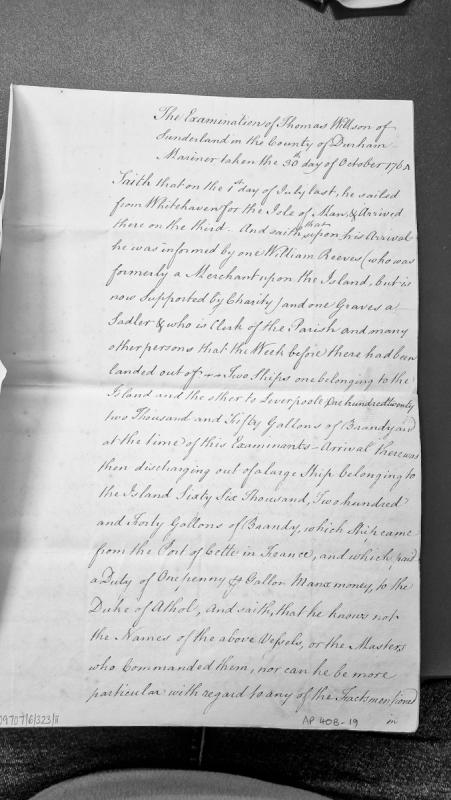
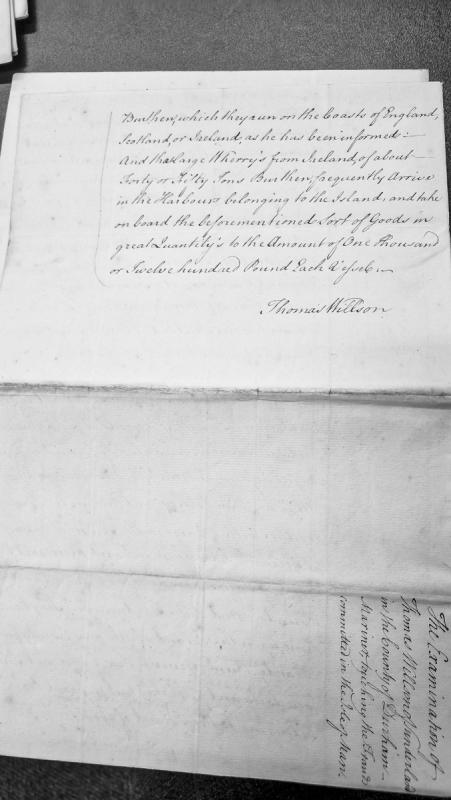
Examination of Thomas Willson, a mariner from Sunderland, concerning the landing of large quantities of brandy on the Isle of Man in July 1764. The document records his testimony about witnessing the discharge of over 188,000 gallons of brandy from multiple vessels, one of which paid duty to the Duke of Athol. This testimony relates to customs and revenue enforcement on the Island.
An endorsement recording the examination of Thomas Willson, a mariner from Sunderland in County Durham, concerning smuggling activities in the Isle of Man. This appears to be a formal legal document related to customs enforcement and illicit trade investigation.
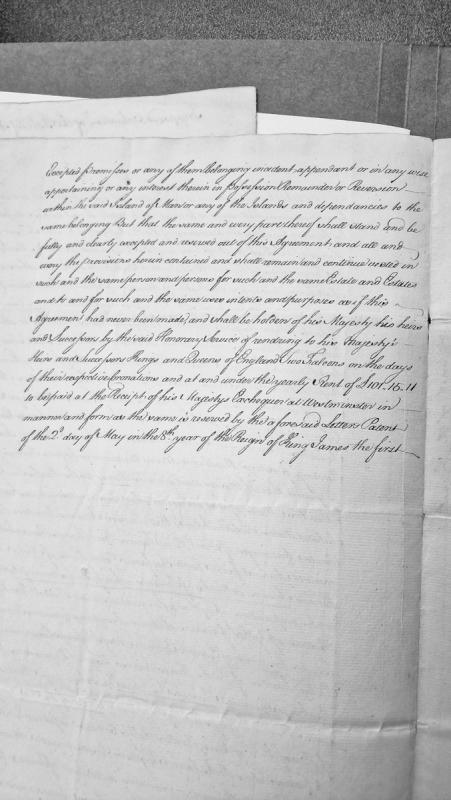
A legal document detailing excepted premises and reserved interests relating to the Isle of Man, referencing the annual rent of £107.15.11 payable to the Exchequer at Westminster and the honorary service of rendering falcons at royal coronations. The text references Letters Patent from 2 May in the 8th year of King James I's reign.
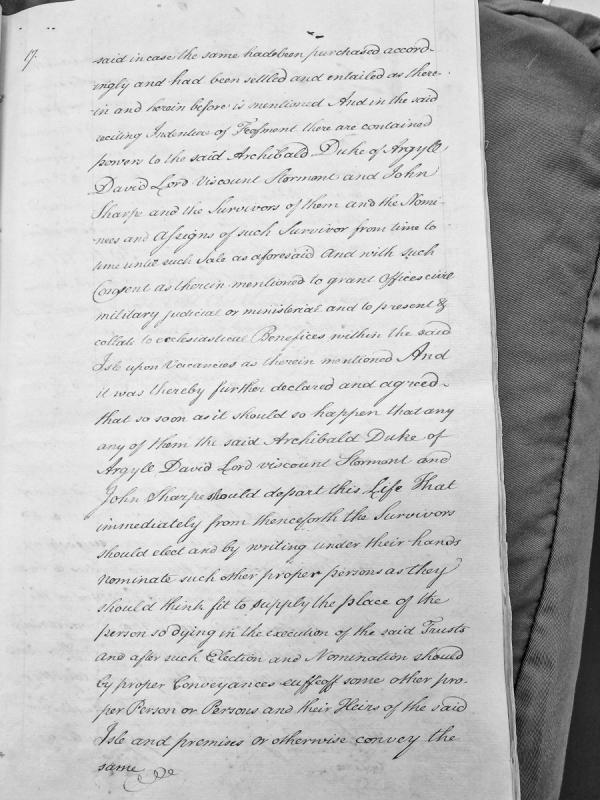
This is an excerpt from a legal document (indenture of feofment) detailing the powers granted to trustees—Archibald Duke of Argyle, David Lord Viscount Stormont, and John Sharpe—regarding the governance and disposition of the Isle of Man. It specifies their authority to grant civil, military, judicial and ministerial offices, present to ecclesiastical benefices, and provisions for succession of trustees upon death.
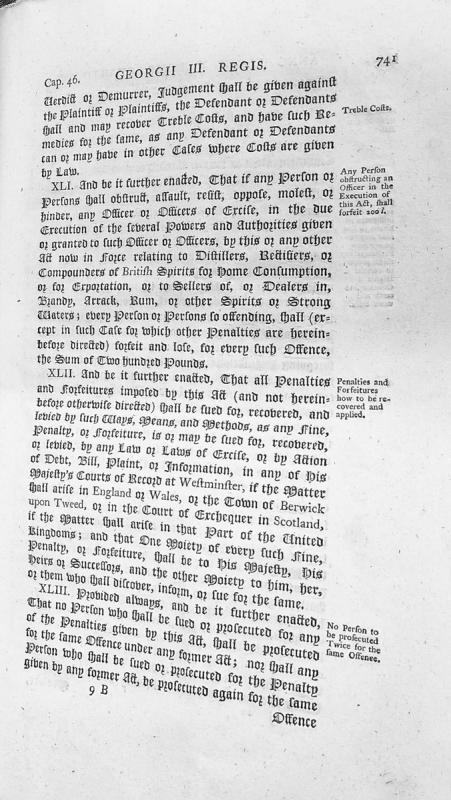
This is a printed excerpt from Chapter 46 of an Act of King George III relating to excise regulations, spirits, and distillation. It sets forth penalties for obstructing excise officers (£200), procedures for recovering penalties and forfeitures, and provisions against double prosecution for the same offence.
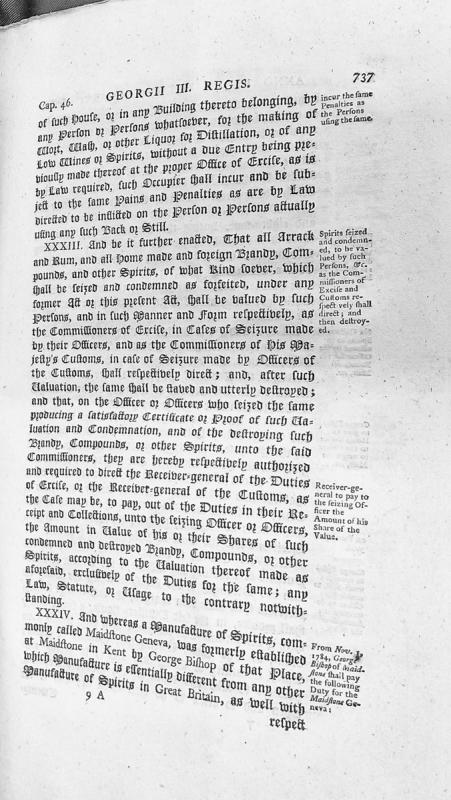
This is an excerpt from a printed Act of Parliament under King George III (Cap. 46, section 737) dealing with excise regulations. It covers provisions for seizing and destroying illicit spirits, valuation procedures for condemned spirits by Excise and Customs commissioners, and compensation procedures for seizing officers. The final section introduces regulations regarding Maidstone Geneva spirits manufactured at Maidstone in Kent.
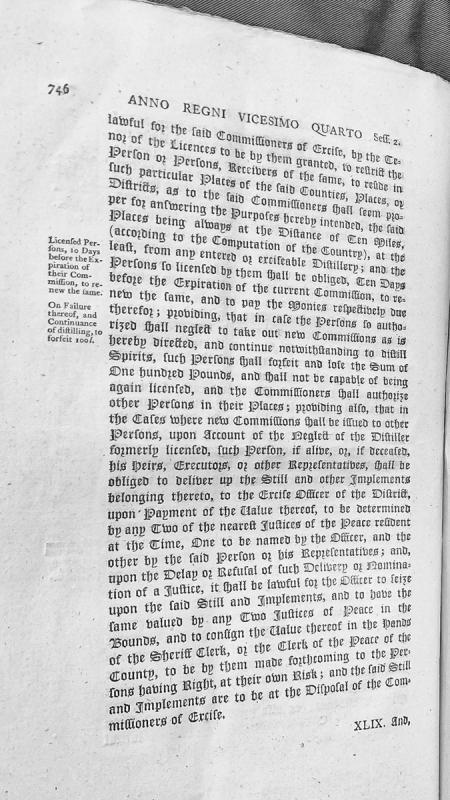
This is an excerpt from legislation (Anno Regni Vicesimo Quarto, Session 2) establishing regulations for Excise Commissioners granting licenses to distillers. It specifies requirements for licensed persons including residential restrictions (10 miles from distilleries), renewal of commissions, penalties for non-compliance (£100 forfeiture), and procedures for seizure and valuation of stills and implements.
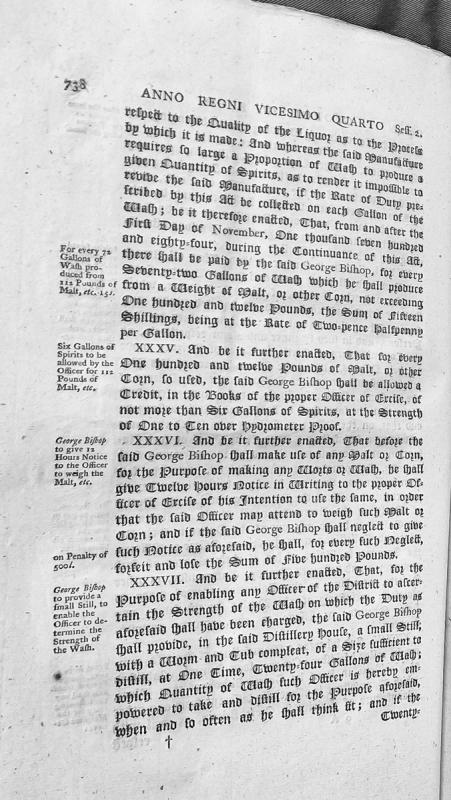
This is an excerpt from an Act of Parliament (regnal year 24) detailing excise duties and regulations for George Bishop's distillery operations on the Isle of Man. The text specifies duty rates on wash production from malt, credit allowances for spirits, notification requirements for excise officers, and equipment specifications for strength testing.
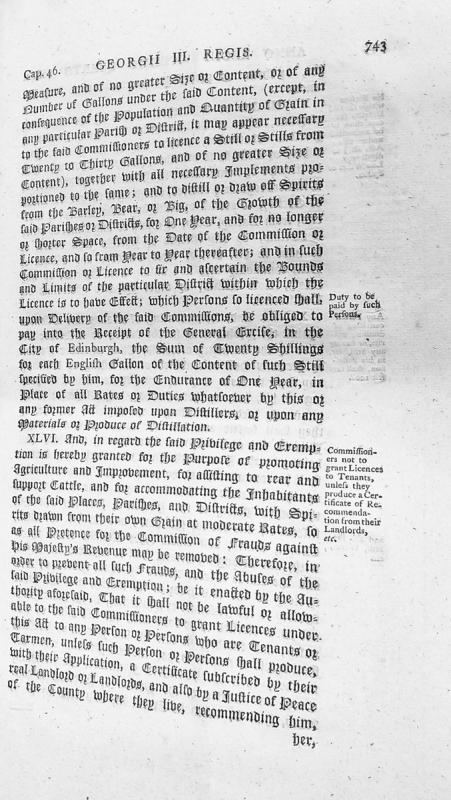
An excerpt from a statute (Cap. 46) under George III concerning licensing of small stills for grain distillation in parishes and districts. The text details regulations for still sizes, duty payments to Edinburgh Excise, and restrictions on tenant licensing requiring landlord certification.
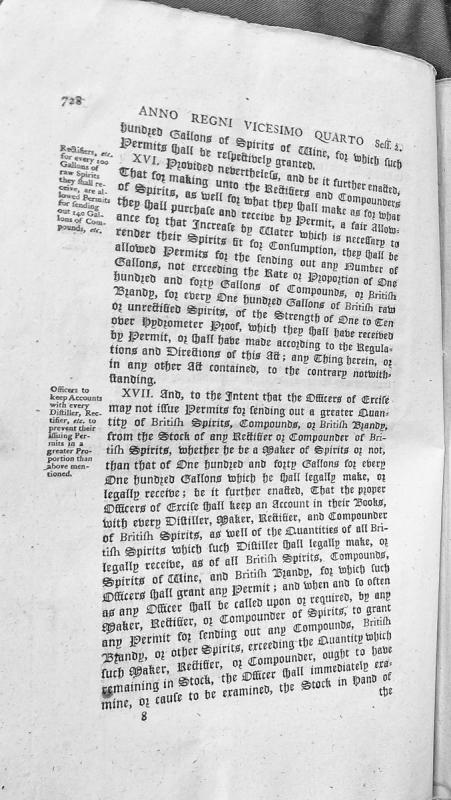
A fragment of legislation (sections XVI and XVII) regulating the excise duties and permit system for rectifiers and compounders of spirits in the 24th regnal year. The text establishes allowances for water dilution in spirit production (140 gallons output per 100 gallons input) and requires excise officers to maintain detailed accounts with spirit makers to prevent over-issuance of permits.
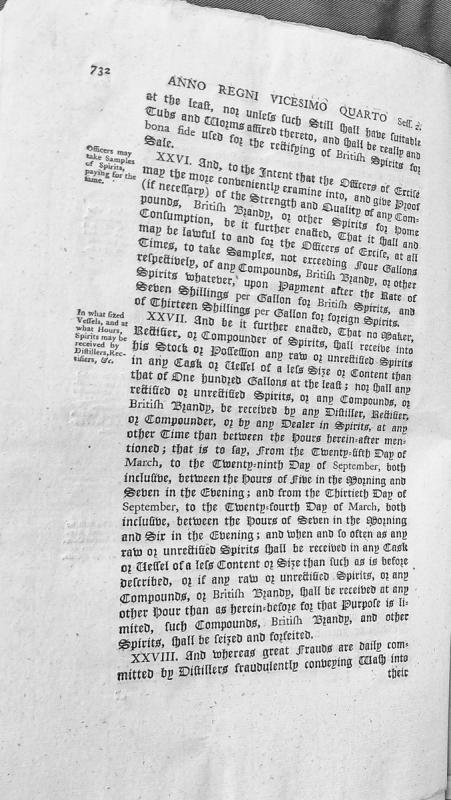
Extract from a printed statutory document outlining excise regulations for the manufacture and handling of spirits in Britain. Details provisions regarding still equipment, sampling procedures for excise officers, vessel sizes for receiving spirits, and hours of operation for distillers and rectifiers.
This is an excerpt from a legislative act regulating the excise duties on spirits in Britain. The document outlines provisions for officers to take stock of spirits, requirements for cask marking and registration, penalties for non-compliance, and procedures for handling spirits during stock-taking operations.
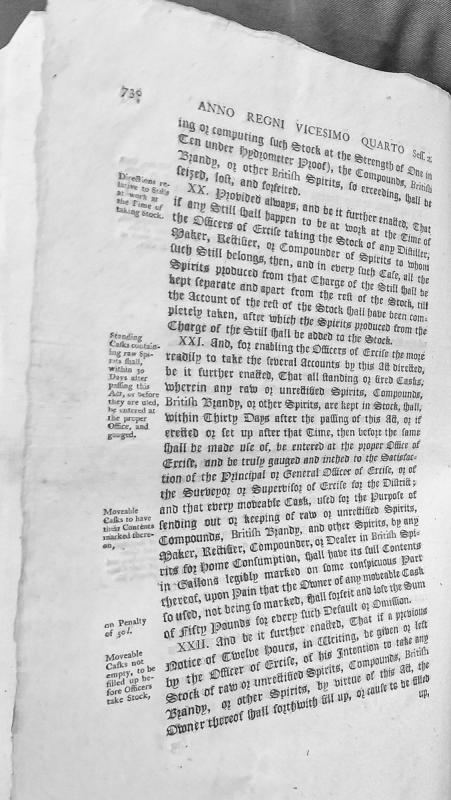
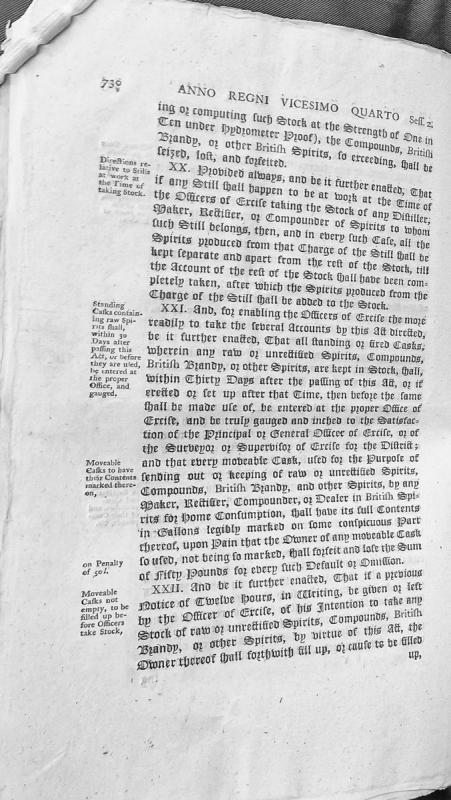
This is an excerpt from legislation (anno regni vicesimo quarto, sessio 2) containing sections XX-XXII detailing excise regulations. It covers procedures for handling spirits when stills are in operation during stock-taking, requirements for entering and gauging standing casks, marking moveable casks with contents, and procedures when officers provide notice before taking stock.
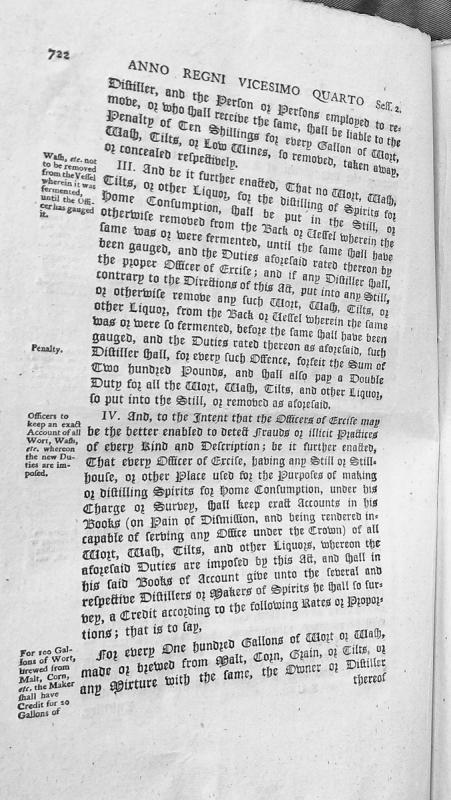
Legislative text (sections III-IV) regulating home spirit distillation on the Isle of Man. Establishes requirements for gauging wort, wash, tilts and low wines before distillation; imposes penalties for unauthorized removal or concealment; mandates record-keeping by excise officers with specified credit ratios for spirit makers.
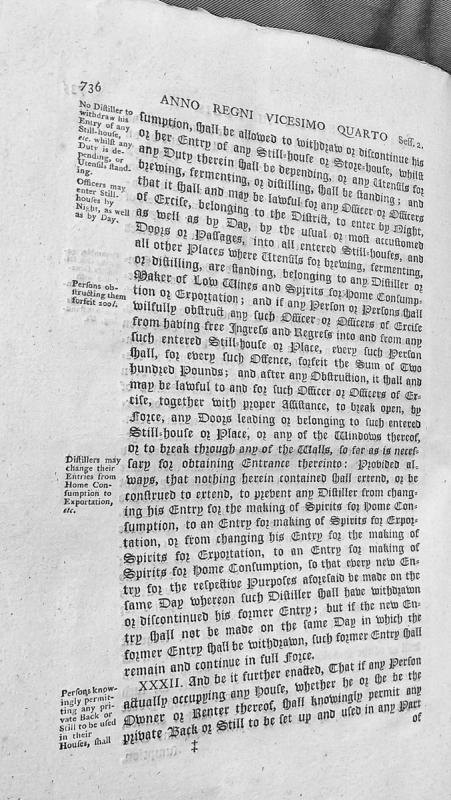
This is a legislative text from the 24th regnal year, second session, containing excise regulations. It details provisions preventing distillers from withdrawing entries while duties are pending, granting excise officers night and day access to still-houses, imposing £200 penalties for obstruction, and outlining procedures for changing entries between home consumption and exportation. The fragment also begins a clause regarding private stills in occupied houses.
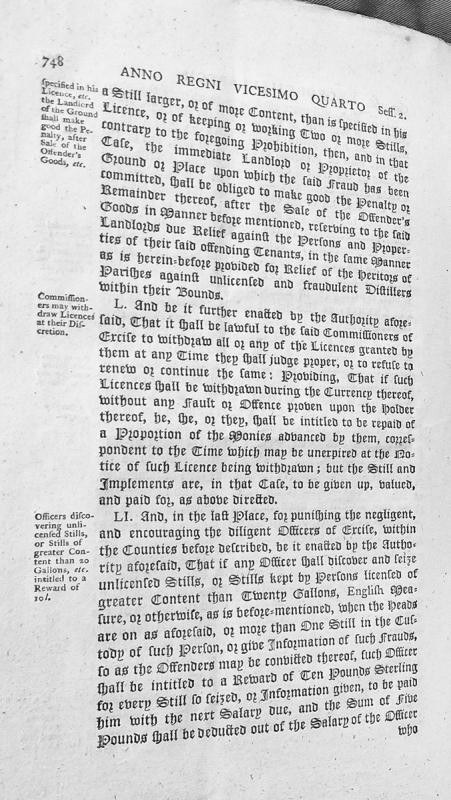
Fragment of legislative text regulating distillery operations, establishing penalties for unauthorized stills, landlord liability for tenant violations, and monetary rewards for excise officers who discover illegal stills. The document appears to be from Scottish or British excise legislation dealing with still licensing and fraud prevention.
William Christian — Illiam Dhone, 'brown-haired William' — was executed at Hango Hill, Castletown. He had surrendered the Island to the Parliamentarians in 1651 to spare the Manx people from siege. After the Restoration, the 8th Earl of Derby had him tried and shot. The parish register of Kirk Malew recorded his death as a martyrdom. The Privy Council later intervened, restoring the Christian estates and disciplining the Deemsters who had convicted him. The Island still mourns him.
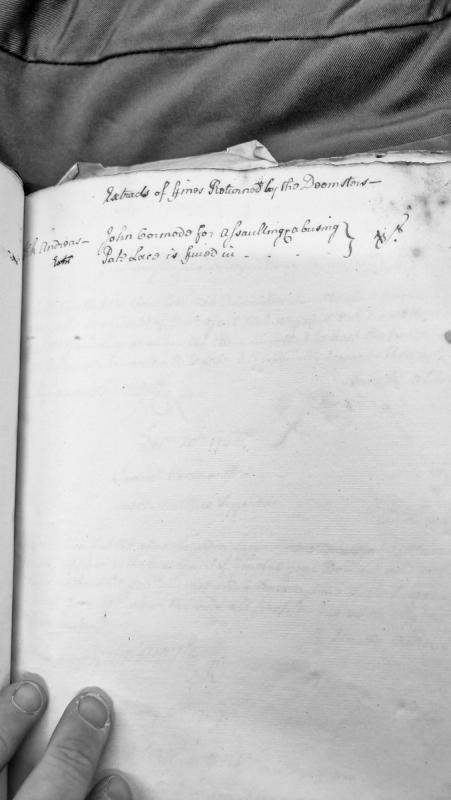
A fragmentary court record documenting fines imposed by Doomsters (judicial officers) for offences including faulting, abusing, and other infractions. The document appears incomplete with partial entries for John Cormode and Pat Lace.
One of the most feared actions of the malevolent fairies was to steal children, especially before baptism. If a child were taken, a decrepit and emaciated fairy would be left in its place. The prettier the child, the greater the risk. Protective measures included laying an iron poker on the child when left alone, tying a red thread around the child's neck, and carrying bread and cheese to give to the first person met on the way to christening. Salt and iron were the most reliable protections. The changeling tradition reflected a world where children were vulnerable and the community had rituals to express and manage that anxiety.
A system of domestic customs designed to maintain good relations with the fairy world. A fire was kept burning in the house through the night so the fairies might come in and enjoy it. Bread was left out for them. Water crocks were filled with clean water before bed, used by the fairies for bathing and thrown out in the morning, never used for any other purpose. Women would not spin on Saturday evenings as this displeased the Mooinjer Veggey. At every baking and churning a small piece of dough and butter was stuck on the wall for fairy consumption. The mountain ash or cuirn, in the form of a cross made without a knife, was placed over the threshold. Yellow flowers growing in a hedge offered protection. These were not quaint survivals. They were practical measures in a world where the fairy folk were neighbours.