King of England who formally renounced royal claims to the Isle of Man and granted the lordship to William Montacute, Earl of Salisbury. This grant established the pattern of feudal lordship separate from the English Crown that would persist for centuries.
Edward III formally recognised Mann as an independent kingdom under William de Montacute, renouncing direct English claims. The Latin text confirmed Mann's separate status — not a territory of the English Crown but a kingdom held under it. This distinction would matter enormously four centuries later when Parliament assumed it could purchase the lordship as though purchasing a piece of England.
Speaker of the old self-elected House of Keys. Resigned in protest at the notion of popular elections and withdrew from public life entirely. His outrage at being made accountable to the people was, in its way, the most eloquent argument for the reform he was protesting.
A biographical entry from Draper's 1864 'House of Stanley' covering Edward Smith-Stanley, 13th Earl of Derby (1775–1851). The text details his parliamentary career (Preston MP 1796–1812, Lancashire knight of the shire 1812–1834), family connections, marriage, children, peerage creation (1832), and major interests in natural history and ecclesiastical patronage. Relevant to understanding the Derby family's position during the Revestment era and the 13th Earl's contemporaneous role in public affairs.
Reigned for 326 days. Never visited the Isle of Man and abdicated. The Manx people named a pier after him — the King Edward VIII Pier at Douglas, opened in May 1936. It is the only public structure in Britain bearing his name. The Island named a pier for a king who never came and never would.
A biographical account of Edward Smith Stanley, 12th Earl of Derby (1752–1834), extracted from Draper's 'The House of Stanley' (1864). Covers his political career, sporting interests (horse-racing, cock-fighting), patronage of charities, marriages, children, and role as lord-lieutenant of Lancashire. Provides context on the Stanley family's prominence and social standing in late-18th and early-19th-century England, relevant to understanding the political background of the 1765 Revestment negotiations.
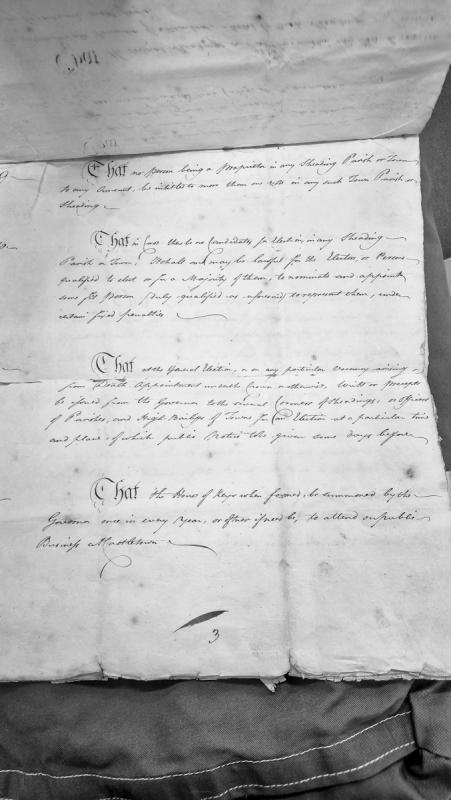
Fragment of electoral regulations establishing voting rights and procedures for House of Keys elections. Stipulates single votes per property owner, nomination procedures for vacancies, issuance of writs for elections, and annual summoning of the House of Keys. Appears to be part of broader electoral or constitutional reform document.
Daughter of Richard Betham, Collector of Customs at Douglas. Born in Glasgow, grew up among sailors and shells. Her father's position brought him into daily contact with every captain who entered the harbour, and Elizabeth had begun assembling a collection of shells that seafarers brought her from their voyages — specimens from the Atlantic, the Caribbean, the Mediterranean. She married William Bligh at Onchan on 4 February 1781.
Presided at Tynwald twice — in 1979 for the Millennium of Tynwald and in 2003. Every visit a day trip. Every Lord of Mann arriving by morning and leaving by evening. No monarch since the Revestment has stayed on the Island the way the Stanleys stayed — living at Castle Rushen, governing from the ground, being buried in the Island's churches. The Stanleys governed. The Crown visits.
The Manx people left. Ohio, Cleveland, Virginia — they carried their language, their constitutional instinct, their identity. Colonel William Christian of Fincastle, Virginia, descended from the same family as Illiam Dhone. The Fincastle Resolutions of 1775 — drafted by Manx-descended Virginians — preceded the Declaration of Independence. John Sayle wrote home from Ohio in Manx Gaelic. The language lived longer in Ohio than it did on the Island.
This transcription file appears to be empty or contains only metadata headers with no actual document content. No substantive text, dates, or identifying information could be extracted.
This transcription file contains no extractable document content. It appears to be either a corrupted file, a blank page, or a transcription error with only metadata headers present.
This transcription appears to contain only metadata headers and formatting but no substantive document content. Unable to extract meaningful information about the source document from the provided text.
This transcription file contains no document content, only metadata headers indicating it was processed through the Manx Museum's automated transcription system. The actual document text is absent.
This is a metadata-only transcription record with no actual document content. The source image reference is provided but the transcription itself contains no text or structured information from a historical manuscript.
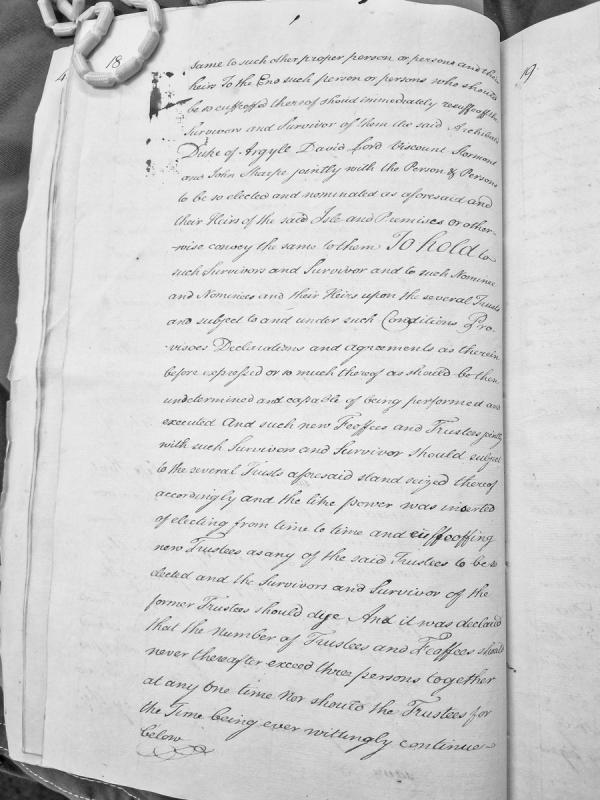
A legal document excerpt detailing provisions for enfeoffment and succession of trustees for Isle of Man property. The text outlines procedures for re-enfeoffment by survivors, nomination of new trustees, and constraints on the number of trustees (not to exceed three at any time).
A comprehensive doctoral thesis examining smuggling as commercial activity, social crime, and policing problem in eighteenth-century England. Covers regional variations (East Anglia, Kent, Sussex, Cornwall), the role of violence, involvement of revenue and military forces, and extends analysis to comparative contexts including the Isle of Man, Channel Islands, France, and Scandinavia. Highly relevant to understanding the smuggling trade that prompted the 1765 Revestment.
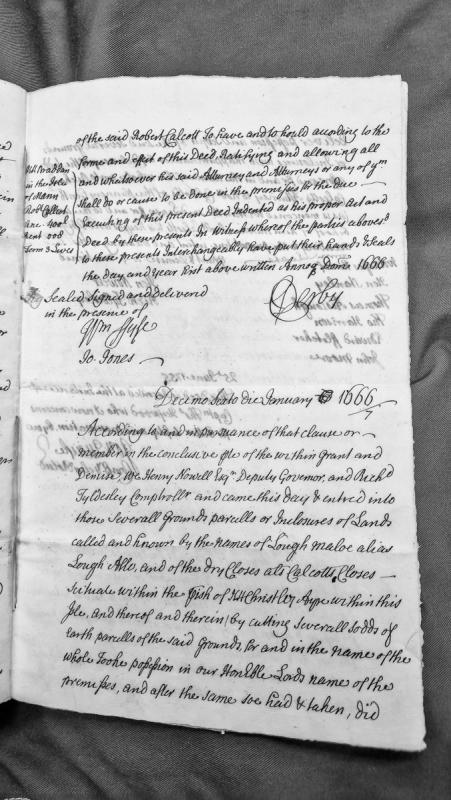
An official record of Henry Nowell (Deputy Governor) and Richard Tyldesley (Comptroller) taking possession of several parcels of land called Lough Maloe, Lough Allo, and the dry Closes/Calcotts Closes in the parish of Christ Ley Ayre. The action was performed by cutting sods of earth as a symbolic act of taking possession on behalf of their Honourable Lord.
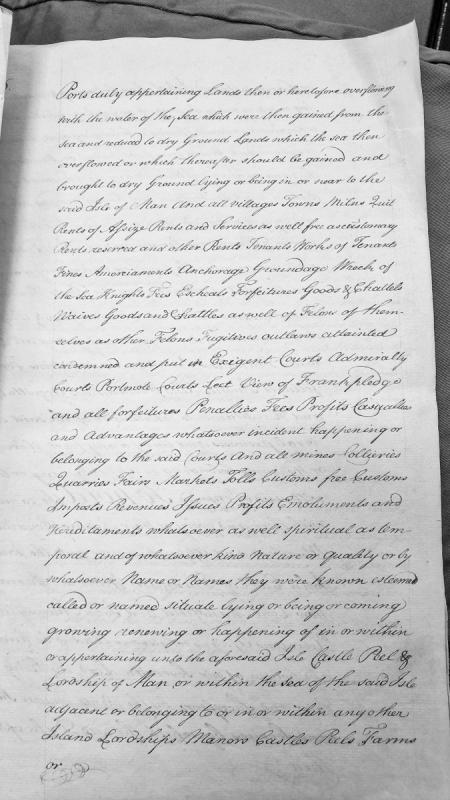
A legal document detailing the comprehensive list of rights, revenues, lands, and jurisdictional powers appertaining to the Isle of Man, including ports, lands reclaimed from the sea, rents, court jurisdictions, and various feudal rights and revenues. The document appears to be part of a larger legal instrument defining the extent of lordship powers and property rights.
An order issued by the Bishop of Man (Derby) in 1691 regarding the administration of funds (£43 19s 10d) deposited for repairs to Peel Cathedral. The order clarifies that no interest is due from the Lord Bishop while funds remain undeployed, and authorizes the Bishop and Governor jointly to invest the money if a secure opportunity arises. Relevant to understanding ecclesiastical governance and financial administration on the Isle of Man in the late 17th century, contextualizing pre-Revestment institutional structures.
Letter from Charles Lutwidge to Grey Cooper at the Treasury (15 June 1770) transmitting an estimate of £155 8s for repairs to Douglas Pier following storm damage in March 1770. Lutwidge requests Treasury approval and proposes a tonnage tax on ships using the harbour to fund repairs. The estimate details costs for mason work, materials, and reconstruction of the lighthouse.
Letter from Charles Lutwidge to Grey Cooper at the Treasury, enclosing an estimate of £155:8:0 for repairs to Douglas Pier damaged by storms in March 1770. Lutwidge requests Treasury approval and proposes a tonnage tax on vessels using the harbour to fund repairs. The document includes itemised repair costs and notes on subsequent harbour damage in 1786.