Parliamentary record from the Rotuli Parliamentorum (21 Ric. II) granting a pardon to the Earl of Warwick, commuting his death sentence to perpetual imprisonment on the Isle of Man. The document outlines the conditions of his exile, his guardianship by Sir William le Scrop and Sir Stephen, and the threat of execution should he escape or seek further grace. Provides historical precedent for the Isle of Man's use as a place of detention and highlights the island's status as outside the English realm.
Letter of counsel from James, 7th Earl of Derby, to his heir regarding ecclesiastical governance of the Isle of Man, including selection of bishops, improvement of the bishopric's revenue, enforcement of clergy residence, and a proposed university. Relevant to understanding the Earl's constitutional authority, revenue interests, and cultural ambitions for the Island.
A chapter from the 7th Earl of Derby's instructions or memoir explaining his rationale for appointing Captain Greenhalgh as governor of the Isle of Man. The text addresses administrative appointments, governance principles, and crowd control strategies. It provides insight into 17th-century Manx governance practices and the Earl's views on authority and management of the Manx population.
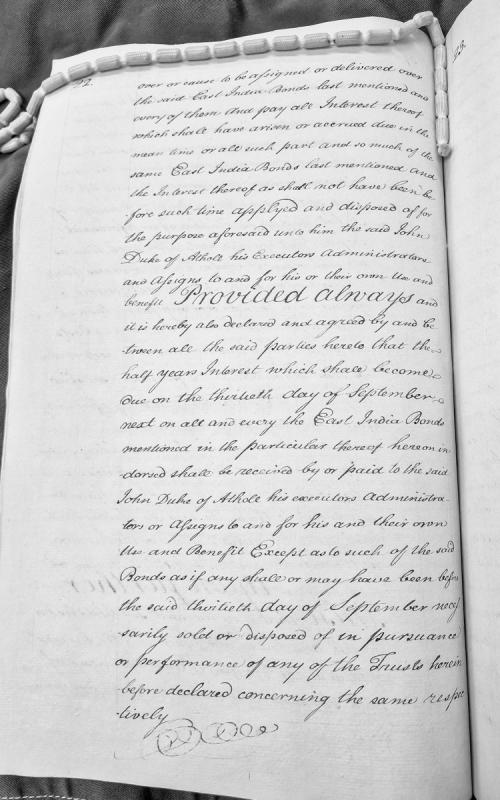
A legal document concerning the assignment and delivery of East India Bonds and accrued interest to John Duke of Athole, with provisions for interest payment due on 30 September and conditions regarding prior disposition of bonds.
The commercial monopoly whose interests drove Parliament to act against the Isle of Man. The Company held the exclusive right to import tea from Asia, protected by Parliamentary tariffs. The Manx running trade offered a route around those tariffs. Research into the 1768–1774 Parliament found 118 MPs held Company stock. Horace Walpole put the figure at a third of the Commons. Grey Cooper told Parliament in 1765 that the Revestment Act was 'principally intended' for the Company's benefit. The Whitehaven merchants' memorial explicitly named the Company's losses alongside Treasury revenue losses. In January 1771, the Keys were consulted about stationing an East India Company regiment on the Island — the Company's own private army garrisoned on Manx soil.
Quantitative analysis of the East India Company's parliamentary lobby during 1763–1813, based on a database of 838 MPs. Examines lobby composition (directors, military/civil servants, stockholders), structural evolution, and voting behaviour across major parliamentary issues including the Regulating Act (1773), Fox and Pitt India Bills (1783–84), and the East India Company Act (1813). Concludes the EIC lobby lacked sufficient unity to prevent restrictive legislation despite significant parliamentary presence.
Quantitative analysis of the East India Company's parliamentary lobby during 1763–1813, examining 838 MPs across four lobby groups by level of involvement (directors, military/civil servants, stockholders, former stockholders). Uses voting records and statistical methods to assess the lobby's composition, evolution, and political influence on key Parliamentary issues including the Regulating Act (1773) and Pitt's India Bill (1784).
The second edition of the East India Company's official register and directory, containing comprehensive listings of Company servants (civil and military) at all presidencies (Bengal, Madras, Bombay), establishments in China, St. Helena, and other locations. Includes administrative structures, regulations on retirement and furlough, casualty records (births, marriages, deaths), and merchant vessel information. Compiled from official returns received at East India House and authorized by the Company.
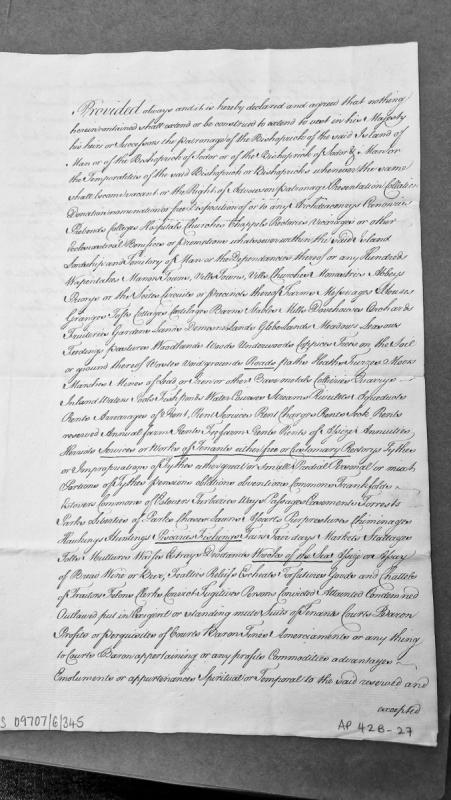
This is a legal proviso declaring that certain ecclesiastical and temporal rights and properties within the Isle of Man shall not vest in the Crown, specifically excluding royal patronage of bishoprics and various ecclesiastical benefices. The document provides an exhaustive enumeration of properties, revenues, rights, and appurtenances (both spiritual and temporal) that are expressly reserved and excepted from the Crown's authority.
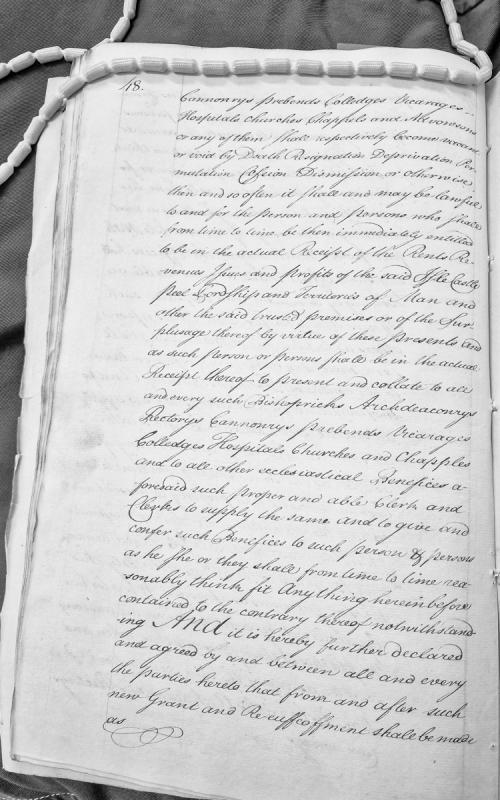
A legal document concerning the rights to present and collate clergy to vacant ecclesiastical benefices (bishoprics, archdeaconries, rectories, canonries, prebends, vicarages, colleges, hospitals, churches and chapels) in the Isle of Man. The document outlines the conditions under which such presentations may be made and the qualifications required of candidates.
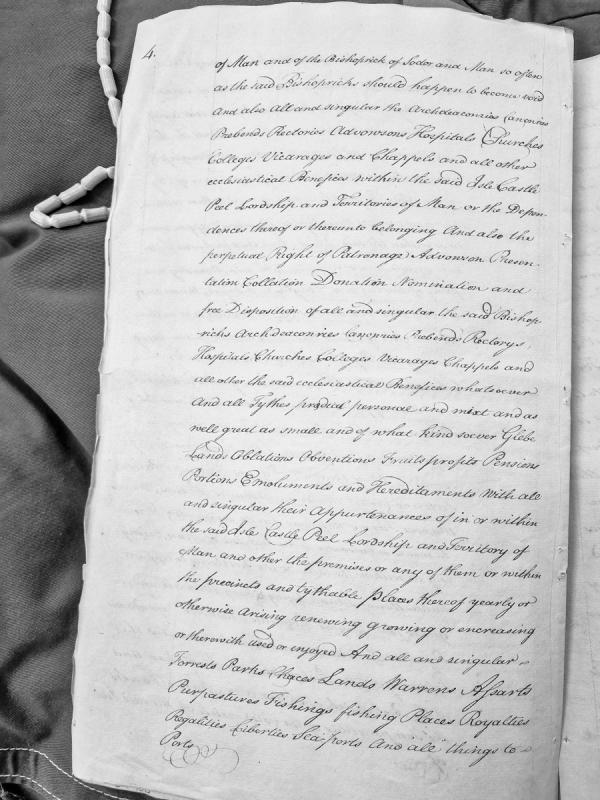
This document appears to be a legal instrument describing the rights, patronage, and ecclesiastical benefices within the Isle of Man, including bishoprics, archdeaconries, canonries, prebends, rectories, churches, and associated tithes and lands. The detailed enumeration of ecclesiastical properties and rights suggests this is part of a larger legal or administrative document, possibly a charter or grant.
Sea captain, merchant, and lieutenant-governor of Mann under the 7th Earl of Derby. Not a provincial figure — he had gone to sea, made a fortune, captained his own vessel, served the East India Company, and commanded a Royal Navy frigate. He proposed elected Keys and accountable Deemsters, threatening the Lord's control. The Great Stanley's assessment: 'excellent good company; as rude as a sea captain should be, but refined as one that had civilized himself half a year at Court.' Derby imprisoned him for eighteen years in Castle Rushen and Peel Castle. He died in Peel in January 1661, having never seen his programme realised. Derby's verdict: 'It was safer much to take men's lives than their estates.' Self-governance and land ownership were the same fight. Edward saw it.
Of the Christian family that had signed the Keys' Resolution of March 1765. Forced to sell the family home at Bemahague in 1789 — twenty-four years after the Revestment — because the economic conditions the Revestment had created had ruined him. The property had been a Christian family home from at least 1600, the same family that had produced Deemsters from 1408. Robert Heywood bought it. The Manx Government purchased it in 1904 and turned it into Government House — maintained at Manx expense for the representative of a Lord who has never spent a night under its roof. A family's farm, lost to the consequences of the Revestment, paid for by the Manx people.
Lost his right leg at Trafalgar. One of the named Manx casualties whose injuries are recorded in the naval muster rolls with flat precision: name, rank, ship, injury.
Royal writ from Edward II to Henry de Bello Monte (or his lieutenant) commanding the resumption of the Isle of Man into the king's hands. The revocation follows ordinances made by prelates, earls and barons chosen on 16 March 1310 to regulate the royal household and kingdom, which invalidated all grants of castles, lands, and other properties made since that date. The Isle is to be delivered to Gilbert Makaskel and Robert de Leiburn, constable of Cokermouth Castle. This document illustrates medieval royal sovereignty over Man and the reversibility of feudal grants.
A royal letter from Edward II to Henry de Bello Monte (or his lieutenant) commanding the resumption of the Isle of Man into the king's hands. The letter revokes grants made since 16 March 1310 following ordinances issued by prelates, earls, and barons chosen to regulate the royal household and kingdom. It orders delivery of Man to Gilbert Makaskel and Robert de Leiburn, constable of Cokermouth Castle.
King of England who formally renounced royal claims to the Isle of Man and granted the lordship to William Montacute, Earl of Salisbury. This grant established the pattern of feudal lordship separate from the English Crown that would persist for centuries.
Edward III formally recognised Mann as an independent kingdom under William de Montacute, renouncing direct English claims. The Latin text confirmed Mann's separate status — not a territory of the English Crown but a kingdom held under it. This distinction would matter enormously four centuries later when Parliament assumed it could purchase the lordship as though purchasing a piece of England.
Speaker of the old self-elected House of Keys. Resigned in protest at the notion of popular elections and withdrew from public life entirely. His outrage at being made accountable to the people was, in its way, the most eloquent argument for the reform he was protesting.
A biographical entry from Draper's 1864 'House of Stanley' covering Edward Smith-Stanley, 13th Earl of Derby (1775–1851). The text details his parliamentary career (Preston MP 1796–1812, Lancashire knight of the shire 1812–1834), family connections, marriage, children, peerage creation (1832), and major interests in natural history and ecclesiastical patronage. Relevant to understanding the Derby family's position during the Revestment era and the 13th Earl's contemporaneous role in public affairs.
Reigned for 326 days. Never visited the Isle of Man and abdicated. The Manx people named a pier after him — the King Edward VIII Pier at Douglas, opened in May 1936. It is the only public structure in Britain bearing his name. The Island named a pier for a king who never came and never would.