Draft letter from the Duke of Atholl responding to the Treasury's formal offer to purchase the Isle of Man under the authority of the 12 George I Act. Atholl asserts the ancient and honourable nature of the lordship, outlines his predecessor's principled position, and notes the long history of failed purchase attempts by Walpole, Pelham, and Newcastle. He argues that even with government ownership, smuggling would persist as it does in the Channel Islands, and claims his revenues derive from legitimate duties. Atholl declines to propose a price but remains open to receiving offers.
A draft letter from the Duke of Atholl responding to the Treasury's initial offer to purchase sovereignty over the Isle of Man under the Act of the 12th of George I. The Duke expresses reluctance to sell an ancient family possession but acknowledges willingness to negotiate if the sale serves the Crown's interest. He references previous failed negotiation attempts under Walpole, Pelham, and Newcastle, and argues that possession by Government would not substantially reduce smuggling given the precedent of the Channel Islands.
Correspondence from the Duke of Atholl to the Duke of Newcastle regarding Crown proposals to purchase sovereignty of the Isle of Man. The Duke articulates his reluctance to part with this ancient patrimony, but expresses willingness to submit to the King's pleasure if deemed necessary for his service. References earlier negotiations with Sir Robert Walpole, Henry Pelham, and the Duke of Newcastle, and provides details of revenues and constitutional status.
Letter from the Duke of Atholl to an unnamed Grace (likely Duke of Newcastle) responding to Treasury inquiries about the sale of the Isle of Man. Atholl reiterates his unwillingness to part with the island despite royal service, references previous negotiation attempts by Sir Robert Walpole and Mr Pelham, and offers to consider proposals. Includes a memorandum confirming this letter accompanied a confidential proposal first delivered to Pelham in November 1752.
The Duke of Atholl responds to James West (Secretary to the Treasury) regarding the Lords of the Treasury's renewed interest in purchasing the Isle of Man. The Duke indicates he had previously submitted proposals to Mr Pelham (circa 1752) outlining terms for the sale and reaffirms his willingness to proceed on those terms. This correspondence predates the formal 1765 Revestment by a decade, documenting earlier negotiation attempts.
The Duke of Atholl responds to James West (Secretary to the Treasury) regarding Crown interest in renewing negotiations for the purchase of the Isle of Man. Atholl references his previous proposals submitted to Henry Pelham two years earlier (c. 1752) and confirms his willingness to proceed on the terms originally proposed. This document demonstrates early formal interest by the British government in acquiring Manx sovereignty.
The Duke of Atholl responds to a Treasury memorial from the Commissioners of Customs regarding smuggling from the Isle of Man. He defends the island's legal import/export regime, confirming that imports pay duties to the Lord of the Island but exports are not regulated or taxed. He pledges to instruct the Governor to prevent future customs violations. This document is crucial for understanding the pre-Revestment constitutional and revenue arrangements, and the Treasury's concerns about smuggling.
The Duke of Atholl responds to a Treasury memorial from the Commissioners of Customs regarding smuggling from the Isle of Man. He discusses the legal status of imports/exports under Manx law, confirms consultation with Governor Cochrane, and pledges to enforce customs compliance. This document predates the 1765 Revestment and illustrates the tensions between sovereign rights, smuggling suppression, and Parliamentary authority.
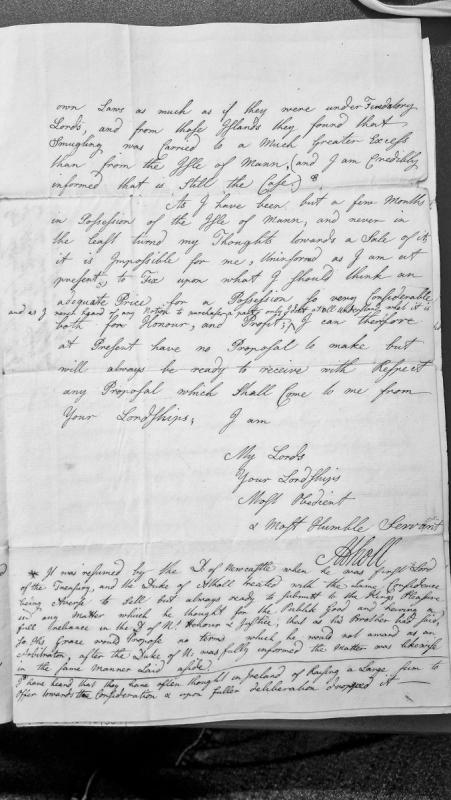
Letter from the Duke of Atholl to Lords regarding a potential sale of the Isle of Man. Atholl states he has only recently acquired the island and is unprepared to fix an adequate price, but remains open to receiving proposals. The document includes a footnote discussing previous attempts at acquisition under the Duke of Newcastle and references Irish interest in purchasing the island.
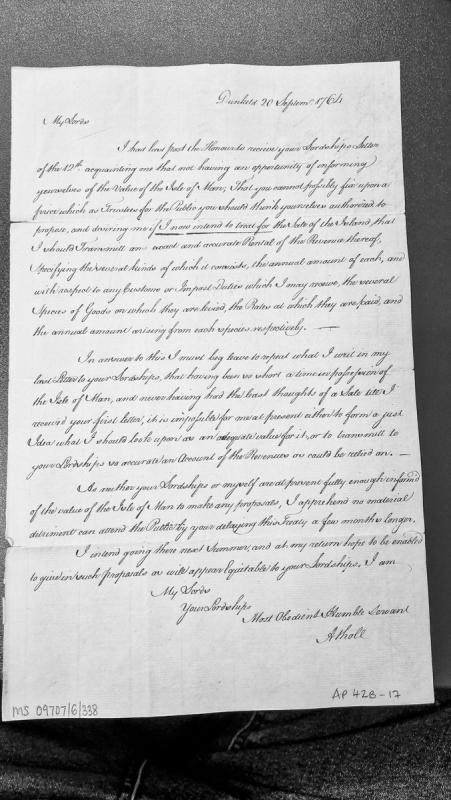
A letter from the Duke of Atholl to Lords (likely Treasury or government officials) responding to their request for financial information about the Isle of Man prior to negotiating its sale. Atholl explains he lacks sufficient knowledge of the island's revenues to provide accurate rental accounts and proposes delaying negotiations until after a summer visit to gather proper information.
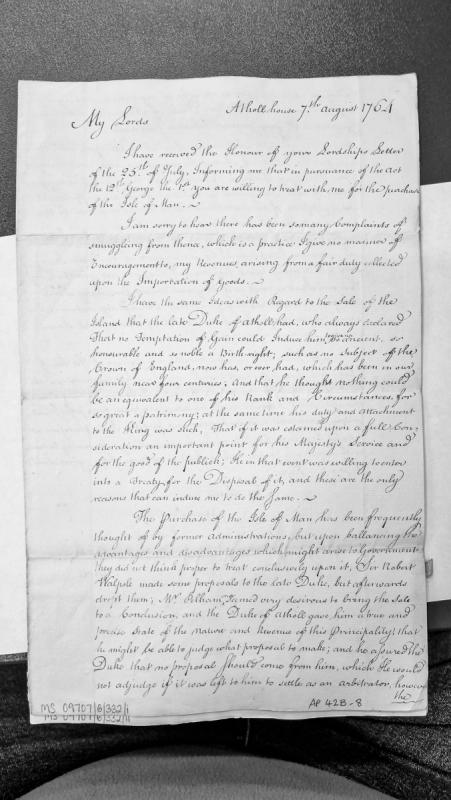
Letter from the Duke of Atholl at Atholl House responding to the Crown's (via his Lordships) inquiry about selling the Isle of Man under the Act of 12 George I. The Duke expresses his reluctance to part with the island as an ancient family birthright of four centuries, but indicates willingness to negotiate if deemed important for His Majesty's service and the public good. He references previous failed attempts by former administrations including Sir Robert Walpole and Mr Pelham to acquire the island.
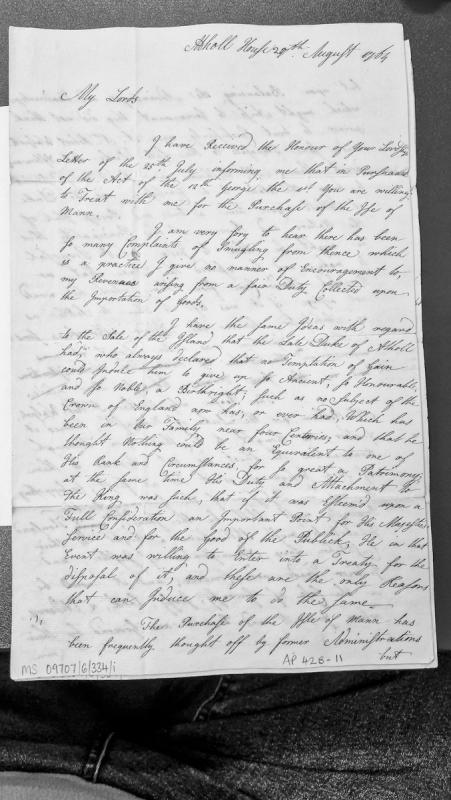
Letter from the Duke of Atholl at Atholl House responding to a proposal from the Crown (dated 25th July 1764) to purchase the Isle of Man under the Act of the 12th George I. The Duke expresses reluctance to sell the island, which has been in his family for nearly four centuries, but indicates willingness to negotiate if deemed essential for the King's service and the public good.
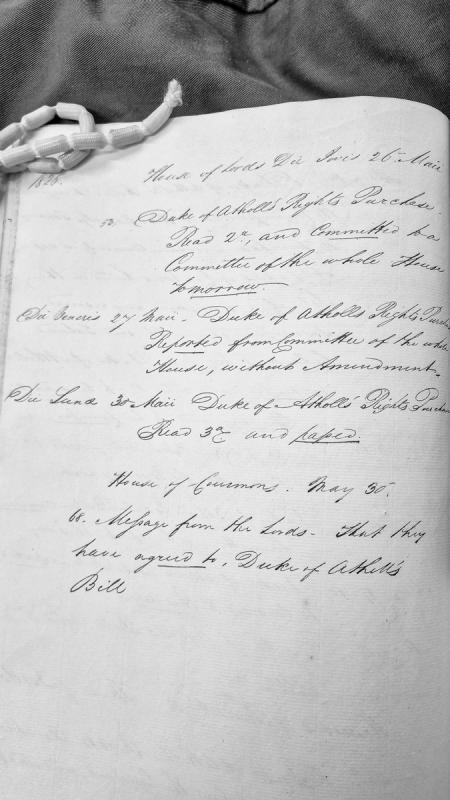
Parliamentary record documenting the passage of the Duke of Atholl's Rights Purchase Bill through the House of Lords (May 26-30, 1825) and agreement by the House of Commons. The bill underwent three readings and committee review before final passage.
6 Geo. IV, c. 34 — the second purchase. Parliament bought the remaining Atholl rights that had been reserved in the 1765 Act. Surveys and arbitrations were conducted 1826–28 to value the properties. The final purchase completed what the 1765 Act had begun — the total transfer of the lordship to the Crown.
Listed 'the proposing the American Tax, and the purchase of the Isle of Man' as twin achievements of the Grenville ministry. Parliament was asserting its authority over its dependencies, and the Island and the American colonies were processed together, in the same session, by the same ministry.
Capital of the Kingdom of Strathclyde, besieged by a Norse fleet in 870. Part of the wider Norse world that connected the Isle of Man to Scotland, Ireland, and the Northern Isles.
Wealthy Liverpool merchant and shipowner. Elizabeth Betham's uncle. One of the men who moved goods and capital between Liverpool and Douglas — the commercial axis on which the running trade turned. Campbell employed William Bligh in his merchant fleet during the peacetime years between Cook's voyage and the Bounty commission.
The Duke of Atholl's Scottish estate. When Hugh Cosnahan told the Duke he could have gone to Dunkeld and let the storm blow over, the Duke's reply confirmed he had chosen to sell.
Irish Taoiseach who in 1948 sent recording equipment across to the Isle of Man to capture the voices of the last Manx speakers, because the Manx government at that time would not. It was an Irish intervention that preserved the spoken form of a Gaelic language the Manx authorities had allowed to die. The recordings made possible the revival that followed — Bunscoill Ghaelgagh, the language society, the children learning mathematics in the language their great-great-grandmothers had spoken.
Patent from James, Earl of Derby, Lord of Mann, appointing Captain Edward Christian as serjeant major of the island's land forces and authorising him to muster, train and exercise able men for the island's defence during the English Civil War. The document reflects the militarisation of Mann during the 1640s rebellion and the earl's authority to levy and command forces.
Patent letter from James, Earl of Derby, Lord of Mann, appointing Captain Edward Christian as serjeant major of land forces on the Isle of Man under Governor John Grenshalgh. The document authorises mustering, training and exercising able men for the Island's defence during the English Civil War period. It provides insight into Isle of Man's military organisation, governance structure, and the Earl's administrative authority during the 1640s conflict.
Issued orders on 4 June 1765 for deployment of troops from Ireland to the Isle of Man. By 28 June, Hale's Light Dragoons had reached the Island. The 2nd Queen's Royal Regiment of Foot followed.
Official correspondence from the Earl of Halifax's office (via Edward Sedgwick) to the Lords Commissioners of His Majesty's Treasury, reporting that military reinforcements have been ordered to the Isle of Man. Two Troops of Light Dragoons under Colonel John Hale and the Second Regiment of Foot are to be dispatched from Ireland. The letter exemplifies the military dimension of the post-Revestment security arrangements and Crown administrative coordination.
Official correspondence from Edward Sedgwick (on behalf of the Earl of Halifax) to Charles Jenkinson at the Treasury, reporting that His Majesty has ordered the dispatch of two troops of Light Dragoons under Colonel John Hale and the Second (Queen's Royal) Regiment of Foot to the Isle of Man. The letter confirms orders issued to the Lord Justices of Ireland on 4 June 1765 for immediate embarkation. This document is directly relevant to the Revestment project as it shows the Crown's military response in the period immediately preceding the formal purchase of sovereignty from the Duke of Atholl.