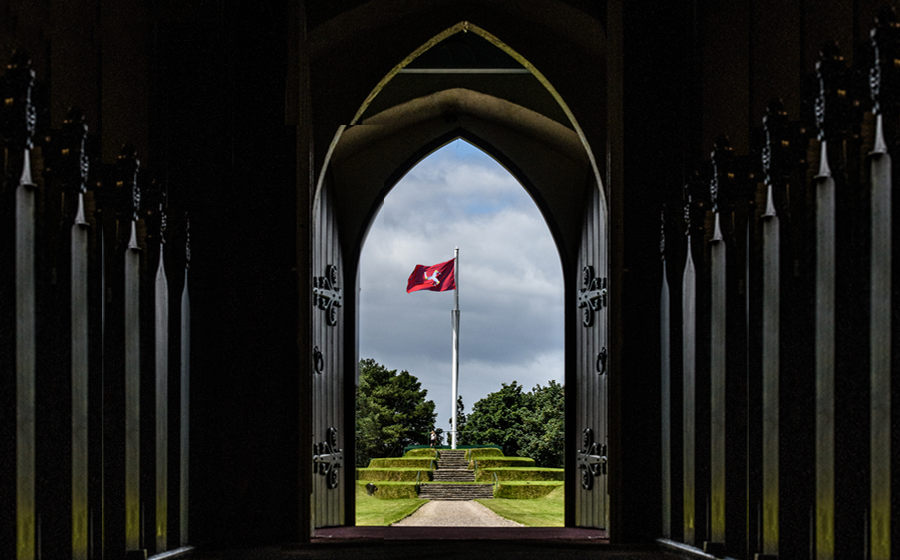
The return to the hill. The constitutional recovery, the 1866 settlement, women's suffrage, the language revival, the Bunscoill. The ceremony still happening. Crown dependence as a living condition — no royal charities, no royal warrant companies, no Governor's charities. The indifference that caused the devastation also permitted the endurance. Titles do not make nations.
The people who left. The ships, the names, the Ohio communities, Kelly's letter home. The language carried across the Atlantic and dying there too. Emigration as loss, not adventure. The Manx world scattered — and what it carried with it.
What survived. The things London never knew about — the language, the customs, the Tynwald ceremony continuing, the accommodation between old belief and new church holding fast. The institutional erosion documented alongside the quiet persistence of everything that made the island itself.
What the island gave and what it got back. Manx men pressed into naval service, the Fencibles raised for wars that were not theirs. The harbour that killed fishermen because no one maintained it. Revenue extracted, nothing returned. The arithmetic of empire applied to a community of thirty thousand.
The human cost. Economic collapse, emigration, institutional failure. The harbours rotting, the warehouses empty, the children offered to Dublin. Robertson's 'universal terror.' Every statistic anchored in a named person or a specific place. The petitions filed into silence.
The 1792 Commission of Inquiry — Parliament sending Commissioners to document what it had done. The Duke's testimony with remarkable candour. The confession of devastation. The recommendations that were never implemented. The final Atholl purchase of 1825. The arithmetic of indifference.
Crown administration replaces the Manx establishment. The Lutwidge dynasty — conflict of interest running through the customs apparatus. Taubman profiteering. The deputations to London achieving nothing. The slow documentation of consequences.
The eight days. The transfer ceremony at Castle Rushen on 11 July 1765. Crown officers take possession. The silencing of Tynwald. The administrative void. The arrival of the garrison. The beginning of the devastation.
The parliamentary manoeuvre. The Duke's vulnerability. The compensation negotiation. The Isle of Man Purchase Act — its passage, its terms, its assumptions. The Mischief Act. The legislative package that dismantled the island's commercial system. The moment Parliament purchased a feudal title and assumed it had bought a territory.
The forces closing in. The East India Company's commercial interests, the Whitehaven merchants' memorial, the customs intelligence, the parliamentary pressure. The constraint that made the purchase inevitable — not a conspiracy, but a convergence of interests in which the Manx people simply had the misfortune to be the target.
The lords who held the island and the custodianship they exercised from a distance. The Stanleys, the Murrays, the Atholl inheritance. How a feudal title became a vulnerability — the Duke who could not afford to keep what Parliament wanted to buy.
The constitution in full — Tynwald, the Keys, the herring-bone oath, the codification. Then the testing: the Keys' resolution, the signatory list, Cosnahan's deputation to London, Quayle's warning about old landmarks. The neighbours silenced. The last year of Manx self-governance.
The last years before the Revestment. Ordinary life on the island — what people ate, how they lived, who they married, what they believed. The trading world and the family web that held it together. The Moores, the Christians, the Taubmans. It was theirs, and it worked.
The trading era. The island's commercial system at its height — the running trade, the merchant families, the harbours alive with traffic. The Peggy in her boathouse. The economy that worked, the community that sustained it, and the world that was watching from across the water.
Illiam Dhone's choice, the Parliamentarian landing, the trial, the execution on Hango Hill. The aftermath and the long memory. Bishop Wilson's arrival and the transformation of Manx life — schools, libraries, the Manx Bible, the episcopate that shaped a generation. The Act of Settlement of 1704 and the rights it secured.
The Stanley lordship. Two and a half centuries of custodianship — the longest continuous lordship in the island's history. The accommodation between church and folk belief. The Tynwald codification of 1417. The Tudor connection. The Civil War reaches the Irish Sea: the Earl at Bolton, the Countess holding the castles, and Illiam Dhone facing the choice that would define him.
From the first recorded Tynwald to the Stanley grant. Godred Crovan's conquest, the Norse Kingdom of Mann and the Isles, the Treaty of Perth, Scottish and English contention, the island passed between crowns. Maughold crosses, Thorwald's Cross, the Kirk Andreas zodiac window. A constitutional entity taking shape.
The deep ground before governance. The physical island, the spiritual landscape, the keeills and holy wells, the ritual year, the spirit taxonomy. The Celtic world that shaped everything that followed. Housing, diet, clothing — the material life of a people essentially unchanged for centuries.
The ancient Tynwald ceremony as lived governance. Midsummer Eve bonfires, bollan bane, rent to Mananan, Tynwald Hill with its four tiers of parish earth. Laws read in English and Manx, petitions heard without barriers. A nation governing itself.