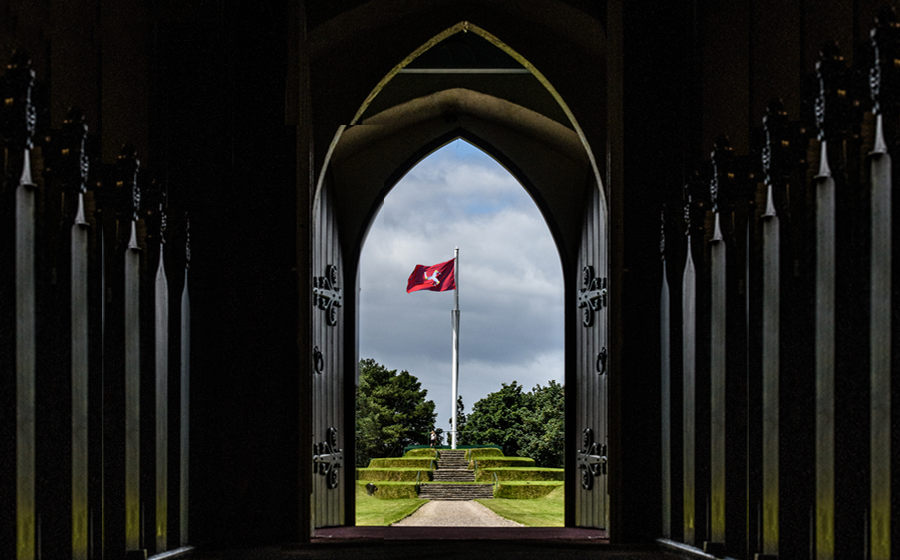
Last native speaker of the Manx language. He had learned Manx as a child from an aunt who spoke no English. He died at ninety-seven in 1974. A language spoken on the Island since at least the fifth century — older than English, older than Parliament, older than the lordship that Parliament had purchased — and when he died, the thread of unbroken transmission that connected the Island to its own past was severed. UNESCO declared Manx extinct. But the recordings existed — made in 1948 when the Irish Taoiseach Eamon de Valera sent equipment across. The grammars existed. The Bible existed. Wilson's translations, Hildesley's completions. UNESCO revised its classification to 'critically endangered.' The language came back.
Speaker of the House of Keys, perhaps the finest historian the Island produced. His History of the Isle of Man documented the crime with the restrained fury of someone who loves the thing that has been damaged. In 1899 he helped found Yn Cheshaght Ghailckagh, the Manx Language Society, with the motto Gyn chengey, gyn cheer — without language, without country. Moore understood what Wilson had understood two centuries before: the language was not a cultural ornament. It was the medium through which the Island knew itself.
Lieutenant Governor who forced the Keys to accept popular election as the price of financial control. The House of Keys Election Act of 1866 was promulgated at Tynwald. The first popular elections took place 2–5 April 1867. The franchise was limited — male ratepayers holding property valued at eight pounds or more, roughly twenty per cent of the adult population. Thirteen of twenty-four seats went to men who had sat in the old self-elected House. The revolution was conservative. But the principle was established. The mechanism that the Revestment had destroyed — accountability, proximity — had been rebuilt by Manx people themselves.
Owner of the Isle of Man Times, picked up Robert Fargher's reform cause in the 1860s. He reported on Keys proceedings. The Keys objected. Brown was summoned before the House and refused to apologise. Governor Henry Loch, watching the confrontation between a newspaper editor and a self-perpetuating legislature, drew the conclusion that Fargher had drawn thirty years before: there could be no responsible government while the Keys remained unelected.
Launched the Mona's Herald in 1833 and began a thirty-year campaign for a democratically elected House of Keys. His method was straightforward: he published what the Keys did, and the publication itself was the argument. A self-elected body operating in secrecy could maintain its authority only as long as nobody outside the chamber knew what happened inside it. Fargher opened the doors with newsprint. The Keys responded by prosecuting him for libel. He was imprisoned. The imprisonment produced public petitions for reform. He had argued in 1844 that the Keys should not be given financial authority because they were unelected. Twenty-two years later, Governor Loch used precisely the same argument to force the Keys to accept popular election.
Manx soldier captured while serving in Wellington's army, held prisoner at Longwy in France from 1806. Wrote to Robert Cannell in Douglas distributing £40 that the Bishop of Sodor and Man had raised for the relief of twenty-seven Manx prisoners held across seven French depots from Cambrai to Besançon. His letter names every man and traces each to his parish. The relief came not from the Crown but from the Island itself — the Bishop's collection, ordinary Manx people contributing what they could for men they would have known by family if not by face.
Major in the 23rd Light Dragoons, son of John Joseph Bacon — one of Douglas's foremost merchants in the pre-Revestment era, whose shipping ledger recorded voyages of the brig Caesar to Naples and Gothenburg. The father's ledger was the record of the commercial world the Revestment destroyed. The son fought in the war that followed. Bacon was wounded twice — at Quatre-Bras and again at Waterloo. His uniform — navy and red jacket, silver-threaded epaulettes, leather sabretache — survives as the oldest known Napoleonic light cavalry uniform in the British Isles, held by Manx National Heritage alongside Quilliam's naval uniform.
Served on HMS Temeraire — the ship that fought alongside Victory at Trafalgar. Lost his right arm in the battle. He came home to Kirk Bride, a parish the census counted at 678 souls. He became a schoolteacher. He taught children to read with one arm, because the arm was gone and there was nothing to be done about it. The Navy that took his arm paid him nothing. The Crown that had pressed him into service offered no pension, no support, no acknowledgment. The children he taught would have been the generation that grew up in the 1820s and 1830s — the years Moore identified as the lowest depth of Manx misery. They learned to read from a man who had seen Trafalgar.
Lieutenant Governor who testified before the 1792 Commissioners and readmitted the clergy to Tynwald — calling their sixteen-year exclusion a 'Singularity.' Overruled his own Attorney General to do it. His letter to the Commissioners contained the story of John Tear, the poor labourer of Garff who won his case in Manx courts only to have it overturned on appeal to London. Shaw reported that 'since 1776 the necessaries of life have more than doubled in price, some of them trebled' while wages had not moved.
Historian and later Lieutenant Governor of the Isle of Man (1888–1893). His history of the Island drew on the parliamentary papers and provided the most detailed English-language account of the Mischief Act and its consequences. He recorded the bonfires after the transfer ceremony and added the detail about the Governor's claret. His verdict on the legislation was measured but unambiguous: the Acts 'not only inflicted an apparently irremediable wound on the prosperity of the Manx people; they concurrently aimed a fatal blow at their independence.'
Lord Chief Justice of England who, in the House of Lords debate of 8 July 1805, called the Revestment 'one of the most corrupt jobs ever witnessed in Parliament.' He was challenged. He did not withdraw. He expanded: 'a proceeding which could only be sanctioned by Parliament in the worst and most corrupt times.' The Lord Chief Justice of England characterising an Act of Parliament as corrupt, in the House of Lords, unchallenged on the substance.
Member of Parliament for Carlisle who presented the Manx petition in the House of Commons in 1790. He reported that in the years since the Revestment, 'the doubts started whether the rights belonged to the Crown, or the noble family' had meant those rights 'were wholly unexercised, to the great inconvenience and annoyance of the inhabitants.' The harbours had decayed. Fifty persons had lost their lives. Curwen told Parliament this. Parliament noted it. Commissioners were appointed the following year.
Built a cotton mill on the Isle of Man in 1779, employed Manx workers for ten years, and exported freely to Liverpool. Then his goods were detained and taxed at the English port. He warned the 1792 Commissioners that he would 'be under the Necessity of giving up his Manufactory, and quitting the Island.' The customs regime could not distinguish between smuggled goods and legitimate manufacture. The one industrial enterprise the Island had attracted in a quarter-century of Crown rule was preparing to leave.
Speaker of the House of Commons, who was 'warmest in his sympathy' toward the Manx deputation. He displayed great kindness and consideration, advised on the form and matter of the Memorial, and later received the thanks of the Keys. One man. Not the government. Not the Treasury. Not Parliament. One individual, in a personal capacity, showing kindness to a delegation from a small island. The institutional indifference was total. The personal warmth of a single sympathetic Speaker made it worse, not better.
Clergyman who accompanied George Moore to London on the second deputation in April 1766. Made the expedition's most significant discovery, and it was accidental: he found a copy of the James I charter confirming Manx rights — 'until then forgot and unknown.' A constitutional document that should have been in the Island's own archives, lost, turned up in a London library by a clergyman who happened to be looking.
One of three men sent to London in late 1765 or early 1766 as the first post-Revestment deputation — alongside Hugh Cosnahan and John Christian. They arrived too late to influence the Mischief Act but achieved one thing: duty-free entry into Britain and Ireland for Manx produce and manufacture. It was not nothing. But it was not what they had gone for.
Crown Governor from 1777. Arrived 'a total stranger to the manners, laws, and customs of the Isle of Man' and within days began legislating. He excluded the clergy from the legislative Council — the Bishop had sat there since at least 1422. He legislated behind closed doors, 'in so secret a manner, that even the principal merchants and inhabitants did not know the substance of the laws until they became binding upon them.' The Taxation Bill was passed with a single Council member present. He abolished the Great Inquest, created new courts under High Bailiffs in his own gift, and reduced the Council to three Crown officers. The template was set from day one: the seneschal replaced by a stranger.
A Peel man who publicly called Charles Lutwidge 'an Egregious Smuggler.' Lutwidge sued for slander. The case collapsed when Parr 'prepared his defence & bid him defiance.' Lutwidge's shipping survey of September 1766 noted that of the entire smuggling fleet, one boat survived — 'belonging to one Cesar Parr a Smuggler in Peel.' The last man standing.
Member of the House of Keys and signatory to the March 1765 resolution. His letter from July 1765 — the month of the transfer ceremony — captures what the Revestment looked like from the Manx side: 'Nothing now, but anarchy and confusion... Bands of armed men go about the country terrifying the people... 'Tis a very melancholy situation we are in... a place governed by martial law and the violence of arms.' Governor Wood's assurance that troops came 'not to oppress' had been issued the same month.
Son of the 3rd Duke who signed the Revestment. Testified to the 1792 Commissioners that his father 'concluded a transaction, which, to the day of his death, he never thought upon but with the deepest regret and dejection.' Spent thirty years petitioning Parliament for additional compensation, producing accounts and estimates reaching £620,000. Appointed Governor in 1793 — Manx people drew his carriage and cheered, regarding him as 'a fellow-sufferer.' But he appointed Scots 'connected with or depending on his family' to most paid offices, and in 1822 told the Keys they were 'no more Representatives of the people of Man, than of the people of Peru.' The remark was 'loudly cheered by an assembled concourse of the most respectable natives.' The final settlement in 1829 paid £416,114 for all remaining rights.
Lord Chief Justice, the most senior judicial figure in England below the Lord Chancellor. Legal adviser to the Duke of Atholl during the Revestment negotiations. Told the Duke plainly: 'They don't mean to treat, much less to contract or agree.' His assessment of the Treasury's letter: 'Their letter is a strange one, it is insidious & looks like laying a trap.' The Duke wrote to Mansfield after his three-hour meeting with Grenville: 'you only saw the law on my side but there was as much or more against me... mighty good bargain I promise you as matters stood.'
Attorney General who drafted the Revestment Act without, by his own admission, knowing anything about the Isle of Man. His approach was revealing: 'the surest way for Government to have their object, by insisting on the whole being given up, and then give back such parts as your family insisted upon.' Take everything first, return what you must later. An explanatory bill was promised for the following session, 'to correct or remedy any inconveniences which might arise from an act, necessarily, hastily drawn up.' It was never introduced. The Act that Norton admitted was hastily drawn up remained on the statute books exactly as written.
Barrister who delivered the most comprehensive constitutional defence of the Island's sovereignty ever made in a British parliament — at the Bar of the House of Commons on 18 February 1765. He established that the Island was 'part of the crown, but not of the realm of England,' that the King's writs had never run there, that the regalities were 'severed from, and granted by, the crown.' He cited Hardwicke, invoked Locke and Grotius, drew the parallel with Normandy held of the French Crown. 'Will this House, famous in all ages for the justice, equality, and temper of its proceedings, transgress a rule which has received adoption and practice in all times and in all nations?' Lord Kinnoull: 'No performance at the Bar of the House of Commons has been mentioned with so universal and high applause as Mr Cooper's since Lord Mansfield left that Bar.' Universal applause. Then the House voted as it had always intended to vote.
First Lord of the Treasury from April 1763. Inherited a post-war fiscal crisis — the Seven Years' War had nearly doubled the national debt. Methodical where predecessors had been indifferent, systematic where they had been opportunistic. He found revenue in two places: the American colonies and the Isle of Man. The Stamp Act and the Revestment Act were conceived as parts of a single fiscal strategy. The Duke of York listed 'the proposing the American Tax, and the purchase of the Isle of Man' as twin achievements. Grenville's diary entry: 'Mr. Grenville was able to go to the House of Commons upon the business concerning the purchase of the Isle of Man, in which he met with universal approbation.' One line. Universal approbation for the purchase of a kingdom.
Attorney General in 1727, later Lord Chancellor from 1737 to 1756 — the most powerful legal figure in England for nearly two decades. His 1727 ruling confirmed that the Customs Commissioners' authority 'doth not extend to that Island' — no officer could make a seizure there. His second opinion (1729) confirmed that Crown jurisdiction followed the person through prerogative institutions, while Parliamentary jurisdiction was territorial and stopped at the shore. These two opinions mapped the constitutional boundary that the Revestment would violate. Grey Cooper cited Hardwicke at the Bar of the House in 1765. Nobody in Parliament had consulted the ruling before acting. The opinions sat in the files. Nobody looked.