A formal petition or memorandum submitted by Charles Lutwidge to the Treasury Lords, arguing for repeal of a restrictive trade clause imposed after the 1765 Revestment. Lutwidge contends that the clause was temporary and its purpose has been satisfied, and that existing statutory controls on tea, spirits, coffee, tobacco, and manufactures are sufficient to protect British revenue without the additional restriction.
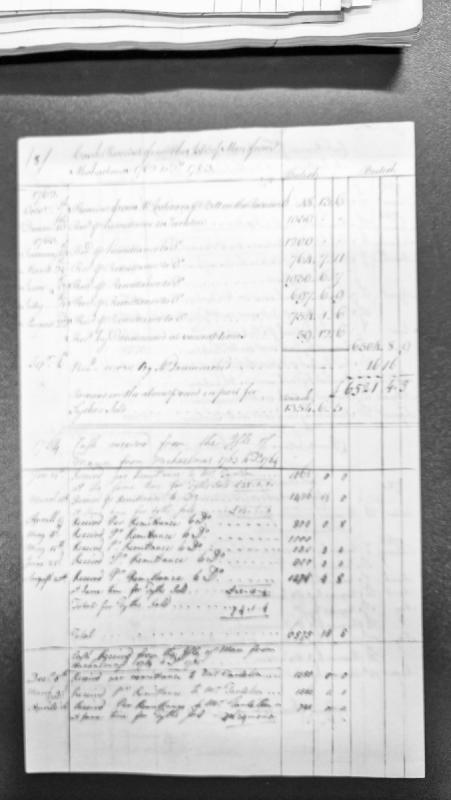
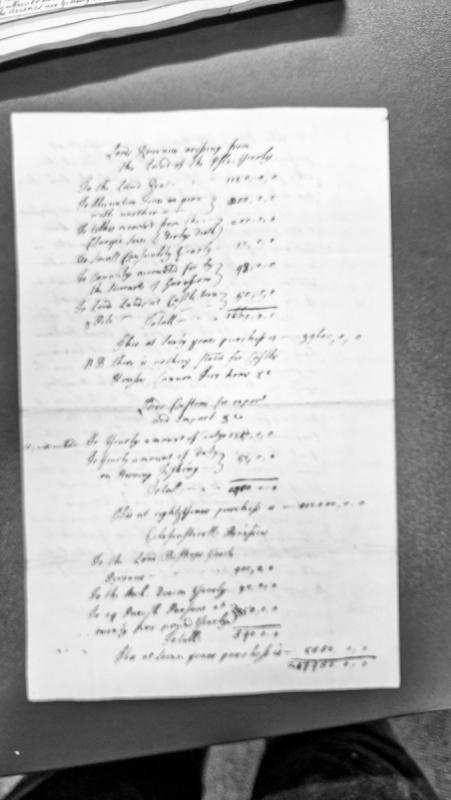
A series of Treasury and Customhouse documents concerning Charles Lutwidge's request for reward and reimbursement for expenses incurred while attending Parliament for the passage of legislation regulating Isle of Man customs. Includes revenue accounts from May 1765 to July 1767, salary statements, and correspondence between the Customhouse Commissioners and Lords of the Treasury debating the propriety of paying expenses from the customs revenue. Documents the financial settlement following the Revestment and shows administrative tensions over revenue appropriation.
Charles Lutwidge's detailed proposals to the Treasury Lords for regulating trade and revenue on the Isle of Man following the 1765 Revestment. The document addresses the elimination of smuggling, establishes duty rates for tea, spirits, coffee and tobacco, and proposes conditions for legal trade with Great Britain and Ireland. It includes comparative pricing data and argues for applying Irish trade privileges to the Isle of Man.
A detailed proposal by Charles Lutwidge, Receiver and Surveyor-General of the Isle of Man, to the Lords Commissioners of His Majesty's Treasury outlining measures to improve revenue and regulate trade following the 1765 Revestment. The document addresses the suppression of illicit trade and proposes specific duty rates, licensing schemes, and trade restrictions for tea, spirits, tobacco, coffee, and other commodities, with comparative pricing analysis.
Charles Lutwidge's administrative report to Grey Cooper on John Fearon's petition concerning salmon fishery losses in the Isle of Man (1768–1770). Includes detailed financial accounts showing Fearon's losses (£387:17:11), discussion of inadequate legal protections for the fishery lease, and Governor Wood's response addressing illegal flax-steeping in Manx rivers. Demonstrates post-Revestment revenue administration and governance challenges.
Charles Lutwidge's official report to the Treasury Lords on John Fearon's petition concerning losses from the salmon fishery lease in the Isle of Man. Includes financial accounts showing Fearon's losses (£387:17:11) and discusses environmental damage from flax steeping in rivers, with Governor Wood's response ordering enforcement of existing prohibitions.
Charles Lutwidge's official response to a Merchants' Petition regarding distressed trade conditions on the Isle of Man, submitted to the Treasury Lords for consideration. Lutwidge addresses ten proposals for trade relief, covering foreign trade restrictions, interior commerce, fisheries, and industrial encouragement, recommending selective concessions while opposing measures that might interfere with British trade or revenue.
Charles Lutwidge's official response to a petition from Isle of Man merchants regarding trade distress, submitted to the Treasury Lords for consideration. Addresses proposals for foreign trade relief, interior commerce regulations, fisheries access, and linen/hemp manufacture encouragement. Reflects post-Revestment administrative concerns about balancing Manx economic needs with British revenue and trade protection.
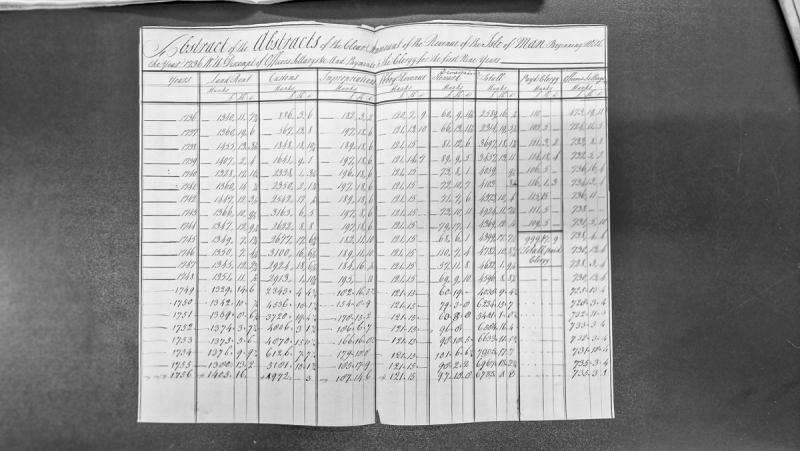
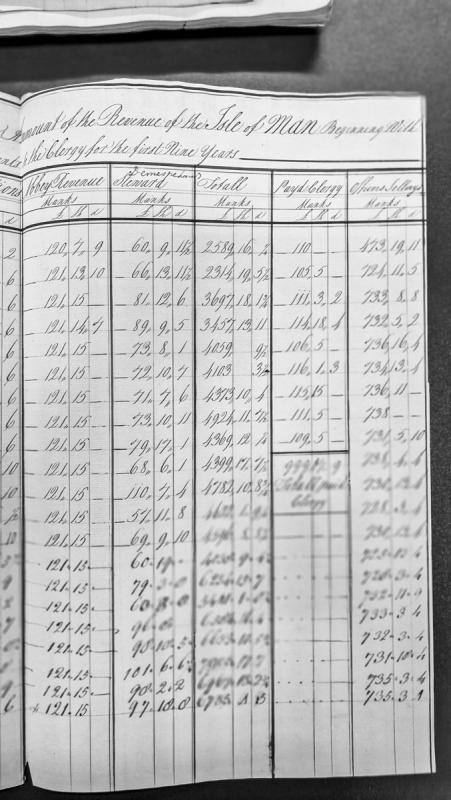
A comprehensive revenue report compiled by Charles Lutwidge, Receiver and Surveyor General, detailing customs duties, herring fishery data, and officer salaries for the Isle of Man from 1767–1782. Includes a Treasury Warrant establishing the customs establishment (1766) and legal observations defending the Crown's claim to herring customs and bay fisheries against the Duke of Atholl's post-Revestment claims.
Letter from Major Joseph J Durbin (Mount Murray) to James McCrone requesting assistance in securing the Duke of Atholl's patronage for a subscription to build a schoolhouse for poor children at Foxdale lead mines. The letter dates to 1825, well after the 1765 Revestment, but provides contextual information about Atholl family charitable interests and land-holding patterns on the Isle of Man during their post-Revestment period.
Extract from Paul Henri Mallet's 1770 work on Northern Antiquities, tracing Scandinavian (Norwegian and Danish) conquest and control of the Isle of Man and northern islands. Covers the 1266 sale of the Hebrides and Isle of Man to Scotland by Magnus Lagabætter, the 1468 mortgage of Orkney and Shetland to James III of Scotland, and the persistence of Norse law and language into the 17th century. Provides historical context for understanding pre-Revestment sovereignty claims over the Isle of Man.
Extract from Paul Henri Mallet's Northern Antiquities (1770) discussing Scandinavian conquest of northern islands, the 1266 sale of the Hebrides and Isle of Man to Scotland by Magnus Lagabætter, and the later mortgaging of Orkney and Shetland to James III in 1468. Provides historical context for Norse/Scandinavian rule and the transition of Manx sovereignty.
An ecclesiastical mandate from John Sharp, Archbishop of York, authorizing the induction, installation, and enthronement of Thomas Wilson as Bishop of Sodor and Man. The document confirms Wilson's nomination by the Earl of Derby (as patron), acceptance by King William III, and consecration by the Archbishop. It includes the form of installation ceremony performed on 11 April 1698 by Samuel Wattleworth, Archdeacon. The text is presented in both English and Latin versions.
An ecclesiastical mandate from John Sharp, Archbishop of York, dated 20 January 1697, formally installing Thomas Wilson as Bishop of Sodor and Man. The document includes the Latin original and English translation, with attestations of installation dated 11 April 1698. Relevant to understanding the Isle of Man's ecclesiastical governance and the formal procedures by which bishops were appointed and installed during the period leading up to the 1765 Revestment.
Collection of three previously published essays by David Craine on early modern Manx history: 'The Killing of William Mac a Faille' (1639), 'Sorcery and Witchcraft' (16th–18th centuries), and 'Church and Clergy, 1600–1800'. Edited and reprinted by Stephen Miller in 1994. Based on close-reading of Manx Museum manuscript holdings, these essays provide insights into Manx legal procedure, folk belief, ecclesiastical governance, agricultural practice, and social structures during the period preceding the Revestment.
Comparative table of customs duty rates on imports and exports in the Isle of Man across four centuries (1577, 1677, 1692), differentiated by native and foreign merchants. Covers staple commodities including agricultural products, alcohol, textiles, and colonial goods. Directly relevant to understanding the revenue base and trade patterns that made the Revestment fiscally significant.
A popular historical essay tracing the Standish family's connections to the Isle of Man and arguing that Myles Standish and his wife Rose (and later her sister Barbara) were of Manx origin before emigrating aboard the Mayflower in 1620. The work examines family genealogy, Manx Church records, property entailments, and the Standish family's subsequent role in Manx political life, including House of Keys membership.
A copyright notice from the Manx Notebook website clarifying the terms of use for HTML editions of scanned historical texts. It asserts copyright over the digital edition while acknowledging that underlying source texts are out of copyright, and sets conditions for linking and reproduction.
Contact page for the Manx Notebook website, providing editor Frances Coakley's email and instructions for research inquiries. Notes her substantial Manx library (1500+ monographs, maps, prints) and research support capabilities. Indicates the site contains 15,000+ pages of Manx historical content and references availability of a CD-ROM archive.
An annotated bibliography and index page cataloguing full-text transcriptions of books, documents, and extracts relating to Isle of Man history, society, and culture. The collection spans from 1656 to 1950, including primary sources, travel accounts, historical studies, and genealogical works. Relevant to the Revestment project as it identifies key contemporary sources from the 1765 period and contextual historical materials.
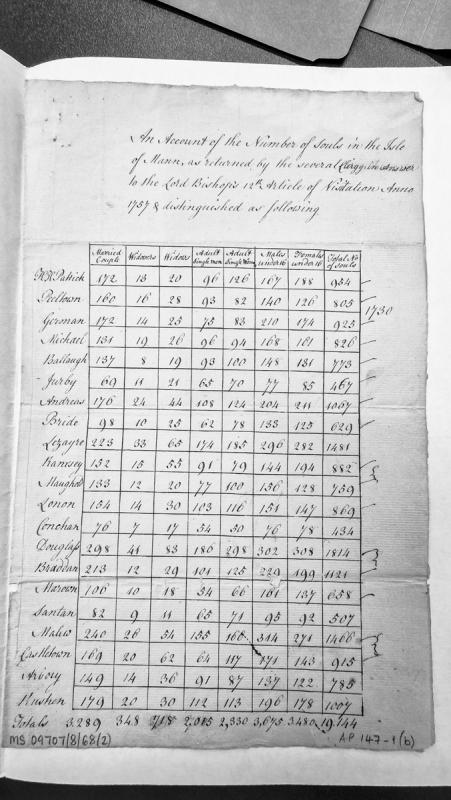
A tabular revenue abstract or statistical summary organized by Manx parishes and districts, with numerical data across eight columns totaling 19,144. The document appears to be administrative record-keeping, possibly relating to taxation, population, or property valuation by parish.
This is a metadata entry for a transcription project at the Manx Museum, indicating an automated transcription was generated on 2026-02-25. The source image reference is provided but the actual document content is not included in this file.
This is a metadata record for an automated transcription from the Manx Primary Source Archive. The actual document content is not present in the transcription file provided, only header information about the transcription process and source image reference.
This is a metadata record for a transcribed document from the Manx Primary Source Archive. The source image file is identified as 20260218_124832.jpg, with transcription completed on 2026-02-25 using automated processing via Claude Batch API.
This is a metadata header for an archived transcription, indicating automated processing of a Manx historical source. No substantive document content is present in the transcription provided.