Letter from Lieutenant Governor R. Dawson to an unnamed superior (likely the Secretary of State or Lord Lieutenant) reporting an attempt by the Duke of Atholl's Seneschal to claim possession of the Court Room in Peel (Douglas). The letter details the legal basis for Crown possession following the 1765 Revestment Act, explains how the Douglas Court Room came to be held by Atholl's agent, and defends Dawson's refusal to surrender Crown property without proof of legal right.
A letter from newly appointed Lieutenant Governor Alexander Shaw to Evan Nepean (Under Secretary of State) dated 26 February 1791, requesting copies of gubernatorial instructions and records that were not provided by his predecessor, Lieutenant Governor Dawson. Shaw references instructions from 1765 relating to the Crown's vesting of the Isle of Man and seeks guidance on his administrative duties.
Lieutenant-Governor Alexander Shaw's formal letter to the Commissioners of Inquiry (1792), submitted 19 October 1791, detailing the constitutional structure of the Isle of Man, the composition and powers of the three Estates (Sovereign, Governor and Council, House of Keys), and critical observations on governance including the exclusion of clerical members from Council and abuses of appeals to the King in Council. Directly relevant to post-Revestment constitutional arrangements and administrative practice.
Letter from Lieutenant-Governor Alexander Shaw to the Secretary of the Commissioners of Inquiry (1792), submitted 19 October 1791, detailing the constitutional structure, legislature, laws, and governance of the Isle of Man. Covers the three estates (Sovereign, Governor and Council, House of Keys), the composition and election of the Keys, the controversy over clerical members of the Council, and extensive discussion of the problem of appeals to the King in Council. A key post-Revestment administrative document.
An extensive biographical and historical introduction to the life of Robert Clive, focusing on the political and military state of India at the outset of his career (1746). The text covers the decline of the Mughal Empire, the rise of European trading companies (especially the East India Company), the Carnatic Wars, and key figures like Dupleix, La Bourdonnais, and various Indian rulers. While primarily biographical, it provides crucial context for understanding the geopolitical environment that shaped the events leading to the 1765 Isle of Man Revestment by illustrating how overseas colonial ventures and commercial rivalries drove imperial expansion.
A comprehensive biography of John Wilkes (1725–1797) by Horace Bleackley, published in 1917 by John Lane. While primarily a biography of the radical politician Wilkes, the work contains extensive contextual material on 18th-century British politics, Parliamentary procedure, radical journalism, and constitutional conflicts that provide important background for understanding the political climate leading to the 1765 Revestment debate.
Comprehensive biography of John Wilkes (1725–1797), the radical politician and libertarian activist whose career paralleled the 1765 Revestment period. Covers Wilkes's political agitation, Parliamentary activities, publishing ventures (The North Briton), and constitutional conflicts with George III. Relevant to the Revestment project for context on 1760s–1770s political radicalism, Parliamentary procedure, and the ideological climate affecting colonial and constitutional questions.
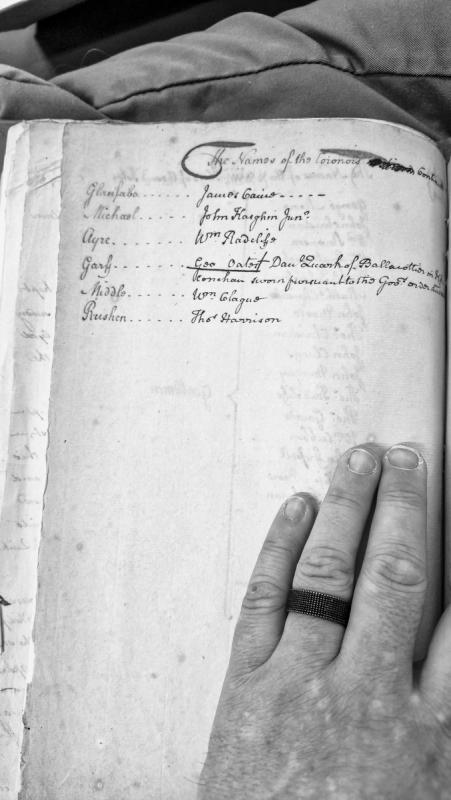
A partial administrative record listing coroners appointed for various parishes (Glenfaba, Michael, Ayre, Garff, Middle, Rushen) in the Isle of Man. The document appears to be a continuation of a larger list, with some names struck through and annotations regarding oaths taken under gubernatorial direction.
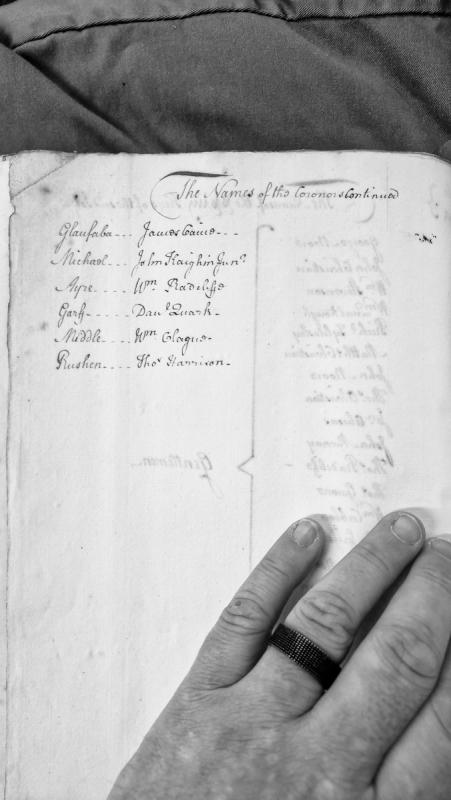
A continuation of a list of coroners appointed to the six parishes (sheadings) of the Isle of Man. Each parish is paired with the name of its coroner, including James Cains (Glaufaba), John Kaughin Jun. (Michael), William Radcliffe (Ayre), Daniel Quark (Garff), William Clague (Middle), and Thomas Harrison (Rushen).
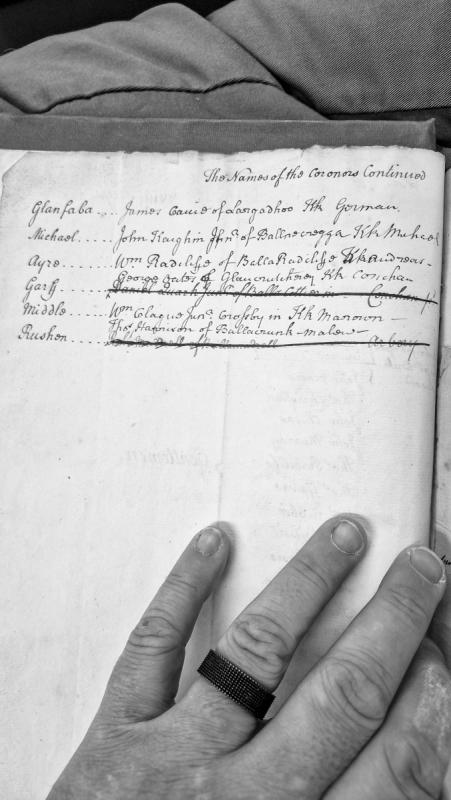
A continuation of a list naming coronors (coroners) for various Manx parishes including Glanfaba, Michael, Ayre, Garff, Middle, and Rushen, with their residences and associated districts. Some entries are crossed out or illegible, suggesting this is a draft or working document.
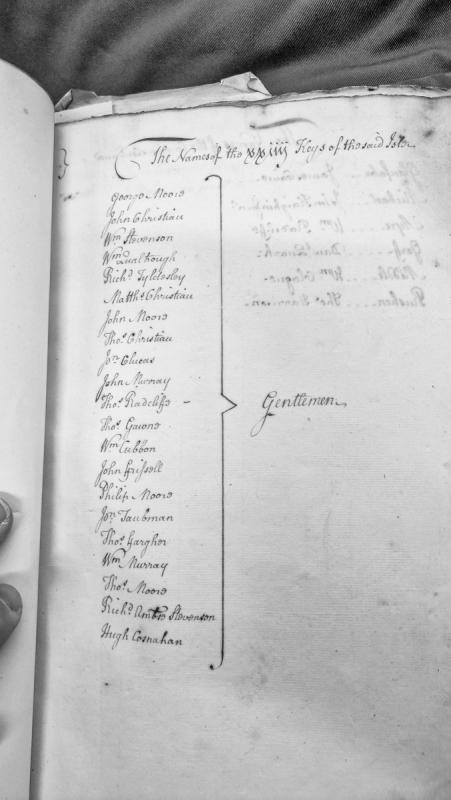
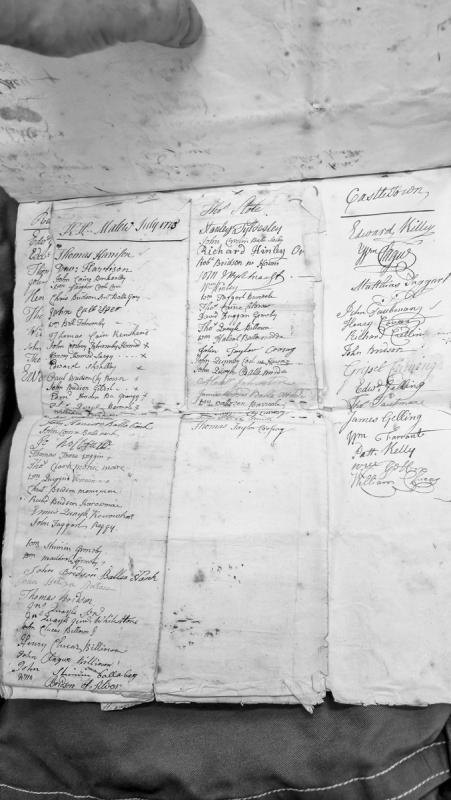
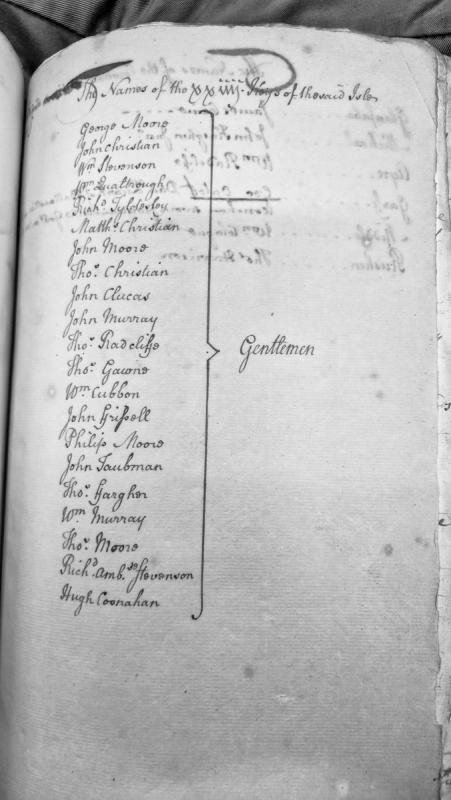
A register of the twenty-four members (Keys) of the House of Keys legislative body of the Isle of Man. The document lists the names of gentlemen serving in this capacity, though the exact date of composition is not specified in the transcription.
A handwritten document from July 1773 listing numerous names of individuals associated with various parishes and locations across the Isle of Man. The document appears to be an administrative or census-related record, with names organized by geographical location. Many entries contain place names and personal identifiers, though legibility is significantly compromised throughout.
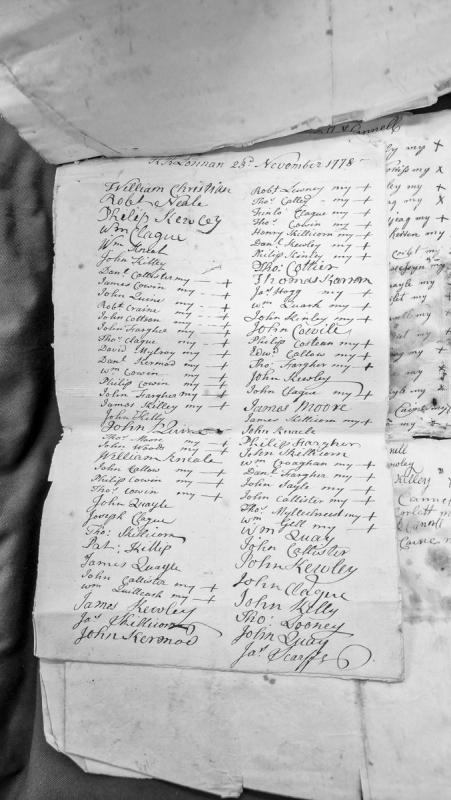
A document listing approximately 80 names from K.K. Lonnan (Kirkby, Kirk Lonan parish) dated 23 November 1778. Many names are marked with 'my' and '+' symbols, possibly indicating some form of parochial or manorial listing, tax assessment, or household enumeration. The purpose and significance of the marks remains unclear without additional context.
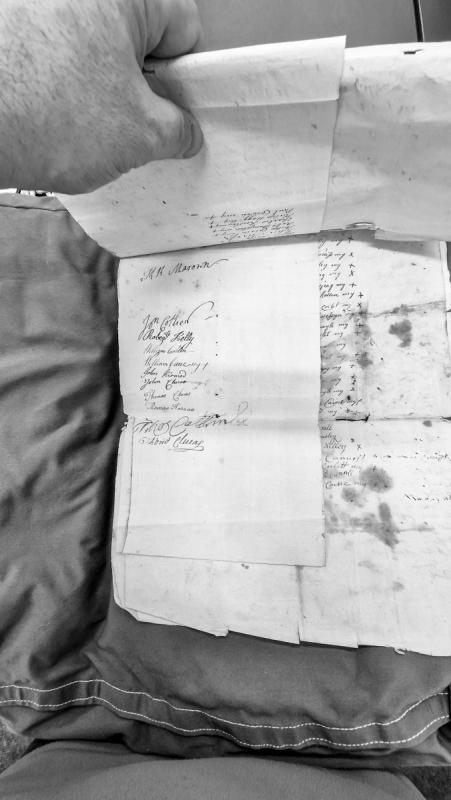
A manuscript list of names from the Marown parish, organized in two columns with various marks ('+', 'x', 'my') beside entries. The right column is substantially obscured by staining and damage. The document appears to be a record or register of local residents.
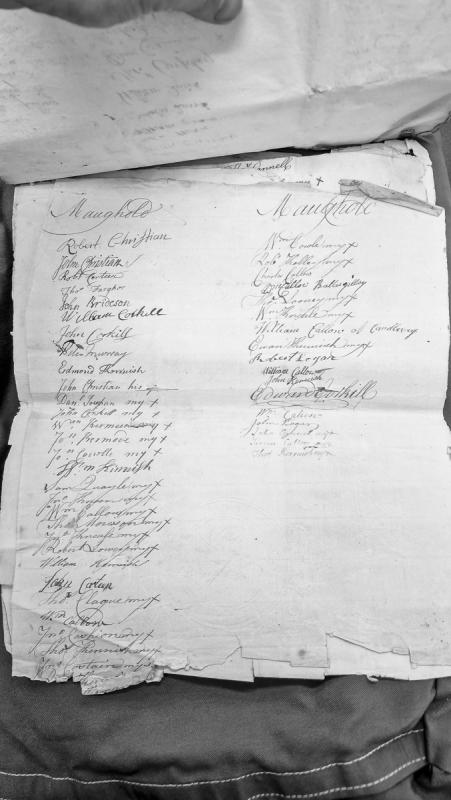
A two-column list of names from the Maughold parish, with many entries marked with '+' (possibly indicating votes, presence, or status). The document appears to be an administrative or court record, though its specific purpose is unclear. Many names are abbreviated and some readings are uncertain.
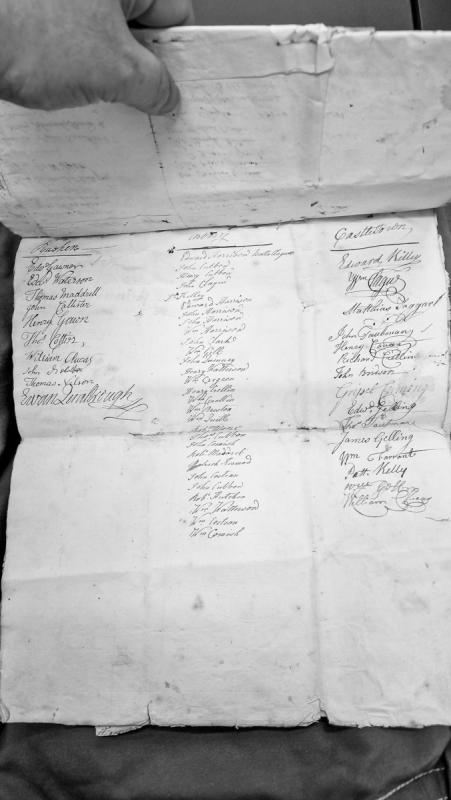
A three-column list of names organized by parish location (Rushen and Castletown). The document appears to be a roster or register of individuals, possibly for administrative, legal, or parochial purposes. Many names have uncertain readings indicated by question marks.
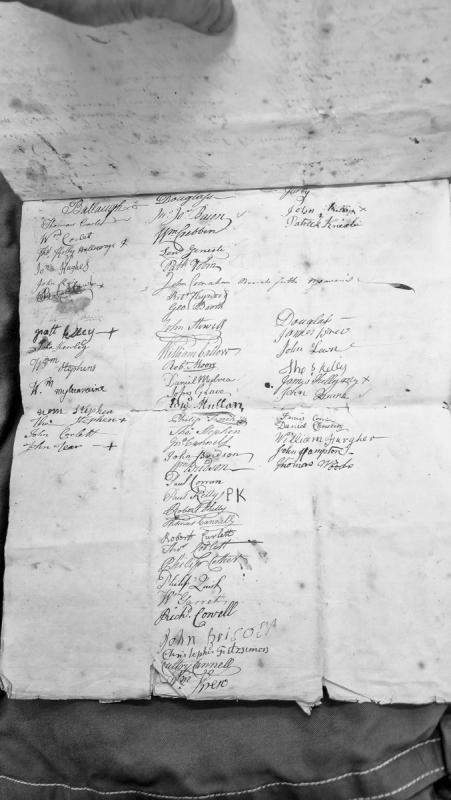
A three-column list of names organized by Manx parishes, likely representing residents, property holders, or participants in an administrative process. The document contains numerous uncertain readings and partial names, suggesting it may be a roster, tax list, or administrative register.
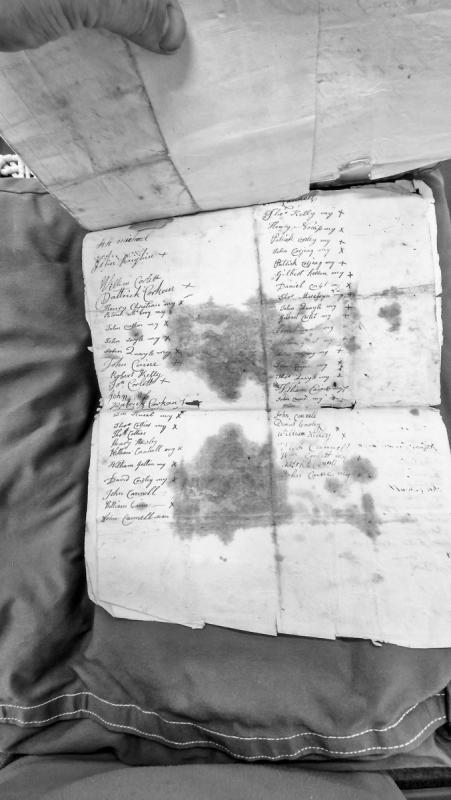
A two-column list of names, predominantly Manx surnames, with various marks ('+', 'my', 'x', '-') indicating signatures, marks, or witness attestations. The document appears to be a record of signatories or participants in a legal or administrative proceeding, though the specific context and date are not provided.
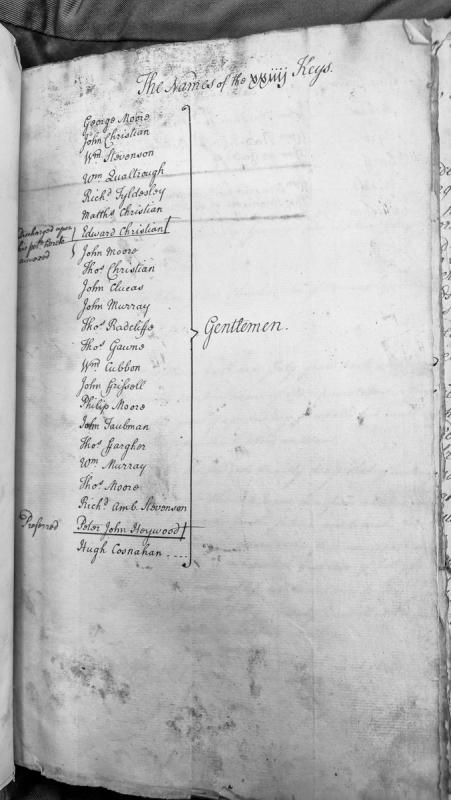
A roster listing the names of 24 members of the House of Keys, the legislative body of the Isle of Man. Marginal annotations indicate that Edward Christian was discharged upon his own request and Peter John Heywood was proposed as a member.
A roster of 21 named members of the House of Keys, the legislative body of the Isle of Man. The document appears to be an administrative list identifying the gentlemen who comprised the Keys during an unspecified period.
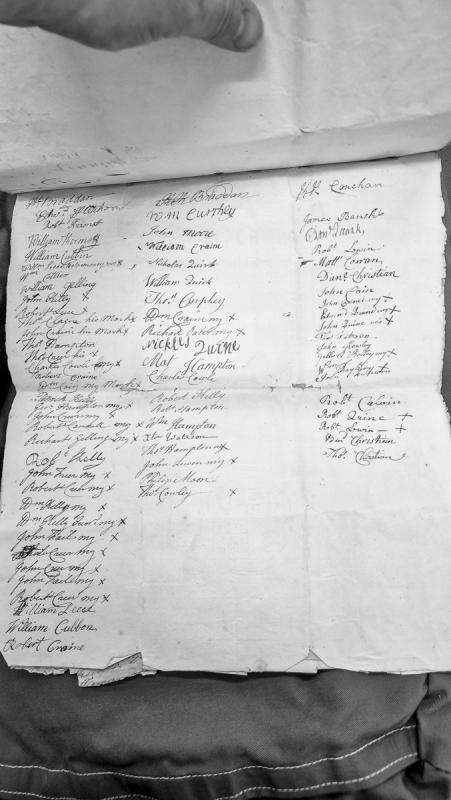
A document containing three columns of names, primarily from the parishes of Kirkby Braddan and Kirkby Conchan on the Isle of Man. Many entries include personal marks (denoted by 'x') or signatures, suggesting this may be a petition, poll list, or administrative register. The presence of marks alongside names indicates inclusion of those unable to write.
Lord Cadogan's official report to the Treasury Lords on the problems of Manx copper coinage, referencing a 1766 memorial by Charles Lutwidge. Discusses the overvaluation of Manx pennies (14 pieces = 1 British shilling despite intrinsic worth of only 3 pence), counterfeiting risks, and the potential adoption of English copper coin. Relevant to post-Revestment fiscal and monetary policy.
Lord Cadogan's report to the Treasury Lords addressing the overvaluation of Manx copper currency (14 Manx pennies equalling one British shilling despite intrinsic worth of only 3 pence). References an earlier 1766 memorial by Mr Lutwidge and discusses the problems of counterfeiting and the need for currency reform, including introduction of English copper coin.
Congratulatory letter from Lord Kinnoull to the Duke of Atholl following the successful conclusion of the negotiations for the sale of sovereignty over the Isle of Man to the British Parliament. Kinnoull affirms that the compensation agreement was prudent and reflects positively on Atholl's conduct and firmness in the transaction. The letter also commends the oratorical performance of Mr Cooper at the House of Commons Bar.
Letter from Lord Mansfield advising the Duke of Atholl on strategy regarding the prospective purchase of the Isle of Man by Parliament. Mansfield cautions against premature response and emphasizes the importance of legal counsel before Parliament convenes. He critiques the approach of other parties (identified cryptically as Sr R W Mr P & D of N) who seek to extract information and demands without committing to formal negotiation or purchase of the whole sovereignty.