Administrative letter from Manx officials (Mylrea and Quayle) to the Duke of Atholl concerning a property application by Mr Arthur for land at Douglas Quay. The letter discusses Arthur's prior occupation of a stable and coach house built ~10 years earlier under Governor Cochrane, and his request for an additional plot and consolidated grant. References harbour proximity, proposed rental payments (5s per year), and mentions Kennedy's bill for £251 12s 1d.
Letter from Dan Mylrea and John Quayle to the Duke of Atholl reporting the discovery of wrecked tobacco off the Isle of Man coast and challenging the authority of the revenue officer Mr Betham to claim wrecks for the Crown. The writers assert that wrecks historically belonged to the Duke and seek Treasury guidance on future wreck jurisdiction following the 1765 Revestment Act.
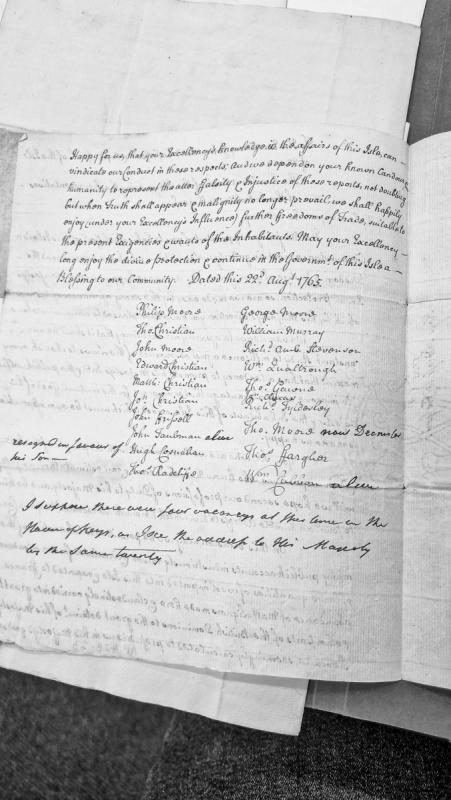
A letter addressed to the Governor ('your Excellency') from representatives of the Isle of Man, defending their conduct against false reports and petitioning for expanded trade freedoms. The document is signed by twenty members, apparently representing the House of Keys, and expresses confidence in the Governor's support.
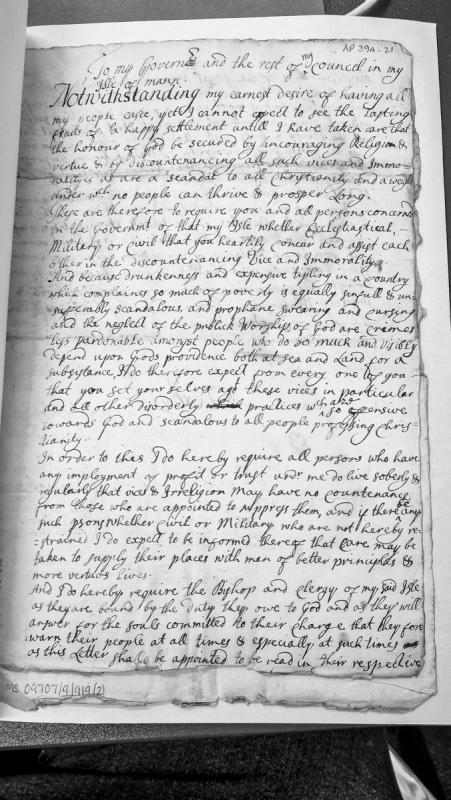
A letter from the Lord of Man (likely the Duke of Atholl) to the Governor and Council of the Isle of Man, emphasizing the need to promote religion, virtue, and moral conduct while suppressing drunkenness, swearing, and other vices. The letter requires government officials and clergy to actively work together to maintain moral standards and set examples of sober, virtuous conduct.
A discursive letter examining the state of the Manks language, its literary output, biblical translations, and scholarly works on the Isle of Man. The author surveys the efforts of Bishop Hildesley and the Society for Promoting Christian Knowledge to publish religious texts in Manks, and provides a comprehensive bibliography of works on Manx history and culture up to 1797. Relevant to understanding the cultural and religious context of the island during the Revestment period.
A substantial letter discussing the state of the Manks language, its preservation and literary development, the publication of religious texts in Manks (1760s–1790s), and a comprehensive bibliography of works on Isle of Man history and culture. Includes specimen Manks texts, linguistic analysis, and details of the Society for Promoting Christian Knowledge's distribution efforts. Highly relevant to understanding cultural conditions on the Island during the Revestment period and immediately after.
Comprehensive administrative and statistical survey of Isle of Man covering ports and creeks (appointed 1776), fairs calendar, parish registers (1647–1796), population figures (1726–1792), vicars/clergy (1798), post-office operations, revenues (1790–1791), import/export duties, commodity trade volumes, and commentary on smuggling suppression post-Revestment. Includes comparative data on Isle of Wight.
A comprehensive administrative letter describing Isle of Man's ports, fairs, parish registers (1647–1796), population statistics (1726–1792), post-office operations, customs duties, imports/exports, and smuggling suppression following the 1765 Revestment. Includes duty schedules, revenue figures, and reflects post-Revestment regulatory changes and Parliamentary acts (5 Geo. III and 1766 act).
An extended letter describing the herring fishery as the staple commodity of the Isle of Man, including natural history of local fish stocks, boat construction, fishing practices, curing methods, export markets (particularly Italy), government bounties, and herring customs duties paid to the Duke of Athol. Includes revenue data from 1760-1765 and export statistics from 1787-1790, plus a patriotic poem on the herring fishery by a Manx lady.
A detailed letter describing the herring fishery as the staple industry of the Isle of Man, including fish species, boat construction, fishing practices, revenue customs, curing methods, and export markets. Accompanied by a poem celebrating the herring migrations and fishermen. Provides economic data on herring duties paid to the Duke of Athol (1760–1765) and export bounties (1787–1790), directly relevant to understanding the island's economy before and after the Revestment.
A lengthy discursive letter on Isle of Man history, governance, and infrastructure. It traces the island's medieval history (Norwegian, Scottish, English, and Stanley rule), discusses the 1765 union with Britain and its social effects (suppression of smuggling, turn to agriculture), explains Manx coinage and its exchange rates with English and Irish currency, describes passenger routes and travel logistics, and concludes with technical observations on horizontal water-wheels found in the island. The author cites Bishop Wilson and other contemporary sources.
A discursive letter discussing the Isle of Man's history from legendary origins through the 1765 Revestment, the island's privileges, practical travel information, coinage systems and their relative values to English and Irish currency, and technical notes on horizontal water-wheels. The author cites Bishop Wilson and references the suppression of smuggling trade post-1765, presenting a contemporary perspective on the social effects of the union with the British crown.
The twelfth letter in a series of observations on Isle of Man governance, law, and society, dated 1798. Provides detailed information on the House of Keys' composition and privileges, historical development of Manx property law (particularly the 1703 Act of Settlement), local statutes and customs, the Tynwald Hill ceremonial process, legal fees, and a comprehensive survey of principal estates across all parishes. Highly relevant to understanding Manx constitutional structures and property rights before the 1765 Revestment's aftermath.
Part of a published letter series describing the Isle of Man's constitutional structures, the House of Keys (24 elected representatives), Manx property law, inheritance customs, criminal statutes, and a comprehensive list of principal estates by parish as of 1798. Provides historical context on the Act of Settlement (1703) and Tynwald ceremony. Highly relevant to understanding pre-Revestment Manx governance and the status quo being negotiated.
Two copies of letters from the Duke of Atholl dated 2 April 1759 to Baron Maule and Lord Mansfield, discussing the Duke's negotiations with the Treasury (West and Martin) regarding the sale of the Isle of Man. References prior proposals to Pelham and Newcastle, seeks advice on negotiation procedure, and requests assistance from Mansfield and the Duke of Argyll in conducting the sale.
A batch of administrative correspondence from Governor John Wood to the Treasury and Secretary of State concerning the separation of civil and manorial administration following the 1765 Revestment, salary arrears, officer pay, government expenses, and the condition of official buildings. Includes routing notes from William Burke (Under Secretary of State) and references to Charles Lutwidge (Receiver General) and John Quillin (Attorney General). Highlights the practical difficulties of establishing Crown governance on the Island.
A collection of nine letters from Governor John Wood to successive Dukes of Atholl covering administrative matters, revenue remittances, officer appointments, and the emerging crisis over smuggling and East India goods. The letters document the transition from the 2nd to 3rd Duke, governance issues including the Taubman deemster commission controversy, and growing concern over Westminster's proposed anti-smuggling legislation in late 1764.
A batch of official correspondence from Governor John Wood of the Isle of Man to the Secretary of State and Treasury officials, covering July–December 1766. Wood addresses critical post-Revestment administrative problems: separation of civil and manorial records and duties, payment of officers and salaries, housing and maintenance of government buildings, and requests for Treasury funding mechanisms. The letters reveal the practical difficulties of implementing the 1765 Revestment and the financial strain on the newly established Crown administration.
A collection of official correspondence from Governor John Wood to the Secretary of State and Treasury officials (1766) detailing post-Revestment administrative problems: separation of civil and manorial administration, officer salary arrears since May 1765, disputed possession of records, housing maintenance, and funding mechanisms. Includes letters from William Burke (Under Secretary of State) routing Wood's concerns through Treasury. Provides direct evidence of governance challenges in the first year after Crown acquisition.
A batch of administrative correspondence from Governor John Wood to the Treasury and Secretary of State concerning post-Revestment governance challenges: separation of civil and manorial administration, salary arrears, officer payments, building maintenance, and contingent expenses. Interspersed with related Treasury communications (Grey Cooper, William Burke). Directly addresses the practical difficulties of establishing Crown sovereignty over the Isle following the 1765 purchase.
A bilingual (Latin and English) royal warrant issued by Henry III granting safe conduct to Harald, King of Mann, to travel to England, remain there, and return, valid until Pentecost in the 30th year of Henry III's reign. This document illustrates the constitutional relationship between the Manx crown and the English monarchy in the 13th century, providing historical context for later sovereignty questions.
A brief royal writ issued by Henry III granting Harald, King of Mann, safe conduct to travel to England, remain there, and return, valid until Pentecost of the 30th year of Henry III's reign. The document is presented in both English and Latin versions and represents early medieval diplomatic relations between the English Crown and the Isle of Man.
A bilingual (English/Latin) record of safe conduct granted by King Henry III to the King of the Isles (Reginald) in 1218, permitting him to travel to the King to render homage and make amends for excesses committed by his subjects in England and Ireland. The document demonstrates early Anglo-Norman relationships with the Hebridean kingdom and the Crown's assertion of feudal overlordship.
A bilingual (Latin/English) royal letter granting safe conduct to Reginald, King of the Isles, when visiting the English King to do homage and address grievances caused by his subjects in England and Ireland. The document establishes a 15-day protection period after Easter in the second year of Henry III's reign (1218) and instructs the Justice of Ireland not to harm the Isles' king or his people. This is an early medieval example of Man's relationship with the English Crown.
Royal letters patent issued by Henry III granting safe conduct to Olave, King of Mann and the Islands, for travel to England to confer with the king. The document includes parallel Latin and English versions and extends safe passage protection to Olave's entourage. It establishes early diplomatic relations between the English crown and the Manx monarchy, demonstrating Mann's separate sovereignty status in the medieval period.