Official correspondence from Lieutenant Governor Charles Smelt to Home Secretary Lord Viscount Sidmouth reporting that the House of Keys (Manx legislature) was declared unsafe on 16 October 1817 by architect Thomas Brine's affidavit. Includes resolutions by House members to adjourn to the George Inn and requests for a government grant to rebuild. A follow-up letter from 7 October 1819 details the rebuilding contract with Brine and payment arrangements. Demonstrates post-Revestment governance infrastructure and the Crown's relationship with Manx institutions.
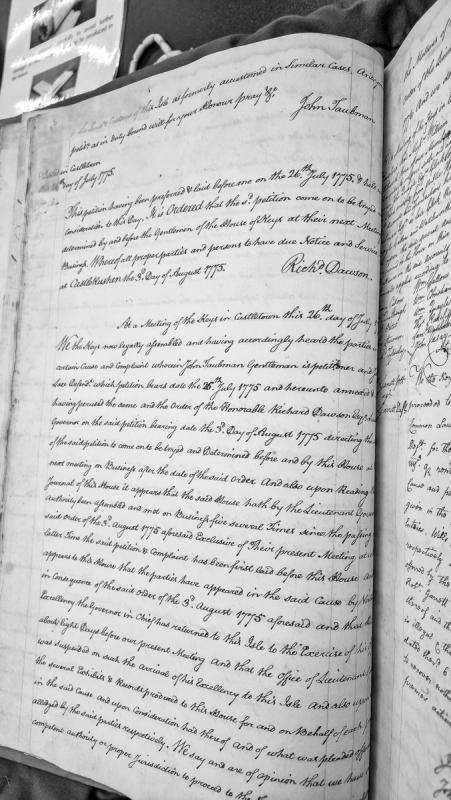
A House of Keys proceeding documenting a petition by John Taubman (Gentleman) against a defendant named Lace. The document includes the original petition dated 26 July 1775, an order by Governor Richard Dawson dated 3 August 1775 directing the matter to the House of Keys, and the Keys' assembled response indicating consideration of the case and jurisdictional questions.
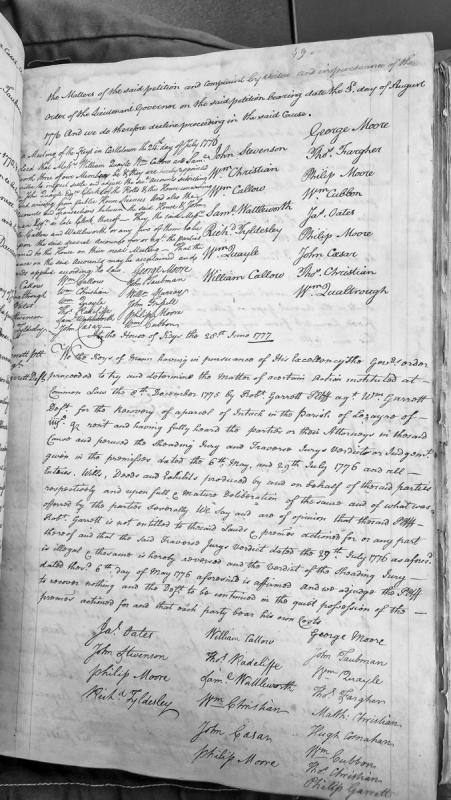
A House of Keys judgment dated 28 June 1777 determining a common law action instituted 8 December 1775 by Robert Garrett (plaintiff) against William Garrett (defendant) concerning an intack (enclosed land) in the Parish of Lezayre. The Keys reversed the traverse jury's verdict of 29 July 1776, affirmed the sheading jury's verdict of 6 May 1776, and ruled in favour of the defendant.
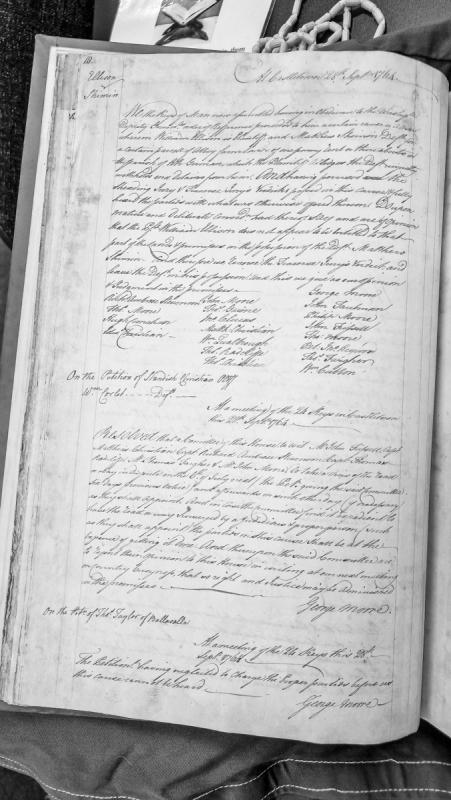
Record of House of Keys proceedings at Castletown on 28 September 1764, containing a judgment reversing a Traverse Jury's verdict in a land dispute over Abbey farm land in the parish of Kirk German between William Ellison (plaintiff) and Matthew Shimin (defendant). The document also records resolutions on petitions regarding a disputed road and a case by Thomas Taylor.
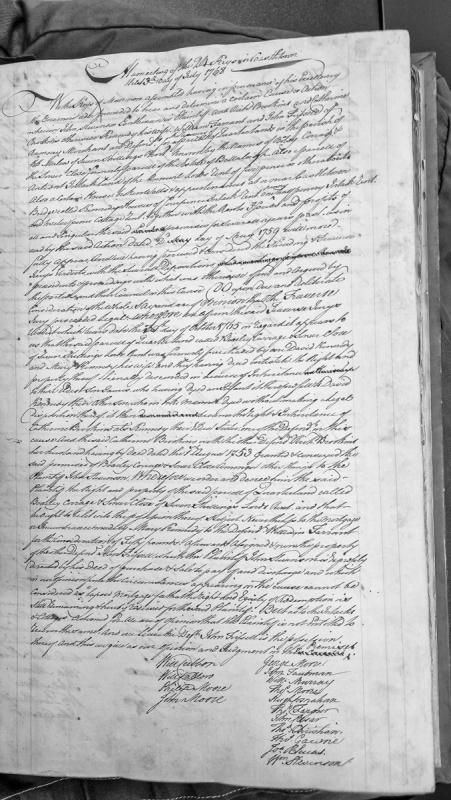
A judgment of the House of Keys assembled at Castletown determining a property dispute over quarterlands and cottage in the Parish of Malew. The Keys affirm a Traverse Jury verdict from 1765, awarding John Swanson possession of Bradly Corage and Simer Close but subject to a mortgage held by William Tarrant, and denying him the Intacks and Cottage.
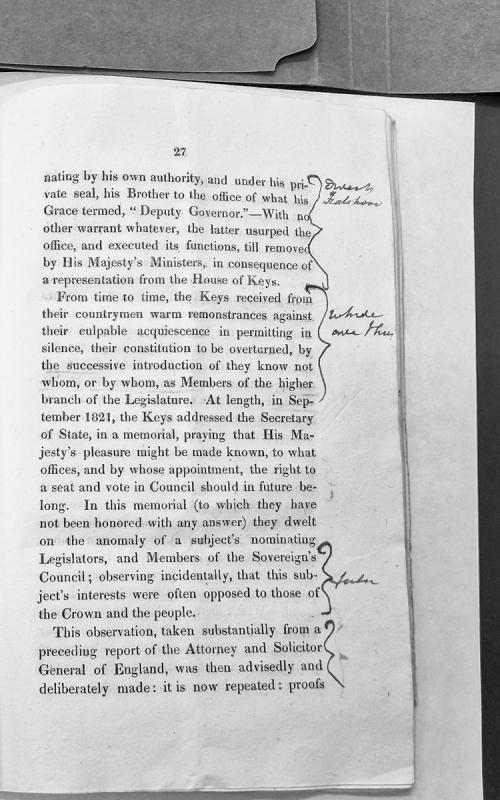
A political document discussing the House of Keys' concerns about the irregular appointment of legislators and council members by private authority. It references a September 1821 memorial to the Secretary of State regarding the anomaly of a subject nominating members to the sovereign's council, with observations that such a subject's interests may conflict with those of the Crown and people.
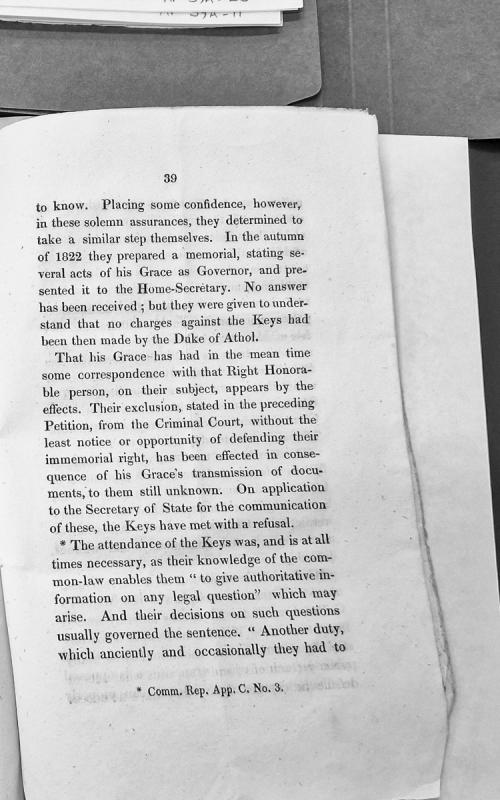
Extract from a petition by the House of Keys describing their exclusion from the Criminal Court and their attempts to address grievances with the Governor (Duke of Athol) through formal channels. The document references a memorial presented to the Home-Secretary in autumn 1822 and discusses the Keys' traditional legal role and rights.
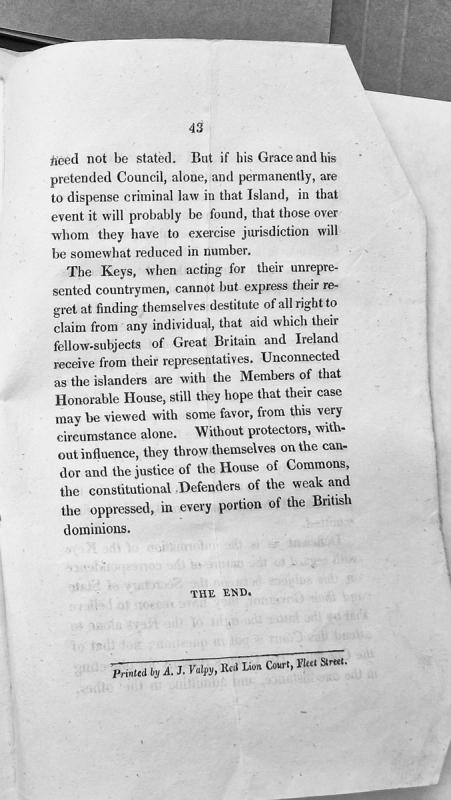
This is the concluding page of a printed pamphlet representing a petition or formal appeal by the House of Keys (the Manx parliament) to the House of Commons. The passage addresses concerns about the concentration of criminal law dispensation in the hands of the Duke of Atholl and his council, arguing that Manx islanders deserve representation and protection similar to other British subjects.
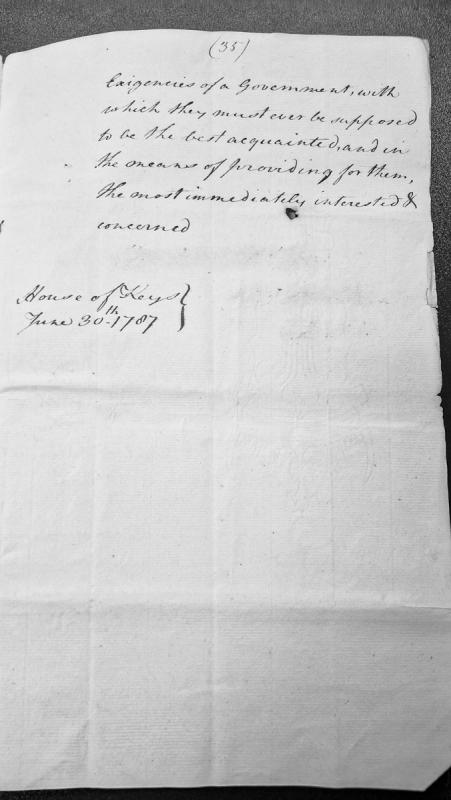
A fragment of a House of Keys document dated June 30th 1787 concerning the exigencies of government and the means of providing for them. The text appears to be part of a larger judgment or resolution discussing governmental matters and the responsibilities of the House of Keys.
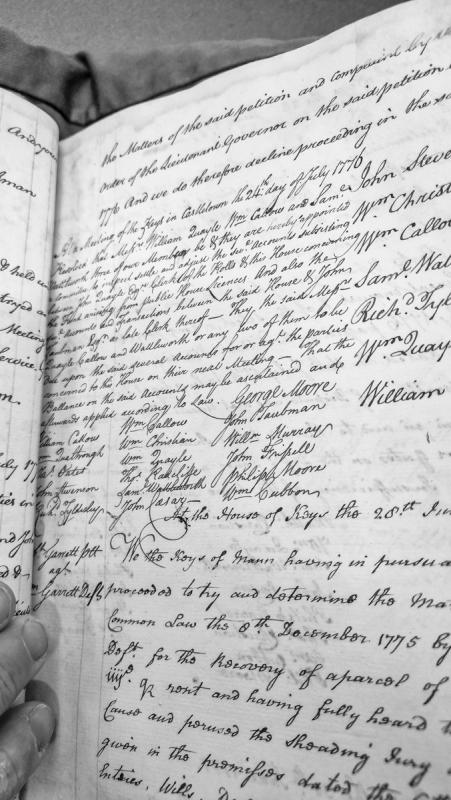
Two House of Keys documents: (1) A resolution from 24 July 1776 appointing a committee to inspect and settle accounts between the House and John Quayle Esq. (Clerk of the Rolls) concerning fines from Public House Licences, and accounts with John Taubman Esq. as late Clerk; (2) A judgment record dated 28 June regarding a Common Law case tried on 8 December 1775 between Sgt Garrett (Plaintiff) and Garrett (Defendant) for recovery of property with associated rent claims.
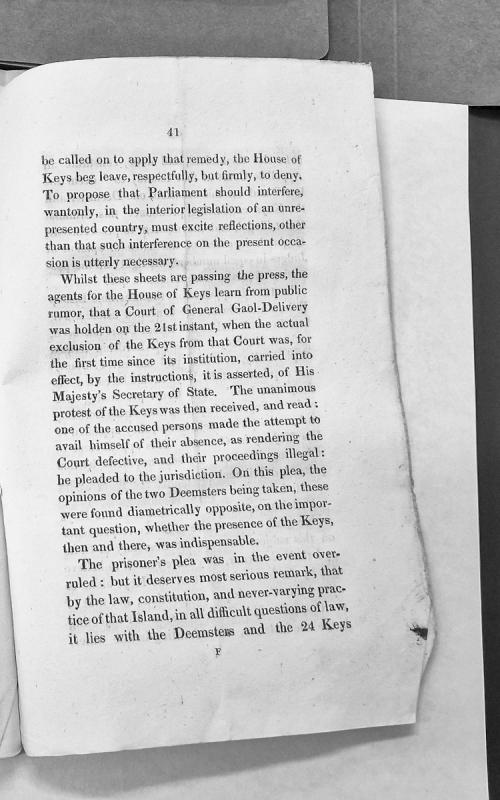
A printed pamphlet page presenting the House of Keys' formal objection to their exclusion from a Court of General Gaol-Delivery held on the 21st instant, allegedly by instruction of His Majesty's Secretary of State. The document discusses the constitutional and legal implications of this unprecedented exclusion and notes a disputed jurisdictional plea by an accused person regarding the absence of the Keys.
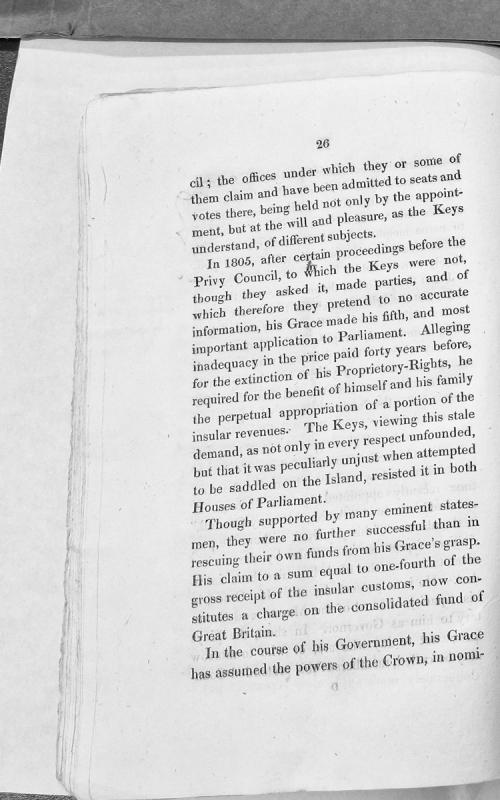
Extract from a legal or political document discussing the House of Keys' opposition to successive applications by a Duke (likely the Duke of Atholl) for financial compensation and appropriation of insular revenues. References proceedings from 1805 before the Privy Council and Parliament regarding inadequacy of compensation paid for extinction of proprietory rights.
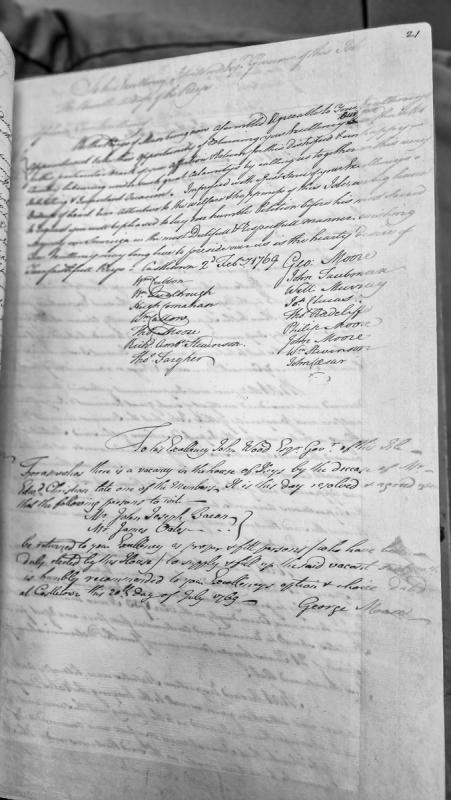
A formal resolution from the House of Keys to Governor John Wood Esq, dated 20 July 1769, recommending two candidates, John Joseph Bacon and James Oates, to fill a vacancy created by the death of Ewan Christian. The document requests the Governor's approval of the elected candidates.
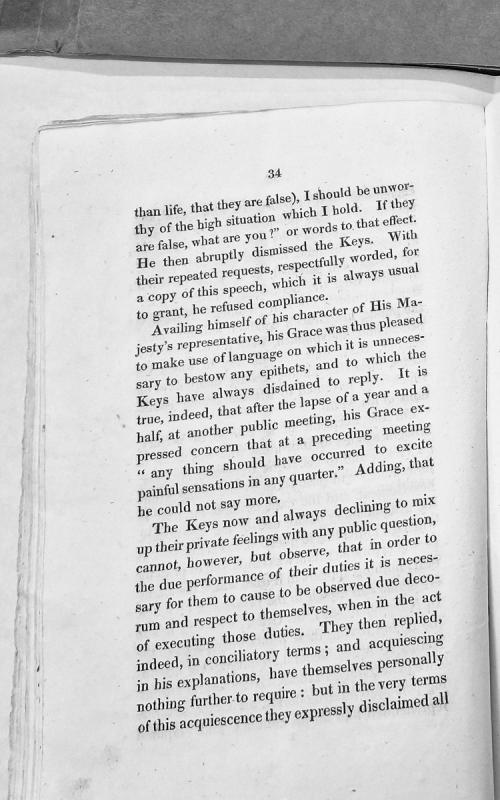
This document records a dispute between the House of Keys and the Governor (referred to as 'his Grace'), regarding the Governor's intemperate language during a meeting and his subsequent refusal to provide a copy of his speech. The Keys describe how the Governor dismissed them abruptly after making what they characterize as insulting remarks, and note that a year and a half later he only expressed vague concern about the incident. The Keys assert their need to maintain decorum and respect in their official duties.
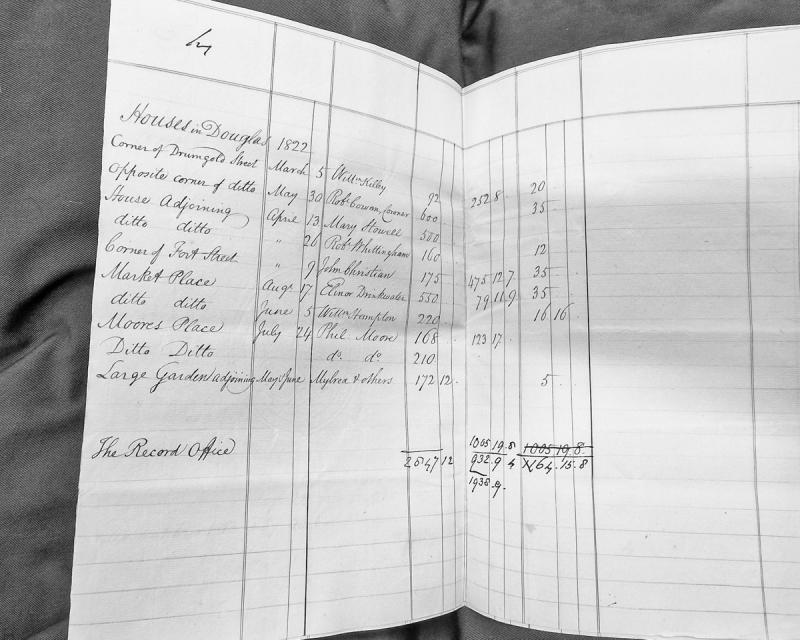
A revenue abstract listing properties in Douglas, Isle of Man during 1822, with owner names, dates of entry, and associated financial values. The document appears to be an official record maintained by The Record Office, detailing house valuations and tax assessments for various locations including street corners and market places.
A peer-reviewed economic history article examining smuggling in 1530s–1540s Bristol through merchant account books and customs records. Jones demonstrates that smugglers were regular merchants who recorded illicit transactions alongside legitimate trade in standard accounts, and uses record linkage to quantify smuggling in leather and grain exports. The study illustrates how high tariffs incentivised evasion and provides methodology applicable to other early modern smuggling analysis.
Extract from the Statutes of the Realm (5 Elizabeth I, 1562) permitting foreign-born merchants to import French wines into Manx ports in foreign-owned vessels, limited to 100 tonnes per year. This establishes early modern trade privileges and Manx commercial autonomy, relevant to understanding pre-Revestment trade frameworks and the Isle's special trading status.
A doctoral thesis examining the Dutch East India Company's decline in the late 18th century through the lens of the relationship between the Company and its servants. The work emphasizes informal institutions (private trade, corruption, networking) as functional mechanisms for adaptation to changing circumstances in Asia. While focused on the VOC, the thesis includes comparative analysis with the English East India Company, offering contextual insights relevant to understanding contemporary corporate and imperial structures during the period of the 1765 Revestment.
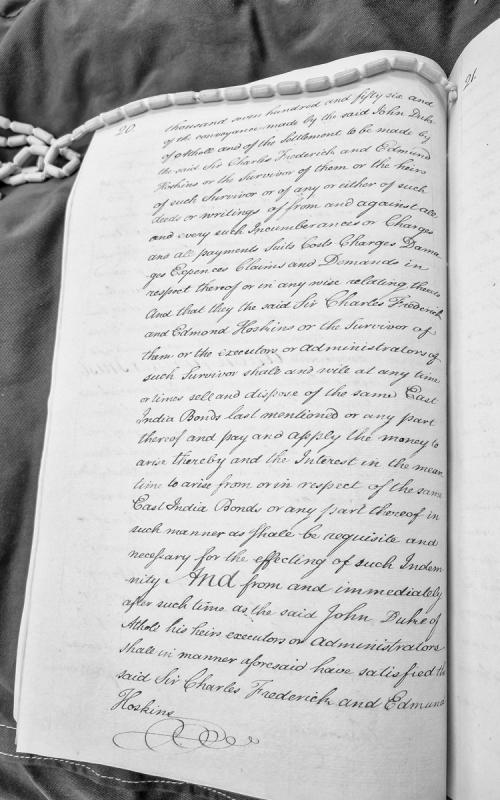
Fragment of a legal indemnity document from 1756 concerning East India Bonds and a conveyance by John Duke of Athol. The document outlines conditions for indemnification by Sir Charles Frederick and Edmund Hoskins, including provisions for the sale and disposition of East India Bonds and the management of arising interest and funds.
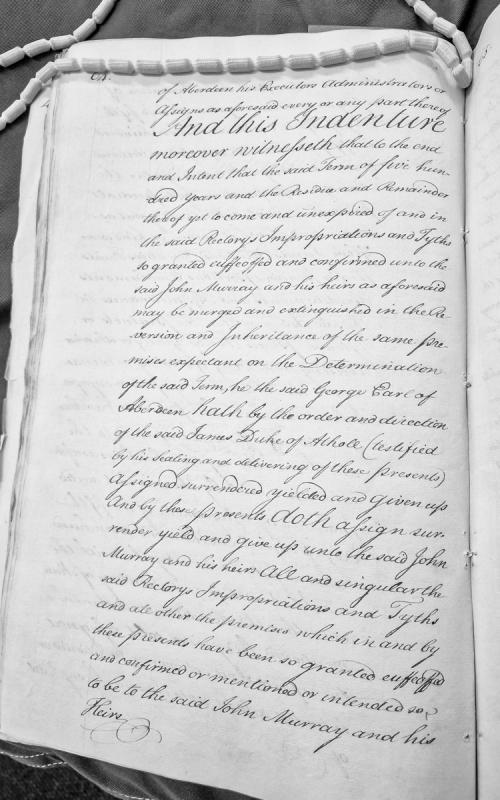
This is an excerpt from a legal indenture concerning the assignment and confirmation of rectory impropriations and tithes to John Murray and his heirs. The document involves George, Earl of Aberdeen, acting under the direction of James, Duke of Athole, and represents a formal legal transfer of ecclesiastical property rights and revenues.
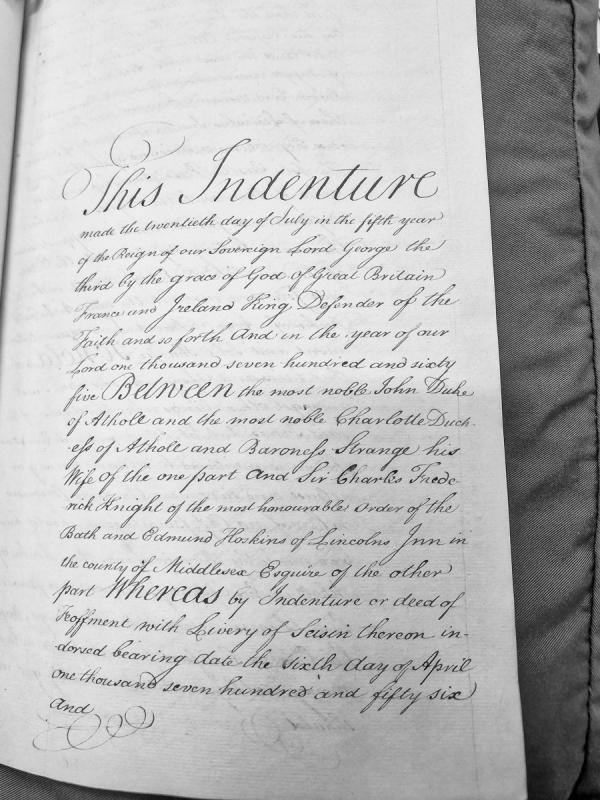
An indenture dated 20 July 1765 between John Duke of Athole and Charlotte Duchess of Athole on one part, and Sir Charles Frederick (Knight of the Bath) and Edmund Hoskins on the other part. The document references a prior deed of feoffment dated 6 April 1756 and appears to concern property matters.
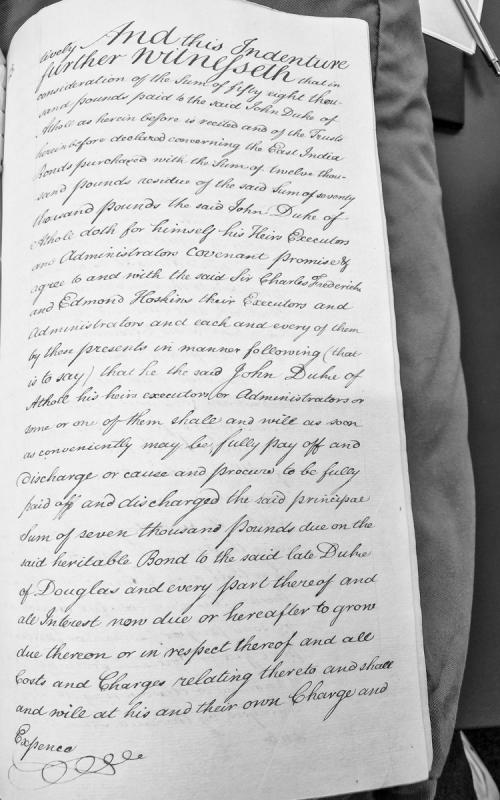
A legal indenture detailing covenants and agreements between John Duke of Athole and Sir Charles Frederick and Edmond Hoskins regarding financial obligations. The document specifies the payment of fifty-eight thousand pounds, trust arrangements for East India Bonds purchased with twelve thousand pounds, and the Duke's covenant to discharge a principal sum of seven thousand pounds due on a heritable bond to the late Duke of Douglas.
A 1503 apprenticeship indenture from the Harleian Manuscripts, documenting an agreement between William Park (master) and John Darse (apprentice) for a 6-year term of service in music instruction and teaching. The document specifies Park's obligations to teach singing, prickle-song, organ-playing, and manners, and Darse's duties of obedience and service. The Abbot of Rushen and other parties serve as sureties. This is a rare example of early Manx institutional and social documentation, providing context for pre-Revestment Isle of Man society and church administration.
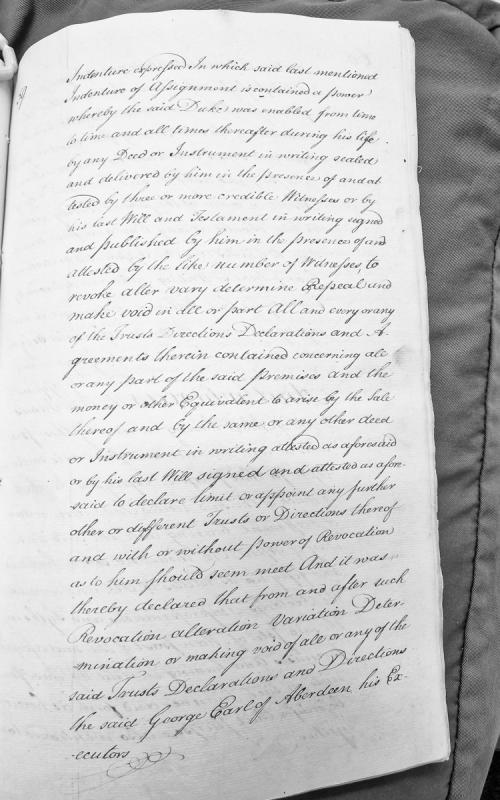
A legal document describing provisions in an indenture of assignment that granted a Duke powers to revoke, alter, vary, and determine trusts and directions concerning premises and proceeds from their sale. The document outlines procedures requiring sealed deeds or wills attested by witnesses, and the subsequent declarations regarding George Earl of Aberdeen and his executors.
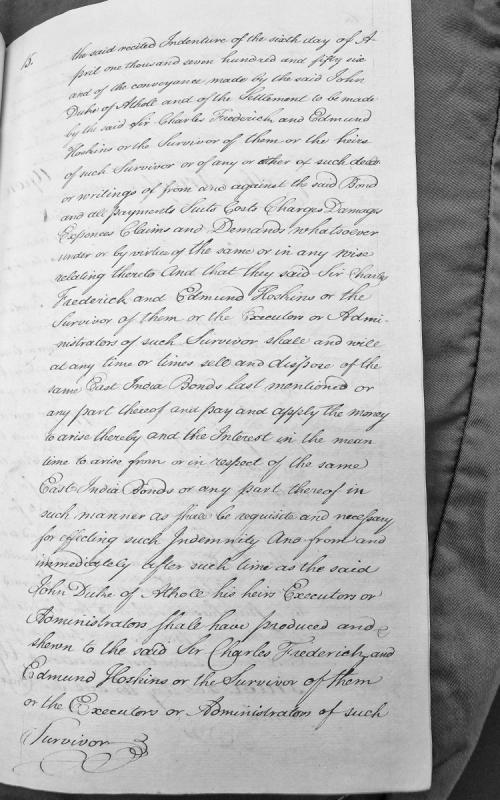
A legal document detailing obligations regarding East India Bonds and indemnification. The document references an indenture dated April 6, 1756, and outlines the duties of Sir Charles Frederick and Edmund Hoskins (or their survivors) to manage and dispose of East India Bonds to effect indemnity.