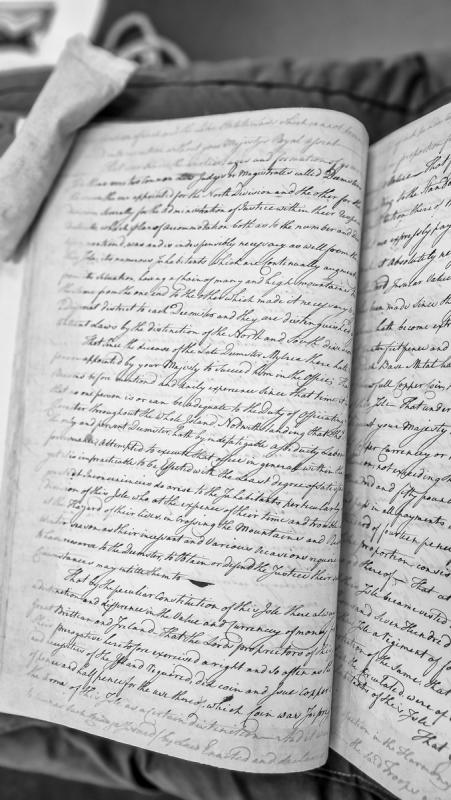
A heavily obscured right-hand page fragment discussing monetary standards, copper coin, currency regulations, and references to royal authority and Isle governance. The document appears to concern coinage valuation and legal tender specifications, mentioning amounts in pounds and pence.
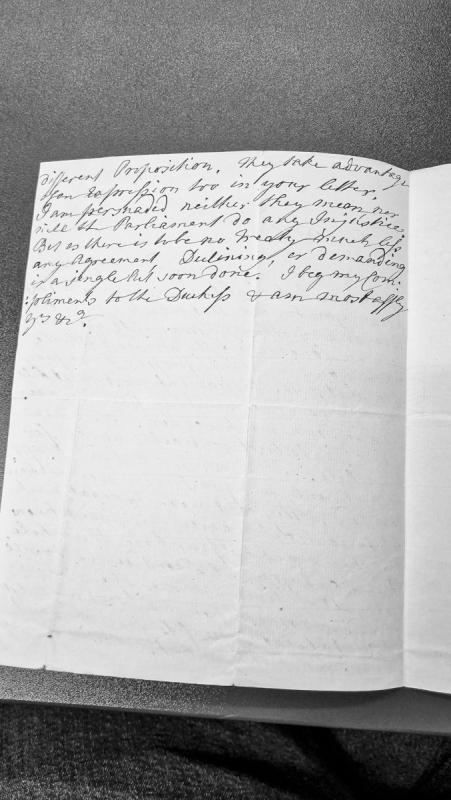
This is a fragmentary letter discussing a proposition and concerns about potential injustice. The writer expresses confidence that neither the addressee nor Parliament intends injustice, and notes that in the absence of a treaty, any agreement or demand can be quickly resolved. The letter closes with compliments to a Duchess.
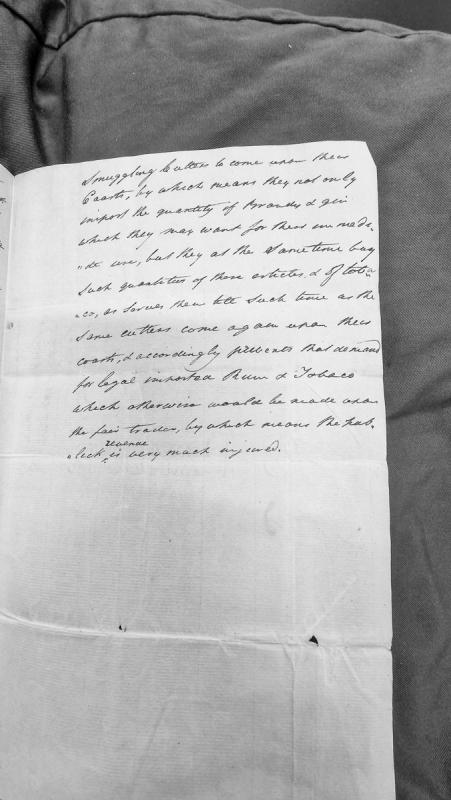
This is a fragmentary passage discussing the impact of smuggling cutters on coastal trade, particularly how they supply brandy, gin, and tobacco to local populations, thereby reducing demand for legally imported rum and tobacco and injuring public revenue.
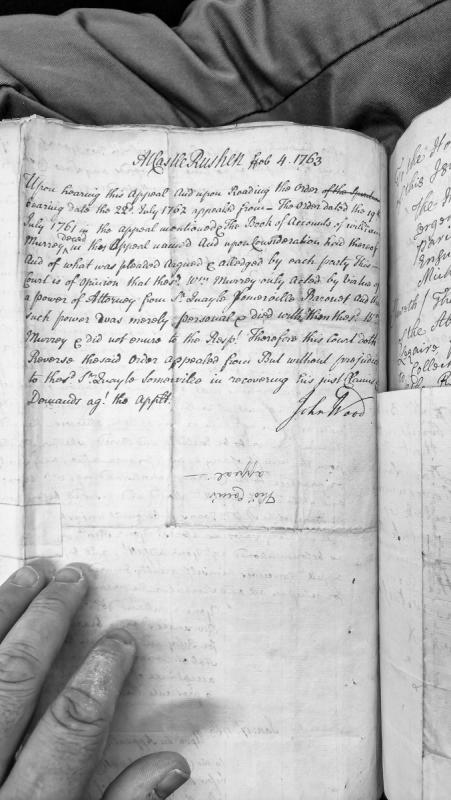
A fragmentary document containing only inverted text at the bottom of a page. The legible text includes 'ex parte' (Latin legal terminology) and what appears to be 'eMurry' or similar, suggesting this may be part of a legal document or court matter.
A heavily damaged or partially visible text fragment showing only the right edge of an adjacent page. The content is largely obscured, with only disconnected words and partial phrases visible, making it impossible to determine the document's purpose or full content.
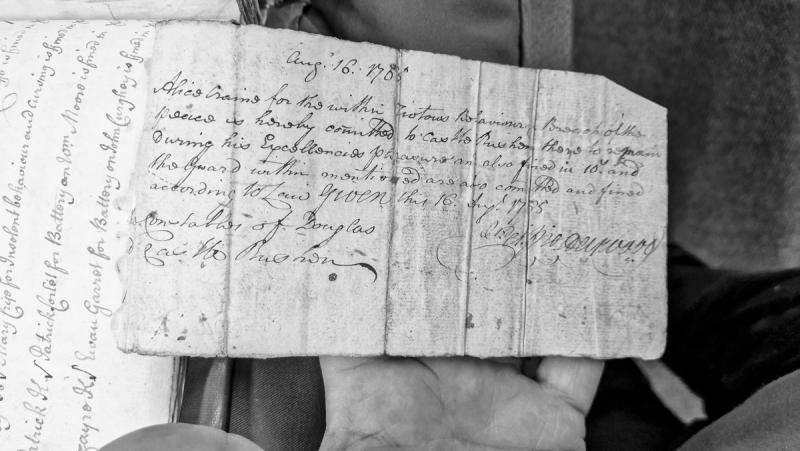
A partially visible and rotated court document recording presentments or charges against multiple individuals. Legible names include Mary Cla[?], Patrick Corlet, and Susan Garret, with charges involving insolent behaviour, cursing, and battery. The document is severely fragmented with substantial text loss.
Letter from Massachusetts Governor Francis Bernard to Benjamin Franklin requesting assistance in arranging his son's passage from Alexandria, Virginia to Philadelphia and onwards to Boston. The letter references earlier correspondence and indicates a logistics issue with the young Bernard's travel arrangements. Contextually relevant to understanding transatlantic colonial communications and the networks of prominent American colonial figures during the pre-Revolutionary period.
A detailed letter from the Attorney General of the Isle of Man defending his non-residence on the island against criticism from the Duke of Atholl. Frankland argues that his services are more effective when based in England, citing precedent, Treasury warrants, constitutional law, and support from island authorities. The letter addresses the tension between the Duke's proprietary interests and the Crown's control over Manx offices.
Attorney General Frankland defends his non-residency on the Isle of Man against criticism from the Duke of Atholl, arguing that his legal services are more effective when based in England. The letter addresses constitutional questions about the Attorney General's duties, the legitimacy of absence under the 1696 Act of Tynwald, and the Treasury Warrant of 1808 governing salary conditions. It provides insight into tensions between the Manx ducal interest and the Westminster establishment.
A certificate issued by royal commissioners (Robert Suthwell, James Layborne, Thomas Holcrofte, and John Ashton) surveying the lands and revenues of Furness Abbey following the Dissolution of the Monasteries. The document specifically lists ecclesiastical and temporal holdings in the Isle of Man, including Rouat wathe (valued at 12d. annually) and the parsonages of St Mahold and St Michael (let at farm for £6 13s. 4d. yearly). Relevant to understanding pre-Revestment Manx governance, church property, and historical land tenure.
Letter from G. Nicolson to Mr. Bowes reporting on attempts by Islanders (Manx) to land in Scotland, with intelligence that they were deterred by defensive preparations. Dated 1 August 1595 (37 Eliz). Originally from State Paper Office, Scotland. Provides evidence of 16th-century Isle of Man activity and cross-border tensions.
A 16th-century historical narrative tracing the legendary and actual rulers of the Isle of Man, from the mythical Mananan mac Leirе through the Stanley dynasty. The text combines folklore (Mananan's necromancy, St Patrick's conversion) with dynastic history, documenting succession through Scandinavian, Scottish, English, and Stanley periods. Provides genealogical context essential for understanding pre-Revestment sovereignty claims.
A 1595 state paper from the Scottish State Paper Office reporting on military intelligence regarding a threat of invasion from Islesmen (likely MacDonald forces from the Hebrides) against Scottish territory and the Isle of Man. The letter discusses the positioning of a 4,000-strong army near Mull of Buntyre and warns of planned attacks on the Isle of Man before potential raids on Ireland. It reflects 16th-century geopolitical tensions in the Irish Sea and northern Atlantic regions.
A letter from George Ackroyd Erskine to George Nicolson dated 25 July 1595 reporting intelligence of a military force of 4,000+ men threatening invasion of the Isle of Man and Scotland from the sea. The writer warns that the force may first attack Man before proceeding to Ireland to seek aid from the Earl of O'Neill. The letter requests urgent notification to the Lord Warden and border officials to dispatch ships for the defence of the island, emphasizing the strategic importance of Man and the threat posed by hostile forces allied with enemies of the English Crown.
Letter from George Grenville (First Lord of the Treasury) to the Duke of Atholl acknowledging receipt of correspondence regarding the Isle of Man settlement and promising to present the Duke's letter to the Treasury Board at their next meeting. Grenville expresses willingness to help settle 'this important business' in accordance with Parliamentary intention and in a manner agreeable to both the Duke and the public interest.
A letter from George Grenville (First Lord of the Treasury) to the Duke of Atholl dated 2 September 1764, acknowledging receipt of the Duke's letter of 20 August and promising to transmit the Duke's letter to the Treasury Commissioners at their next meeting. Grenville expresses willingness to help settle 'this important business' in accordance with Parliament's intention and to the Duke's satisfaction. This is a crucial document in the pre-Revestment negotiations.
A biographical and historical study of George Moore (1709–1787), a prominent Peel merchant and Speaker of the Keys, examining his commercial ventures in the contraband trade, his family life, and his political role during and after the 1765 Revestment. Based on Moore's personal letter books held in the Manx Museum, this retiring presidential address illuminates merchant life, smuggling economics, and the political tensions surrounding Manx independence.
A scholarly article by David Craine examining the life and business activities of George Moore (1709–1787), a prominent Peel merchant and Speaker of the Keys during and after the 1765 Revestment. Based on Moore's letter books held in the Manx Museum, the paper explores his involvement in the smuggling trade, his transatlantic commercial ventures, his role in Manx political affairs, and his complex relationship with Bishop Wilson's anti-contraband stance.
Official correspondence warning of a potential Highland incursion against the Isle of Man, addressed to a Scottish official. The document comes from the State Paper Office, Scotland, and reflects 16th-century security concerns regarding the island. While predating the 1765 Revestment by 170 years, it provides historical context on external threats to Manx governance and authority.
A brief administrative letter from George Nicolson to Mr. Bowes dated 8 May 1595, reporting intelligence that Highland forces intend a surprise attack or incursion against the Isle of Man. The letter urges vigilance and defensive preparations. This document provides early modern context for external threats to the island's security and governance prior to the Revestment period.
Letter from George Quirk, Water Bailiff of the Isle of Man, to James Clarke discussing contemporary political tensions on the island, including disputes between the House of Keys and the Governor over parliamentary procedure, the Gaol Delivery question, and a proposed High Road Bill. References memorials to the Privy Council and House of Commons, and mentions resignation of General Cuming from the Keys.
Letter from George Quirk, Water Bailiff of Isle of Man, to James Clarke (likely a government official) detailing internal political tensions on the island in 1824. Discusses memorials from the House of Keys challenging the Lieutenant Governor's authority, disputes over Gaol Delivery court membership, disagreements on highway legislation, and factional divisions. Written in the post-Revestment era, it illuminates continued constitutional friction between the Manx legislature and British-appointed executive.
A confidential letter from George Quirk (Castletown) to James Clarke reporting on Isle of Man political affairs in 1824, including the House of Keys' petition against the Duke of Atholl, the Petition presentation, governance disputes, proposed legislation (Registry, Highroad, Coroners' Bills), and tensions between the Keys and the Duke's administration. Provides contemporary insight into post-Revestment constitutional friction.
A detailed letter from George Quirk (Castletown) to James Clarke (presumed Home Office official) dated 22 April 1824, discussing tensions between the House of Keys and the Duke of Atholl, the Keys' petition against the Duke, disputes over legislative bills (Registry, Highroad, Jail Delivery), and broader constitutional conflicts. The letter provides insights into post-Revestment governance, local political factionalism, press suppression, and the Keys' growing institutional power.
Personal letter from George Washington to Burwell Bassett discussing agricultural conditions in Virginia during the drought of 1765, recent burgess elections in which Washington was elected for Fairfax County, and Governor Fauquier's prorogation of the Virginia Assembly. Provides contemporary perspective on colonial electoral politics and the political climate following the Stamp Act crisis.