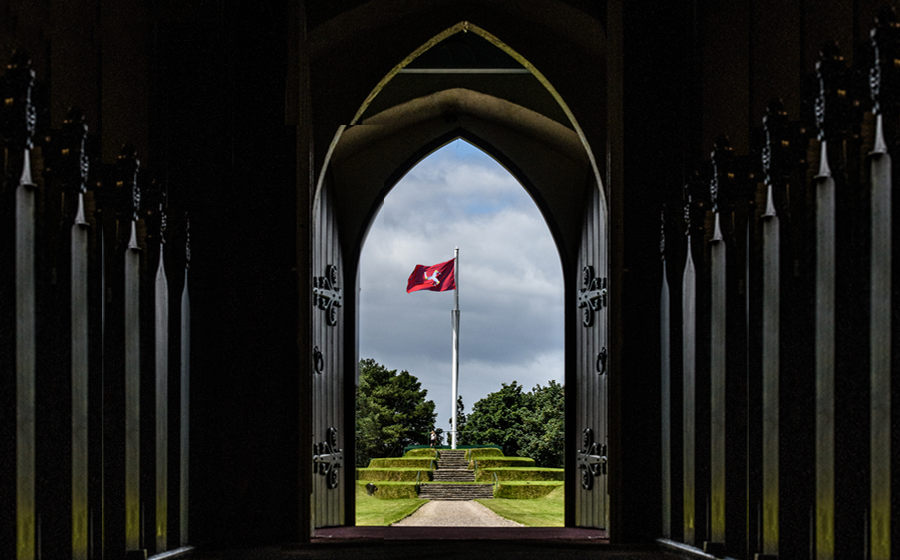
The Manx-medium primary school opened at St John's — within sight of Tynwald Hill. Children learning in the language that was supposed to have died, at the centre of the Island's constitutional life. The survival of Manx identity is the people's achievement, not the Crown's.
Ned Maddrell, the last native speaker of Manx Gaelic, died at Cregneash. His death was reported internationally as the death of a language. But by then, Brian Stowell and Douglas Faragher and others had already begun the revival work that would prove the reports premature. The language was not dead. It was waiting.
The Manx Language Society — Yn Cheshaght Ghailckagh — was founded to preserve and promote the Manx language. A.W. Moore and others recognised that the language was dying and that its loss would mean the loss of the Island's cultural identity. The Society's work would eventually feed the revival that produced Bunscoill Ghaelgagh a century later.
The Isle of Man granted property-owning women the right to vote — decades before Westminster. The Island that had been treated as constitutionally insignificant led the British Isles in democratic reform.
The House of Keys Election Act gave Manx people the right to elect their own representatives for the first time. Previously the Keys had been a self-electing body. The Act was the culmination of forty-five years of petitioning — the constitutional machinery that the Revestment had silenced, slowly restarting.
Press gangs operated in Douglas, seizing Manx men for the Royal Navy. The Island that had lost its merchant fleet to Crown seizure now lost its men to Crown impressment. The fishermen and sailors who had worked the Irish Sea routes were taken for service in wars that had nothing to do with them.
Parliament debated the condition of the Isle of Man. The devastation was acknowledged. And then Parliament voted to send Manx surplus revenues to the Consolidated Fund. The Island paid for its own dispossession. The circle was complete.
Captain John Quilliam of Inch, Isle of Man, served as First Lieutenant aboard HMS Victory at Trafalgar. He took the helm after the original helmsmen were killed, steering the flagship through the battle. Other Manx sailors were among the wounded. The Island that had been stripped of its men by impressment still sent them to fight Britain's wars.
Parliament sent Commissioners to investigate conditions on the Island twenty-seven years after the Revestment. The Commission documented the devastation — economic collapse, population decline, infrastructure decay — and recommended remedies. The Duke of Atholl testified with remarkable candour about the coercion, administrative chaos, and the rushed nature of the original transaction. The recommendations were largely ignored.
A storm destroyed Douglas harbour, killing fishermen. The harbour had been neglected under Crown administration — the infrastructure that the Manx people depended on for their livelihoods left to rot because the Crown had no interest in maintaining what it had purchased.
George Moore and others travelled to London repeatedly to petition for relief from the consequences of the Revestment. The deputations were received politely and achieved nothing. Moore's letters from London, preserved in the Bridge House Papers, document the experience of a Manx patriot confronting parliamentary indifference.
For over a decade after the Revestment, Tynwald was effectively silenced. No petitions heard in the old way. No laws promulgated as the constitution required. The ancient ceremony continued in form but the substance — the living governance the Prologue describes — was hollowed out. The silence is the book's recurring structural motif: told, acknowledged, ignored.
The formal transfer of sovereignty from the Duke of Atholl to the Crown. Crown officers took possession of Castle Rushen. The Duke's administration ended. The ceremony marked the moment when the custodianship — held by the Stanleys and then the Atholls for three and a half centuries — passed to a Crown that had no interest in the Island beyond stopping the trade.
The Isle of Man Purchase Act (5 Geo. III, c. 26) received Royal Assent. Parliament purchased the Duke of Atholl's sovereignty and revenue rights for £70,000. The Act was titled 'for the more effectual preventing of the mischiefs arising to the Revenue and Commerce of Great Britain and Ireland, from the illicit and clandestine Trade to and from the Isle of Man.' Parliament bought a feudal title. It did not acquire the Manx nation. It did not assume the duty of governance.
The House of Keys passed a formal resolution opposing the sale of the Island. The signatories — the elected representatives of the Manx people — recorded their opposition 'as much as in them lies.' They sent Hugh Cosnahan to London to deliver the petition. Parliament received it and ignored it.
Whitehaven merchants petitioned Parliament about the Manx trade, complaining that goods entering the Isle of Man at low duty were being re-exported to Britain, undercutting British merchants who paid full rates. The memorial was one of the triggers for Parliament's eventual decision to purchase the Island — the East India Company's commercial interests dressed as a revenue protection measure.
The Act of Settlement codified the relationship between lord and people, securing Manx land rights and defining the custodianship. It happened because the Lord needed his tenants to invest in land they believed was theirs — the alignment of interest producing constitutional settlement. This was the arrangement Parliament would purchase in 1765 without understanding what it was buying.
The Privy Council — the King-in-Council, not Parliament — intervened after Illiam Dhone's execution. The Deemsters were committed, the Christian estates restored, Edward Christian reinstated to his judicial office. This was an exercise of the Crown's personal authority over a feudal subordinate, not Parliament's legislative reach. The distinction would prove crucial a century later when Parliament assumed legislative authority over the Island during the Revestment.
William Christian — Illiam Dhone, 'brown-haired William' — was executed at Hango Hill, Castletown. He had surrendered the Island to the Parliamentarians in 1651 to spare the Manx people from siege. After the Restoration, the 8th Earl of Derby had him tried and shot. The parish register of Kirk Malew recorded his death as a martyrdom. The Privy Council later intervened, restoring the Christian estates and disciplining the Deemsters who had convicted him. The Island still mourns him.
The codification of Manx law at Tynwald in 1417 preserved the Island's legal tradition in written form. The breast law — customary law carried in the memory of the Deemsters — was recorded. This was not an imposition of new law but the writing down of what the Deemsters already knew and applied.
Tynwald formally ratified Stanley rule — not as automatic acceptance of an English king's grant, but as the Manx constitutional body exercising its own authority to confirm a new lord. The distinction is important: the grant came from Henry IV, but the legitimacy came from Tynwald.
Henry IV granted the lordship of Mann to Sir John Stanley in 1405 (lifetime grant), re-granted as inheritable on 6 April 1406. The Stanley dynasty would hold the Island for over two and a half centuries. The grant came after Percy's rebellion — the Island as political reward. The family that bet on Henry at Bosworth would later collect the earldom of Derby.
Sir William le Scrope was inaugurated as Lord of Mann at Tynwald — the first recorded formal installation of a lord at the ancient assembly site. He was executed six years later in 1399, his lordship forfeit.
Edward III formally recognised Mann as an independent kingdom under William de Montacute, renouncing direct English claims. The Latin text confirmed Mann's separate status — not a territory of the English Crown but a kingdom held under it. This distinction would matter enormously four centuries later when Parliament assumed it could purchase the lordship as though purchasing a piece of England.
The Treaty of Perth ended Norwegian suzerainty over the Isle of Man and the Western Isles. Magnus of Norway ceded the territories to Alexander III of Scotland. For the Isle of Man, this began a period of contested sovereignty — alternating between Scottish and English claimants — that would last until the Stanley grant of 1405.