
Institutions
- Title
- Institutions
Items
Bridge House, Castletown
The administrative and commercial heart of pre-Revestment Mann. Standing on the harbour at Castletown, Bridge House served as the office of the Clerk of the Rolls — the Duke's principal administrative officer. John Quayle conducted the lordship's business from here, with windows looking out over the water where ships from Rotterdam and Barcelona discharged their cargoes. His grandson George Quayle ran Quayle's Bank from the same building, and in 1789 built a concealed dock beneath it to house the armed yacht Peggy — with sea gates opening directly onto the harbour, winding gear, concealed cupboards, secret doorways, and mechanical alarm bells. The Peggy was discovered in 1935, the oldest surviving yacht in the world.
1792 Commission of Inquiry
Parliamentary investigation into the consequences of the Revestment, appointed in 1791 following J.C. Curwen's presentation of the Manx petition. Three Commissioners examined witnesses including the 4th Duke of Atholl, John Quayle (Clerk of the Rolls), Lt-Governor Shaw, and numerous Manx officials. Their report confirmed in exhaustive detail what everyone who had been paying attention already knew: the customs system was 'in many of the fundamental and most essential Parts and Requisites, ill digested, incomplete, and unfit.' The Commissioners confirmed that the Manx legislature possessed authority 'as completely binding within its Jurisdiction, as the Legislature of any Country whatever.' David Reid submitted dissenting observations. The report documented harbour collapse, revenue extraction, prison conditions, legislative silence, and administrative chaos.
Yn Cheshaght Ghailckagh
The Manx Language Society, founded in 1899 by A.W. Moore — Speaker of the House of Keys, historian, the man whose History of the Isle of Man documented the crime with the restrained fury of someone who loves the thing that has been damaged. Its motto: Gyn chengey, gyn cheer — Without language, without country. The revival began before the last native speaker died. Brian Stowell began teaching and promoting Manx in the 1960s. Douglas Faragher's English-Manx dictionary introduced twentieth-century vocabulary to a language frozen in the nineteenth. In 2001, Bunscoill Ghaelgagh opened — the first primary school teaching entirely through Manx.
Manx Fencibles
Defensive regiment raised on the Isle of Man in the 1790s during the Napoleonic Wars. Officered by Manx families, recruited from the parishes, trained on the Island's own ground. Not the British garrison — the Fencibles were Manx men serving in the Manx military tradition that predated the Revestment by centuries. Raised from an island that Parliament treated as a revenue line, from families living in the conditions the Revestment had created — collapsed economy, ruined harbours, sixpence-a-day wages. They volunteered anyway. Not out of loyalty to the Parliament that had done this to them, but out of something older: the habit of service woven into the Island's identity.
British Garrison (post-Revestment)
British regular troops deployed to the Isle of Man from 1765. Hale's Light Dragoons arrived by 28 June 1765, followed by the 2nd Queen's Royal Regiment of Foot. These were not Manx troops under new command — they were British regulars shipped from Ireland, answering to British officers under British military law. The 42nd Black Watch — the Freiceadan Dubh, originally raised to police the Scottish Highlands after the Jacobite risings — followed. Home Office papers from 1828 confirm continuous presence for sixty-three years 'excepting when occasionally withdrawn for short intervals.' The barracks were in bad repair by 1783, the bedding 'very bad and defective.' No Parliamentary money was forthcoming for repairs.
The Manx Garrison (pre-Revestment)
The Lord of Mann's military establishment. A community force numbering perhaps fifty men across the entire Island. The disbursement accounts from 1670 to 1765 preserve the names: the Brew family serving across four generations, the Killeys father and son, the Quayleys and Corins and Christians. These were tradesmen who happened to draw garrison pay. William Corris was a soldier and also the slater who kept Castle Rushen in repair. They answered to the Lord of Mann through his officers. They were Manx. They knew the people they served alongside, because they were the same people. A garrison made of neighbours is not an occupying force. It is a community maintaining its own defences.
Crown Customs Establishment (post-Revestment)
The revenue administration imposed after 1765. All Duke's revenue officers were dismissed on the day of transfer. Charles Lutwidge — of the Whitehaven family that had lobbied for the Revestment — was appointed Receiver-General. The 1792 Commissioners found the system 'in many of the fundamental and most essential Parts and Requisites, ill digested, incomplete, and unfit.' Ten specific failures catalogued. Former smugglers appointed as revenue men. The Riding Officers in 'Neglect and Disorder.' Lutwidge absent since 1786, sitting on £5,119 in unreported balances. Manx people were charged more for tea than consumers in Great Britain — the revenue measure that destroyed their economy made their goods more expensive than anyone else's in the King's dominions.
Manx Customs Establishment (pre-Revestment)
The Duke of Atholl's revenue collection system on the Isle of Man. The entire operation was managed by a handful of officers paid on a scale that invited accommodation. Paul Bridson, the principal revenue officer at Douglas, was paid three pounds Manx per year. The total salary bill for every revenue officer on the Island came to forty-nine pounds, thirteen shillings, and fourpence — for collecting six or seven thousand pounds annually. A significant portion of duties were charged ad valorem, assessed on the value declared by the importers themselves. The Duke observed: 'When I hear of people on such salaries as these, living splendidly, bringing up numerous families, or dying opulent, I cannot but doubt the fair collection.'
East India Company
The commercial monopoly whose interests drove Parliament to act against the Isle of Man. The Company held the exclusive right to import tea from Asia, protected by Parliamentary tariffs. The Manx running trade offered a route around those tariffs. Research into the 1768–1774 Parliament found 118 MPs held Company stock. Horace Walpole put the figure at a third of the Commons. Grey Cooper told Parliament in 1765 that the Revestment Act was 'principally intended' for the Company's benefit. The Whitehaven merchants' memorial explicitly named the Company's losses alongside Treasury revenue losses. In January 1771, the Keys were consulted about stationing an East India Company regiment on the Island — the Company's own private army garrisoned on Manx soil.
HM Treasury
The British government department that drove the Revestment. The Treasury had been gathering intelligence on the Isle of Man's trade for decades before 1765 — obtaining the 1692 Book of Rates through a leak, commissioning the 'Impartial Enquiry' for Prime Minister Pelham in the 1750s, receiving Charles Lutwidge's detailed revenue analysis in July 1764. The Treasury calibrated the £70,000 purchase price from Lutwidge's intelligence. After the Revestment, Manx surplus revenue was directed to the Treasury. Governor Wood wrote in April 1766 that he had not received 'a farthing Salary or Fund' since the transfer. In 1854, the Treasury declared it was 'unable to recognize the proportion of the public revenue derived from the Isle of Man in any other light than that in which they regard the revenue from any locality of the United Kingdom.'
Governor of the Isle of Man
The Lord of Mann's representative on the Island — his lieutenant, his eyes and ears, the person who sat at the top of Tynwald Hill when the Lord could not. Under the lordship, the Governor's oath required him to 'truly and uprightly deal between the Lord and his people, and as indifferently betwixt party and party as this staff now standeth.' The Governor was a mediator, a constitutional participant. After the Revestment, Wood's commission came from the Privy Council — a British procedure. 'The Lord and his people' became 'the king and his subjects.' The language of custodianship was replaced by the language of possession. Colonel Smith arrived in 1777 'a total stranger to the manners, laws, and customs of the Isle of Man' and within days began legislating behind closed doors. No Manx-born person has ever been appointed Lieutenant Governor.
Diocese of Sodor and Man
The ecclesiastical jurisdiction of the Isle of Man. Sodor derives from the Norse Sudreyjar, the Southern Isles. The diocese had its own bishop, its own cathedral at Peel (St German's), its own ecclesiastical courts, and its own relationship with the wider church that owed nothing to Canterbury and little to York. The Archbishop of Trondheim held metropolitan authority until Pope Calixtus III transferred the diocese to York in 1458 — a papal act, not an English one. Bishop Thomas Wilson (1698–1755) rebuilt the diocese over fifty-seven years, establishing parochial schools and libraries, translating scripture into Manx, and defending ecclesiastical jurisdiction against the civil power. After the Revestment, the clergy were excluded from Tynwald in 1776 without constitutional authority. The patronage of the bishopric was included in the 1829 final settlement, valued at £100,000.
Lordship of Mann
The feudal sovereignty of the Isle of Man, held under Letters Patent from the English Crown. The grant to Sir John Stanley in 1405 was made 'to Sir John Stanley and his heirs for ever' — a custodianship of an operating nation, not ownership of a territory. The Lords appointed Governors, received customs revenues, and held criminal jurisdiction, but the Island governed itself through its own institutions. The Stanleys held the lordship from 1405 to 1736, the Atholls from 1736 to 1765. The title changed from King to Lord under the 2nd Earl of Derby. Parliament purchased the sovereign rights in 1765 for £70,000 under the Isle of Man Purchase Act. The Duke retained land, manorial rights, and ecclesiastical patronage until the final settlement of 1829. The Crown has held the title Lord of Mann since 1765. No monarch since the Revestment has stayed on the Island the way the Stanleys stayed.
The Deemsters
The judges of the Isle of Man — two of them, one for the north and one for the south. The office is ancient, appearing in records from the thirteenth century but clearly well-established by then. The name derives from the Norse dómr (judgment). Before 1417, the law existed primarily in the Deemsters themselves — 'breast law,' locked up in the Deemsters' breasts. The oath they swore was unlike anything in English jurisprudence: to execute the laws 'as indifferently as the herring's backbone doth lie in the midst of the fish.' The herring's backbone — a legal principle expressed in the idiom of a fishing people. After the Revestment, one Deemster was abolished around 1775. The judicial salary had not increased, but the cost of bringing a case multiplied sevenfold. The Deemster's oath is still sworn. The herring's backbone is still in it.
House of Keys
The lower house of the Manx legislature, comprising twenty-four members. Originally a body summoned to hear and affirm the law as declared by the Deemsters — 'a jury rather than a Legislature' in Walpole's phrase — the Keys evolved by the mid-sixteenth century into a law-making body initiating statutes, levying duties, and setting the Book of Rates. Members were not elected by popular vote until 1866; when a member died, the remaining Keys nominated two candidates and the Governor chose one. Membership was for life. The Keys' Resolution of March 1765, signed by sixteen members, appointed commissioners 'to preserve the inherent and Constitutional Rights of the People of this Isle, as much as in them lies.' The Keys spent £3,153 of their own money across forty-five years defending Manx constitutional rights. In 1853, the Keys admitted their own self-elected status was constitutionally indefensible. The House of Keys Election Act of 1866 introduced popular election. Women property-holders gained the vote in 1881 — the first territory in the British Empire to include women in the electorate for a national legislature.
Tynwald
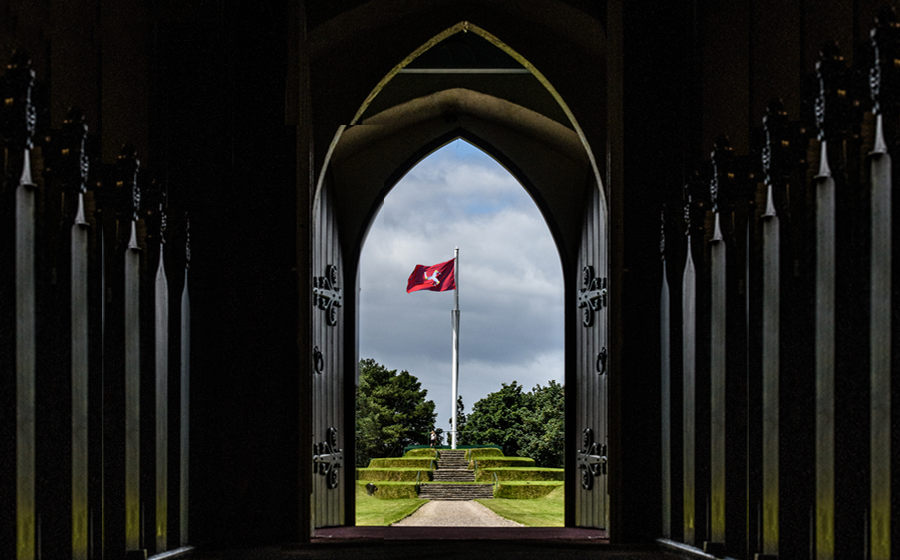
The parliament of the Isle of Man, widely considered the longest continuously operating parliament in the world. Established at the assembly field at St John's, where a four-tiered mound — Tynwald Hill — has served as the site for the promulgation of law for at least a thousand years. The name derives from the Old Norse þing-völlr, the assembly field. Laws not promulgated at Tynwald Hill were not, in Manx understanding, fully laws. The legislature met in two places: the chapel of St John the Baptist for ordinary debate, and the hill itself for ceremonial promulgation. After the Revestment, Tynwald was silenced for eleven years (1765–1776) and the outdoor ceremony at St John's did not resume until 1770. Colonel Smith legislated behind closed doors from 1777. The institution survived every change of overlord — Norse, Scottish, English, Crown — because the people who operated it understood that their smallness was their protection. Tynwald still meets every July on the hill where it has met since before the Normans came to England.